UTI vs STD: How to Tell the Difference (and Why It’s Often Both)
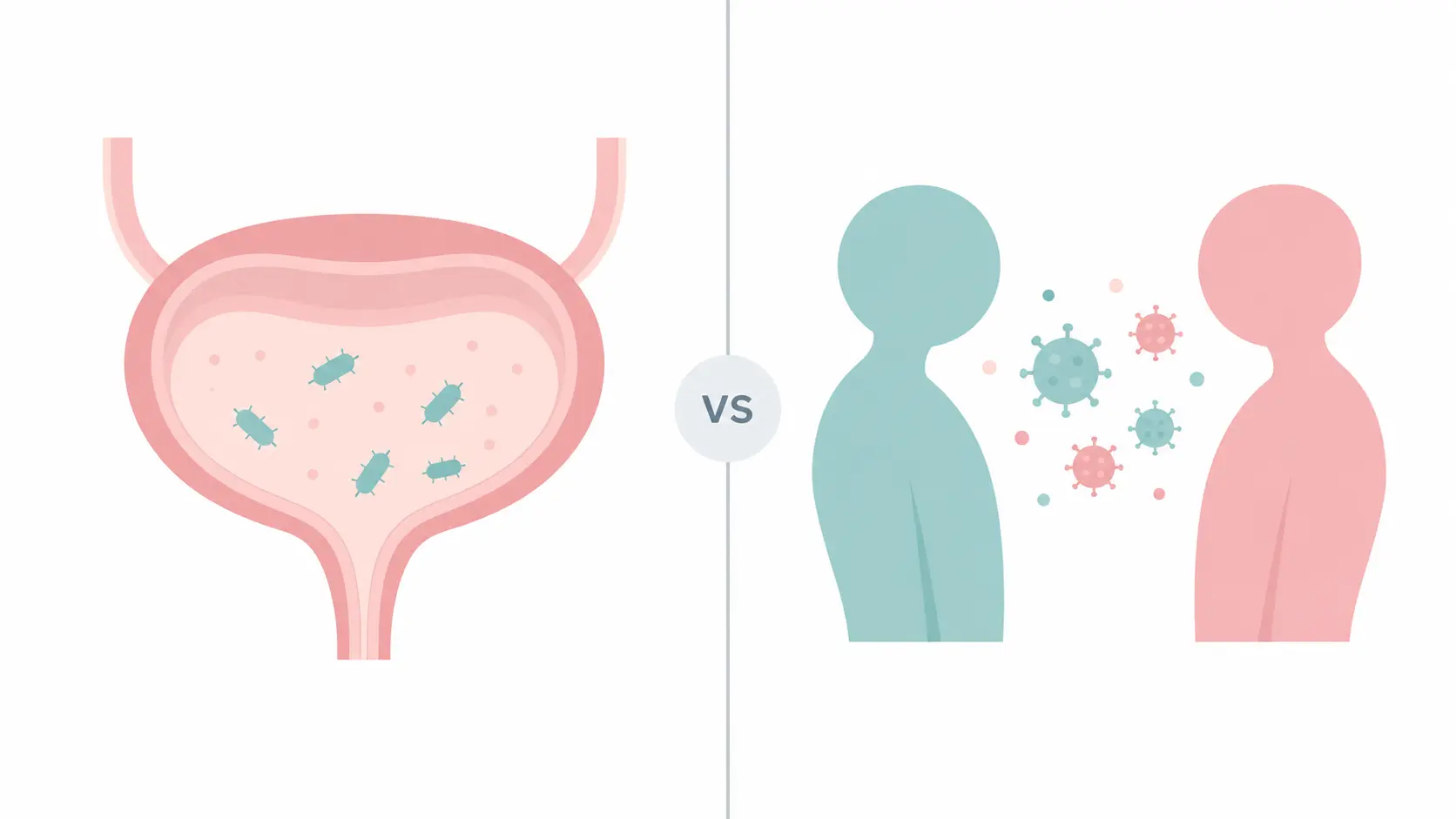
A urinary tract infection (UTI) isn’t a sexually transmitted disease (STD). A UTI happens when bacteria from your own body, usually E. coli from the bowel, get into the bladder. An STD, also called a sexually transmitted infection (STI), passes from one partner to another. The catch is that chlamydia, gonorrhea and trichomoniasis can burn exactly like a UTI, and a standard UTI urine test won’t find them. After sex with a new or untested partner, ask for both tests.
- Cause: a UTI comes from bowel or skin bacteria. An STD comes from bacteria, viruses or parasites passed during sex.
- Spread: a UTI isn’t contagious. An STD passes between partners, often without symptoms.
- Where: a UTI is in the bladder, urethra or kidneys. An STD can affect the urethra, cervix, vagina, penis, rectum, throat or the whole body.
- Main symptoms: a UTI brings burning, urgency and frequent peeing. An STD more often brings discharge, sores, itching or pain with sex, or no symptoms at all.
- Test: a UTI is found with a urinalysis and urine culture. Most STDs need a NAAT on urine or a swab, or a blood test.
- Treatment: a UTI is treated with antibiotics for you alone. STD treatment depends on the infection, and partners need treatment too.
For more on UTIs themselves, see our guide to UTI symptoms, causes and treatment.
Is a UTI an STD?
No. The CDC says plainly that a UTI is not a sexually transmitted infection, even though sex is a common trigger. During sex, bacteria already living around the anus and genitals get pushed toward the urethra. That’s why UTIs often start a day or two after sex, and why they can happen to people who have had only one partner for years, or who aren’t having sex at all.
A UTI isn’t contagious. You can’t catch one from a partner, and you can’t give one to a partner, through vaginal, anal or oral sex. Your partner doesn’t need testing or treatment for your UTI.
UTI vs STD at a glance
| UTI | STD | |
|---|---|---|
| What it is | Bacteria growing in the bladder, urethra or kidneys | Infection passed through sexual contact |
| Common causes | E. coli in most cases | Chlamydia, gonorrhea, trichomoniasis, Mycoplasma genitalium, herpes, syphilis, HIV, HPV |
| Contagious | No | Yes |
| Burning when you pee | Yes, inside | Common with chlamydia, gonorrhea and trich; on the skin with herpes |
| Urgency and peeing often | Typical | Sometimes, milder |
| Cloudy, strong-smelling or bloody urine | Common | Less common |
| Discharge from the penis or vagina | No | Common |
| Sores, blisters, bumps | No | Herpes, syphilis, HPV |
| Itching | Not typical | Trich, herpes, sometimes urethritis |
| Pain with sex or bleeding after sex | Not typical | Points to cervicitis or PID |
| No symptoms at all | Uncommon | Often |
| Fever, back or side pain | Kidney infection warning sign | PID warning sign, with pelvic pain |
| Test | Urinalysis, urine culture | NAAT on urine or swab; blood tests for HIV and syphilis |
| Partners treated | No | Yes |
STDs that feel like a UTI
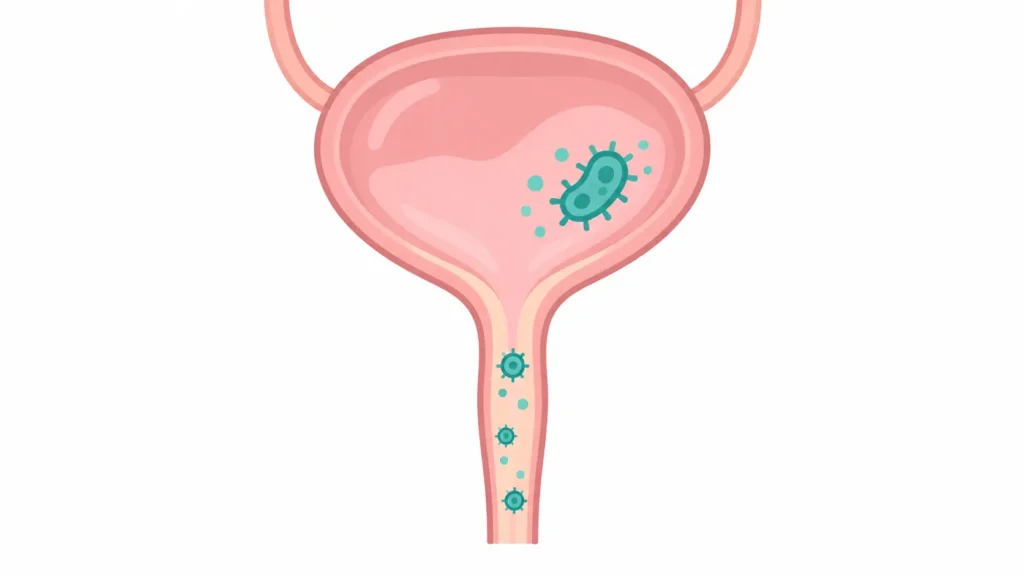
Several STIs infect the urethra, the tube urine passes through. Doctors call that inflammation urethritis, and its main symptom is the same burning you get with a bladder infection. The CDC lists painful urination, itching inside the urethra and discharge as the signs of urethritis.
Chlamydia
Chlamydia is the most frequently reported bacterial infection in the US, according to the CDC. Most people with it have no symptoms. When it does cause symptoms, they include burning when you pee and a discharge from the vagina or penis. In women it can also cause bleeding between periods or after sex and pelvic pain; in men, less often, pain and swelling in a testicle.
Gonorrhea
Gonorrhea causes burning when you pee and, more often than chlamydia, a thick yellow, white or green discharge. It often travels with chlamydia, so clinics test for both on the same sample. It can also infect the throat and rectum.
Trichomoniasis
Trich is caused by a tiny parasite. The CDC estimates about 2.6 million people in the US have it, and 70% to 85% have few or no symptoms. Women may notice a frothy, yellow-green or foul-smelling discharge, itching and burning when peeing. Men may have urethritis symptoms or none at all.
Mycoplasma genitalium
M. genitalium is a less-known bacterium. The CDC says it causes about 15% to 20% of urethritis not caused by gonorrhea in men and about 40% of urethritis that keeps coming back. In women it can cause cervicitis and is linked to pelvic inflammatory disease (PID). It needs its own test, which many clinics don’t run unless symptoms persist.
Genital herpes
Herpes causes blisters or open sores on or around the genitals. Urine running over the sores burns badly, and herpes can make it hard to start peeing. The first outbreak can bring fever, body aches and swollen glands. Many people with herpes have mild symptoms or none.
Chlamydia or UTI: how to tell
| Chlamydia | UTI | |
|---|---|---|
| Burning | Yes, often mild | Yes, often strong |
| Urgency and frequent small trips | Less common | Typical |
| Discharge | Common | No |
| Bleeding between periods or after sex | Possible | No |
| Urine test | Separate chlamydia NAAT needed | Urinalysis and urine culture |
| Starts after | A new or untested partner | Sex, but also no sex at all |
| Treatment | Doxycycline for 7 days | Antibiotic such as nitrofurantoin or fosfomycin |
Many UTI antibiotics, such as nitrofurantoin and fosfomycin, don’t treat chlamydia. If your “UTI” came back or never really cleared, ask for a chlamydia test.
Symptom by symptom: what points to which
- Burning when you pee: both. A strong burn with urgency and small, frequent trips points to a UTI. A milder burn at the tip of the penis or with discharge points to an STI. Our guide to why it burns when you pee covers every cause.
- Peeing often: more typical of a UTI. Chlamydia and gonorrhea can cause it, but usually less strongly.
- Cloudy or strong-smelling urine: more typical of a UTI. Discharge from an STI can also drip into a urine sample and make it look cloudy.
- Blood in urine: more typical of a UTI. With an STI, blood on the toilet paper often comes from an inflamed cervix rather than the bladder. See our guides to blood in urine and bleeding that looks like a period with a UTI.
- Discharge: points away from a bladder infection. Thick yellow or green suggests gonorrhea; frothy yellow-green suggests trich; thick white with itching suggests a yeast infection, which isn’t an STI. Our guide to UTI vs yeast infection covers that one.
- Itching: not a UTI symptom. Think trich, herpes, yeast or BV; see does a UTI cause itching.
- Sores or blisters: STI (herpes or syphilis), never a UTI.
- Pain with sex or deep pelvic pain: points to cervicitis or PID from an STI.
- Fever with back or side pain: kidney infection. Fever with deep pelvic pain: possible PID. Both need care the same day.
A review in JAMA found that burning plus frequent peeing, with no vaginal discharge or irritation, makes a UTI more than 90% likely. Discharge or irritation lowered the odds of a UTI, which is when an STI or vaginal infection moves up the list.
Signs that point to an STI
- Discharge from the vagina or penis that’s new or has changed
- Sores, blisters, bumps or warts on the genitals, anus or mouth
- Itching or irritation inside the penis or around the vagina
- Bleeding between periods or after sex
- Pain during sex
- Pain or swelling in a testicle
- Burning when you pee without the urgency of a bladder infection
- Symptoms after a new partner, or a partner who has symptoms or has tested positive
Many people with an STI have none of these, which is why regular screening matters.
Quick self-check: UTI or STD?
Answer these honestly:
- Did your symptoms start within a few days after sex with a new partner or a partner who hasn’t been tested?
- Do you have discharge, sores, blisters or itching?
- Do you have pain during sex or bleeding after sex or between periods?
- Is the main problem urgency and peeing every few minutes, with a strong burn?
- Is your urine cloudy, strong-smelling or pink?
- Have you had UTIs before that felt exactly like this and were confirmed by a test?
- Did a recent “UTI” come back, or not clear with antibiotics?
Mostly yes to 4, 5 and 6, and no to the rest: a UTI is likely. Get a urine test.
Yes to any of 1, 2, 3 or 7: an STI is possible, alone or with a UTI. Ask for STI testing as well as a urine test.
This list can’t diagnose you. A test can.
Why STIs get mistaken for UTIs
Burning when you pee is the classic UTI symptom, so it’s easy for patients and clinicians to stop there. A 2015 study in the Journal of Clinical Microbiology looked at 264 women seen in an emergency department with urinary or genital symptoms. Doctors diagnosed a UTI in 175 of them, but only 84 had one on urine culture. Among the women who had an STI, the infection was missed in 37%, and many of those missed STIs had been labeled as UTIs instead.
When an STI is treated as a UTI:
- The STI may not be cured. Many UTI antibiotics don’t work on chlamydia, gonorrhea or trich.
- It can cause damage. The CDC says untreated chlamydia can lead to PID, which can scar the fallopian tubes and cause ectopic pregnancy, infertility and long-term pelvic pain. In men it can, less often, cause painful swelling near the testicles.
- Partners aren’t told, so the infection keeps passing back and forth.
- You take antibiotics you didn’t need, which adds to resistance.
Can an STD cause a UTI, or a UTI turn into an STD?
No to both. They’re caused by different germs. E. coli in your bladder doesn’t turn into chlamydia, and chlamydia in your urethra doesn’t turn into a bladder infection. A UTI also can’t make you test positive for an STI.
What does happen is overlap. The same sexual contact can lead to both, and an STI that inflames the urethra can feel like a bladder infection. Some websites claim STIs cause “secondary” UTIs, but that isn’t established.
Can you have a UTI and an STD together?
Yes. They’re separate infections, so nothing stops both. And yes, you can have a UTI without an STD; most UTIs have nothing to do with an STI. If you’re sexually active with a new or untested partner and develop urinary symptoms, testing for both at the same visit is the simplest way to know.
UTI vs STD in men
UTIs are uncommon in younger men, because the male urethra is longer. That’s why burning at the tip of the penis in a sexually active young man is more often urethritis from an STI than a bladder infection. The CDC recommends testing men with urethritis for chlamydia and gonorrhea with a NAAT, and urine is the preferred sample.
A UTI in a man is taken seriously. It’s less common, so doctors usually order a urine culture and look for a cause, such as an enlarged prostate, a stone or a blockage. Treatment often lasts 7 days, and fever with a UTI can mean the prostate is infected. In older men, prostate problems and UTIs become more common than STIs, though STIs don’t stop with age.
Signs that point to an STI in men: discharge or a drip from the penis, itching inside the urethra, sores, or pain and swelling in a testicle.
How doctors test for each
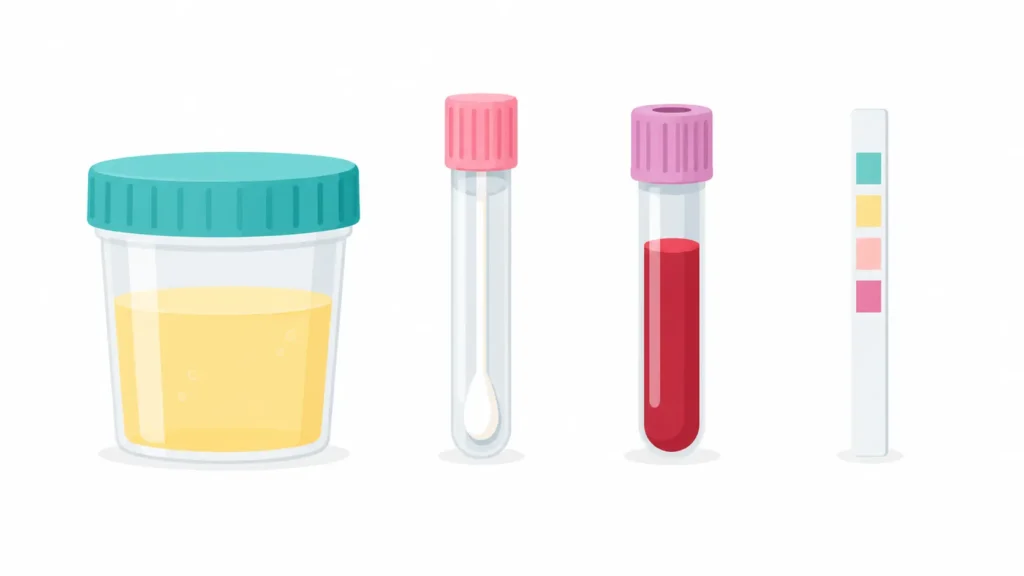
| Test | What it checks | Finds a UTI? | Finds STIs? |
|---|---|---|---|
| Urinalysis (dipstick and microscope) | White blood cells, nitrites, blood, bacteria | Suggests one | No, but white cells without bacteria are a clue |
| Urine culture | Grows bacteria from the bladder | Confirms one and shows which antibiotics work | No |
| NAAT on first-catch urine or a swab | Genetic material of chlamydia, gonorrhea, trich, sometimes M. genitalium | No | Yes |
| Vaginal swab under a microscope | Yeast, BV, trich | No | Trich only |
| Blood tests | HIV, syphilis, hepatitis B and C | No | Yes |
| Swab of a sore | Herpes, syphilis | No | Yes |
Our urinalysis guide and our page on nitrites in urine explain the UTI results.
Do STDs show up on a UTI test?
Not directly. A urinalysis and urine culture look for bacteria growing in the bladder, and the germs behind most STIs don’t show up that way. What an STI can do is raise the white blood cell count in urine while the urine culture stays negative. That pattern, called sterile pyuria, is a strong reason to test for STIs. Our guide to leukocytes in urine explains it.
For a NAAT, the clinic may ask for “first-catch” urine, the first part of the stream, which is different from the midstream sample used for a UTI. If you’re being tested for both, you may give two samples or a swab.
When to test after sex
If you have symptoms, get tested now. Without symptoms, a test done a day or two after sex may be too early to pick up a new infection. If you test within days of an exposure and the result is negative, ask whether to repeat it in a couple of weeks. HIV and syphilis blood tests can take longer to turn positive.
The CDC recommends yearly chlamydia testing for sexually active women under 25 and for older women with new or multiple partners. About 1 in 5 people in the US had an STI on any given day in 2018, according to CDC estimates.
Home and online tests
Home UTI strips check for nitrites and white blood cells, but they can’t detect STIs. For STIs, the FDA authorized the first home sample collection kit for chlamydia and gonorrhea in 2023, and in March 2025 authorized the first fully at-home test for chlamydia, gonorrhea and trichomoniasis, which gives results from a vaginal swab in about 30 minutes. Mail-in kits and telehealth services are another option if a clinic visit is hard.
Treatment: UTI vs STD
| Infection | Usual treatment (CDC or IDSA) | Partner treatment? |
|---|---|---|
| Bladder infection (UTI) | Antibiotic such as nitrofurantoin, trimethoprim-sulfamethoxazole, fosfomycin or pivmecillinam | No |
| Chlamydia | Doxycycline 100 mg twice a day for 7 days | Yes |
| Gonorrhea | One ceftriaxone injection, plus doxycycline if chlamydia isn’t ruled out | Yes |
| Trichomoniasis | Metronidazole: 7 days for women, a single dose for men | Yes |
| Mycoplasma genitalium | Doxycycline for 7 days, then moxifloxacin for 7 days | Yes |
| Genital herpes | Antiviral pills such as valacyclovir; not curable but controllable | Partners can be tested and advised |
| Syphilis | Penicillin injection | Yes |
For the full list of UTI antibiotics and how long each takes to work, see our UTI guide.
Telling partners and avoiding reinfection
For chlamydia, gonorrhea and trich, the CDC advises:
- No sex for 7 days after a single-dose treatment, or until a 7-day course is finished and symptoms are gone, and until partners are treated.
- Partners from the past 60 days should be tested and treated. If your last partner was longer ago than that, the most recent one should still be treated.
- Expedited partner therapy (EPT): in many places, your clinician can give you medicine or a prescription to pass to your partner without a separate visit.
- Retest about 3 months later, because reinfection is common, even if your partner was treated.
Which is more serious?
Both can be serious if ignored, in different ways. An untreated bladder infection can climb to the kidneys and, rarely, the bloodstream, and it shows itself quickly with fever and back pain. Many STIs stay silent while they cause harm: chlamydia and gonorrhea can lead to PID and infertility, syphilis can damage the brain and other organs, HIV attacks the immune system, and some types of HPV cause cancer. A UTI usually clears with one short course of antibiotics, while some STIs, like herpes and HIV, are lifelong but treatable.
How to prevent both
To lower UTI risk:
- Pee after sex and don’t hold urine for hours.
- Drink enough fluid to pee regularly.
- Wipe front to back.
- Avoid spermicide if you get repeat UTIs.
To lower STI risk:
- Use condoms or dental dams every time with new or untested partners.
- Get tested when you start with a new partner, and ask partners to test too.
- Get vaccinated against HPV and hepatitis B.
- Ask about doxycycline after sex (doxy-PEP) if you’re at high risk; the CDC recommends it for some groups.
- Get screened on schedule, even without symptoms.
When to see a doctor
See a provider within a day or two if:
- You have burning, urgency or frequent peeing
- You have discharge, sores, blisters or itching
- You’ve had sex with a new partner or a partner who has symptoms or a positive test
- A UTI came back soon after treatment, or didn’t clear
- You’re pregnant, since both UTIs and STIs can affect the pregnancy
- You’re a man with urinary symptoms
Get care the same day for fever, chills, back or side pain, vomiting, severe pelvic pain, or a painful, swollen testicle.
The bottom line
A UTI isn’t an STD: it comes from your own bacteria, isn’t contagious and doesn’t need partner treatment. But chlamydia, gonorrhea, trich and M. genitalium can burn just like a UTI, often with no discharge at all, and a routine UTI test won’t find them. Urgency and cloudy urine point to a UTI; discharge, sores, itching, pain with sex or a new partner point to an STI. When you’re not sure, ask for a urine test and an STI test at the same visit.
Frequently asked questions
Can I have oral sex with my partner if she has a UTI?
A UTI isn’t contagious, so you won’t catch it. It’s kinder to wait until her symptoms settle, since any sex can irritate an inflamed urethra. Oral sex can still pass STIs such as gonorrhea and herpes.
What are the most serious STDs?
HIV, syphilis and hepatitis B can cause lifelong or life-threatening disease, and high-risk HPV can cause cancer. Chlamydia and gonorrhea are curable but can cause infertility if left untreated.
What is the most common cause of a UTI?
E. coli, a bacterium from the bowel, causes most bladder infections, about 75% to 95% of simple cases according to IDSA guidelines. It reaches the urethra from the skin around the anus.
Can a UTI cause a false-positive chlamydia test?
No. Chlamydia tests look for the genetic material of chlamydia itself, not for the bacteria behind UTIs. A positive result means chlamydia, and a retest is reasonable only if the result seems doubtful.
Can you get an STD from a toilet seat?
Almost never. The germs behind STIs don’t survive well on hard surfaces and need direct sexual or skin contact to spread. A toilet seat won’t give you a UTI either.
Do condoms prevent UTIs?
Not really. Condoms protect against most STIs, but sexual contact can still push bacteria toward the urethra. Spermicide-coated condoms may raise UTI risk, so choose condoms without spermicide if you get repeat UTIs.
Will UTI antibiotics cure chlamydia?
Usually not. Common UTI antibiotics such as nitrofurantoin, fosfomycin and cephalexin don’t treat chlamydia. The CDC’s recommended treatment is a week of doxycycline, so a separate test and prescription are needed.
Can a woman give a man a UTI?
No. UTIs aren’t passed between partners. A man who notices burning soon after a new partner is more likely to have an STI or irritation, and should get tested.
Sources
- Centers for Disease Control and Prevention. Urinary Tract Infection Basics
- Tomas ME, et al. Overdiagnosis of urinary tract infection and underdiagnosis of sexually transmitted infection in adult women presenting to an emergency department. Journal of Clinical Microbiology, 2015. Reported by Consultant360
- Centers for Disease Control and Prevention. Chlamydial Infections, STI Treatment Guidelines, 2021
- Centers for Disease Control and Prevention. Gonococcal Infections Among Adolescents and Adults, STI Treatment Guidelines, 2021
- Centers for Disease Control and Prevention. Trichomoniasis, STI Treatment Guidelines, 2021
- Centers for Disease Control and Prevention. Mycoplasma genitalium, STI Treatment Guidelines, 2021
- Centers for Disease Control and Prevention. Urethritis and Cervicitis, STI Treatment Guidelines, 2021
- Centers for Disease Control and Prevention. About Chlamydia
- Centers for Disease Control and Prevention. About Genital Herpes
- Centers for Disease Control and Prevention. Sexually Transmitted Infections Prevalence, Incidence, and Cost Estimates in the United States
- US Food and Drug Administration. FDA grants marketing authorization for first home test for chlamydia, gonorrhea and trichomoniasis, 2025
- Bent S, et al. Does this woman have an acute uncomplicated urinary tract infection? JAMA, 2002
- Gupta K, et al. International clinical practice guidelines for the treatment of acute uncomplicated cystitis and pyelonephritis in women. Clinical Infectious Diseases, 2011 (IDSA)
Disclaimer
This blog is for informational and educational purposes only, and does not intend to substitute any professional medical advice or consultation. For any health related concerns, please consult with your physician, or call 911.