Does a UTI Cause Itching? What an Itch Down There Usually Means
No, itching isn’t a typical symptom of a urinary tract infection (UTI). A UTI burns or stings inside when you pee and makes you need to go often. If you’re itchy, the cause is more likely a vaginal yeast infection, bacterial vaginosis (BV), a sexually transmitted infection (STI) or irritated skin. These can show up alongside a UTI, or right after one, because UTI antibiotics can trigger a yeast infection.
Itching and burning down there feel alike when you’re uncomfortable, and many people use the words for the same thing. But where you feel it, and whether it itches or stings, tells you a lot about what’s going on. This guide covers what a UTI feels like, what different kinds of itching point to, how to tell a UTI from a yeast infection, why itching often starts during UTI treatment, what discharge means, and how to get relief.
For the full picture on UTI symptoms and treatment, see our guide to UTI symptoms, causes and treatment.
What a UTI feels like, and why it isn’t itchy
A UTI is an infection of the bladder, urethra or, less often, the kidneys. The CDC lists the main bladder infection symptoms as:
- Pain or burning while peeing
- Peeing often
- Feeling you need to pee even when your bladder is empty
- Bloody urine
- Pressure or cramping in the groin or lower belly
Itching isn’t on the list, and it isn’t on Mayo Clinic’s list either. The infection sits inside the bladder and urethra, so the discomfort is inside too: a hot, stinging feeling as urine passes, and pressure low in the belly that doesn’t let up.
Where UTI discomfort is felt
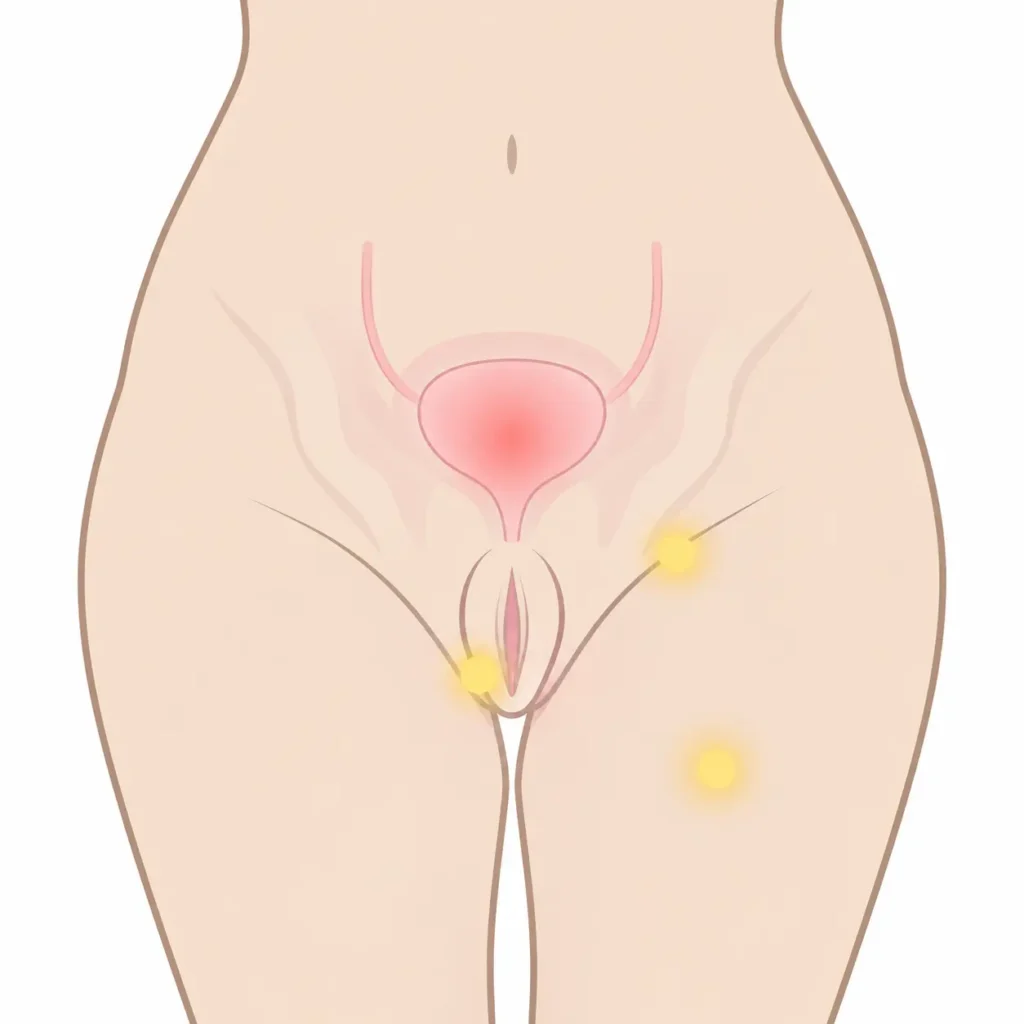
UTI discomfort is felt deep and central: at the urethra as you pee, and above the pubic bone. It’s worst during and just after peeing. Between trips to the bathroom, you mostly feel urgency and pressure. The skin outside, around the vaginal opening and the vulva, usually feels normal.
Can a UTI cause vaginal itching?
Not usually. Vaginal and vulvar itching comes from the vagina or the skin around it, not the bladder. When someone with a confirmed UTI also itches, there’s usually a second problem, most often a yeast infection, BV or skin irritation. A UTI and a vaginal infection can happen together, and one can follow the other, which is why it can seem like the UTI is causing the itch.
Does a bladder infection itch?
A bladder infection (cystitis) is the most common type of UTI, and it causes burning, frequency, urgency and pelvic pressure, not itching. If you’re searching this because you itch, look at the causes below rather than assuming the bladder is to blame.
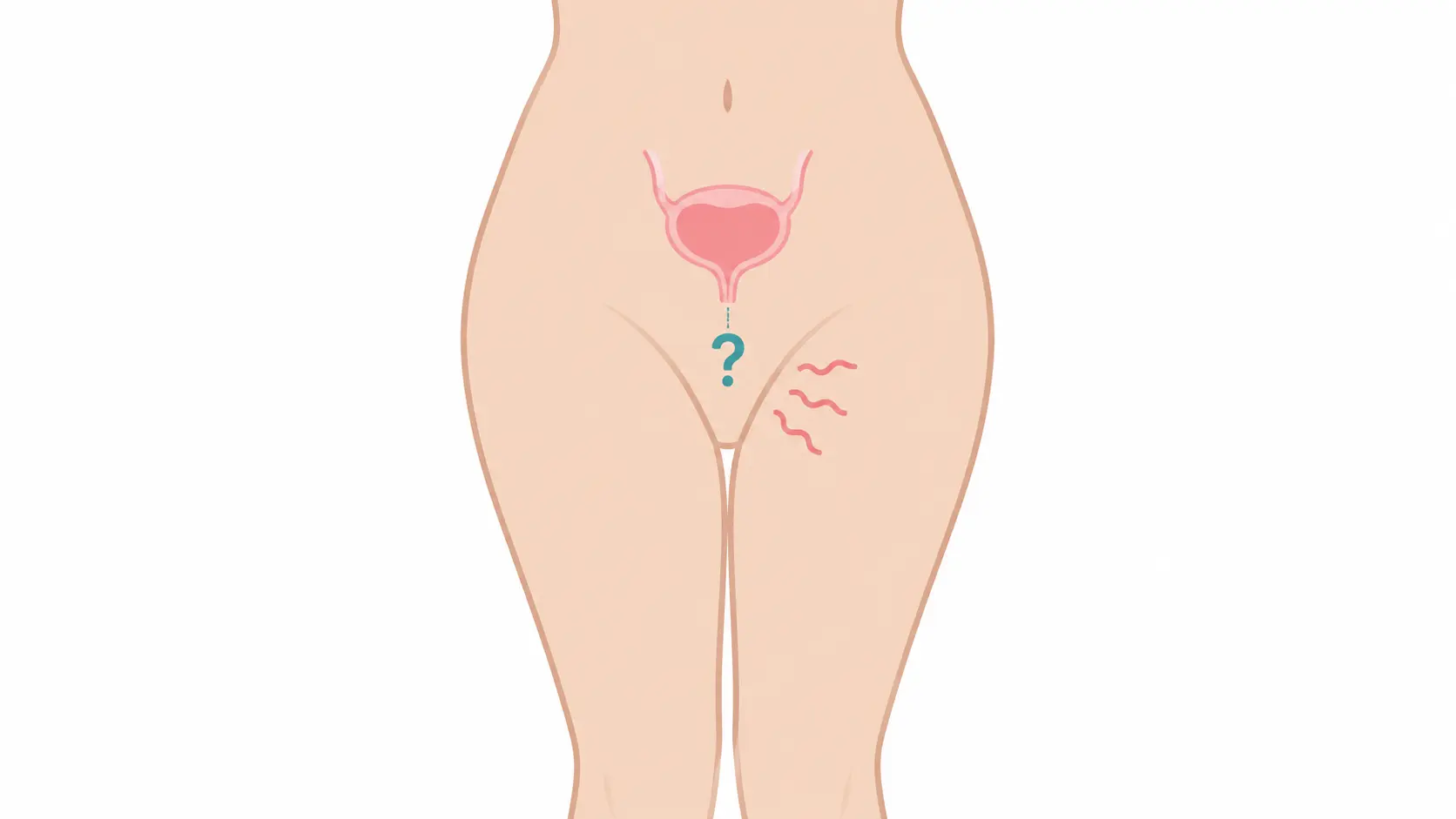
Where does it itch? What the location tells you
The spot you feel it is one of the best clues.
| Where you feel it | What it feels like | Most likely cause |
|---|---|---|
| Inside, as urine passes | Burning, stinging, urgency | UTI |
| On the skin outside, when urine touches it | Stinging on raw or irritated skin | Yeast infection or other vaginal infection; the CDC calls this “external dysuria” |
| Vulva and vaginal opening, all the time | Itching, soreness, redness, swelling | Yeast infection, BV, trichomoniasis, irritation from products, dryness after menopause |
| Tip of the penis or inside the urethra (men) | Itching or irritation, discharge | Urethritis, often from an STI |
| Groin crease and inner thighs | Itchy red rash, often ring-shaped | Jock itch (a fungal skin infection) |
| A spot that tingles or itches, then blisters | Tingling, itching, then painful sores | Genital herpes |
| Around the anus | Itching, sometimes bleeding after a bowel movement | Hemorrhoids, irritation, yeast |
Common causes of itching that feel like a UTI
Yeast infection
A vaginal yeast infection is an overgrowth of Candida, a fungus that normally lives in the vagina in small numbers. The CDC lists itching, vaginal soreness, pain during sex, pain when urine touches irritated skin and abnormal discharge as the usual symptoms. The discharge is often thick and white. Yeast infections are common: the CDC estimates 75% of women have at least one, and 40% to 45% have two or more.
Yeast is more likely after antibiotics, in pregnancy, with high-estrogen birth control, with diabetes that isn’t well controlled and with a weakened immune system, according to Baptist Health and the CDC.
Bacterial vaginosis
BV is an imbalance of the normal bacteria in the vagina. The CDC says many people with BV have no symptoms. When it does cause symptoms, they include a thin white or gray discharge, a strong fish-like odor that’s often worse after sex, burning when peeing and itching around the outside of the vagina. That burning is why BV gets mistaken for a UTI.
Trichomoniasis and other STIs
Trichomoniasis is a common STI caused by a parasite. In women, the CDC lists itching, burning, redness or soreness of the genitals, discomfort when peeing and a clear, white, yellowish or greenish discharge. In men, it can cause itching or irritation inside the penis, burning after peeing or ejaculating and discharge. About 70% of people with it have no symptoms at all.
Chlamydia and gonorrhea can also cause itching or abnormal discharge, according to MedlinePlus. Our guide to UTI vs STD explains how to tell an STI from a UTI.
Genital herpes
Before a herpes outbreak, the skin may tingle, itch or burn for a day or so, according to the American Academy of Dermatology. Blisters or sores follow. Herpes can also make peeing burn or hard to start, most often in women, which adds to the confusion with a UTI.
Irritation from soaps and products
Detergents, fabric softeners, feminine sprays, creams, douches and contraceptive foams or jellies can all irritate the skin of the vulva, according to MedlinePlus. Scented pads, new condoms or lubricants, bubble baths and shaving or waxing can do it too. The itch usually starts soon after a new product and fades when you stop using it.
Vaginal dryness after menopause
Lower estrogen after menopause thins and dries the tissue of the vagina and the area around the urethra. MedlinePlus lists dryness, soreness, burning and itching as symptoms. The same change, called genitourinary syndrome of menopause, also brings painful urination, urgency and repeat UTIs, according to the 2025 guideline from the American Urological Association, the Society of Urodynamics and the American Urogynecologic Society. So an older woman can have both a real UTI and real itching from dry tissue. Vaginal estrogen treats both.
Lichen sclerosus
Lichen sclerosus is a long-lasting skin condition of the vulva. A review in the Canadian Medical Association Journal names itching as its chief symptom, often worse at night, with white, thin, shiny patches of skin. It’s most common after menopause. It needs a doctor’s diagnosis and prescription steroid ointment, and it carries a small extra risk of skin cancer, so it shouldn’t be treated as a repeat yeast infection.
Jock itch
Jock itch is a fungal skin infection that causes a red, itchy rash in the groin crease, inner thighs or buttocks, often ring-shaped. It’s the same fungus as athlete’s foot and is more common with sweating and tight clothes. It affects the skin, not the urinary tract.
UTI vs yeast infection: how to tell
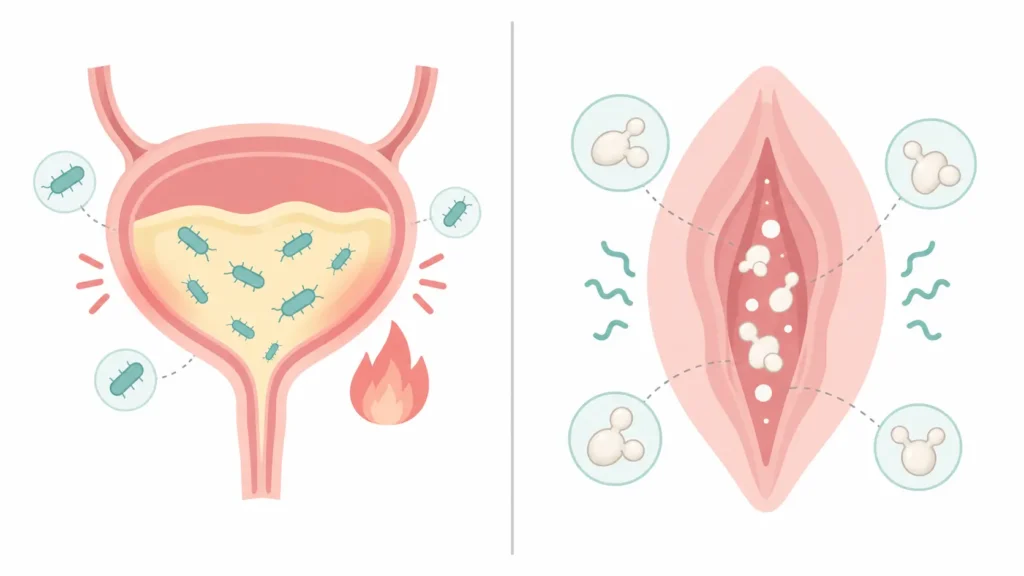
UTIs and yeast infections are both common, they can happen together, and both can make peeing uncomfortable. The differences:
| UTI | Yeast infection | |
|---|---|---|
| Cause | Bacteria, usually E. coli, in the bladder or urethra | Overgrowth of Candida fungus in the vagina |
| Main feeling | Burning inside when you pee | Itching and soreness outside |
| Urge to pee | Strong, frequent, often small amounts | Usually normal |
| Discharge | No vaginal discharge from a bladder infection | Thick, white, often clumpy |
| Urine | Cloudy, strong-smelling, sometimes pink or red | Usually looks normal |
| Smell | Strong urine odor | Usually no strong odor |
| Pelvic pressure | Common | Uncommon |
| Treatment | Prescription antibiotics | Antifungal cream, suppository or pill |
| Can be triggered by | Sex, low fluids, spermicide, menopause | Antibiotics, pregnancy, diabetes, tight damp clothing |
How a provider tells them apart
A urine test and a vaginal swab can settle the question quickly:
- Urinalysis and urine culture look for white blood cells, nitrites and bacteria, the signs of a UTI.
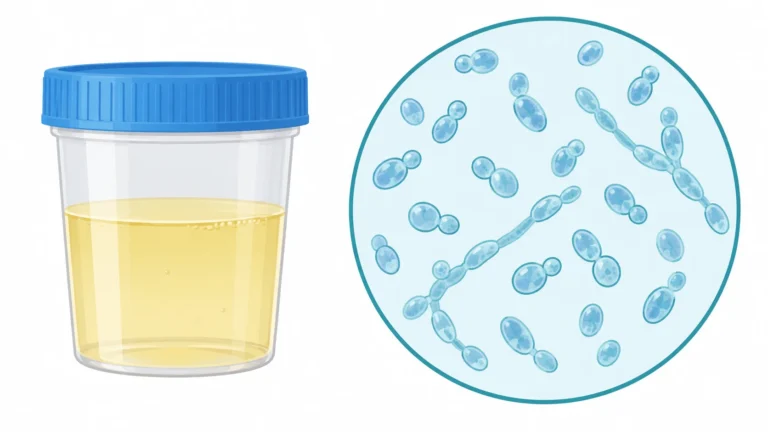
- A vaginal swab looked at under a microscope with a drop of potassium hydroxide (KOH) shows budding yeast if you have a yeast infection, according to the CDC. If that test is negative but symptoms fit, the lab may grow the sample to look for yeast.
- Vaginal pH helps too. The CDC notes that a yeast infection comes with a normal vaginal pH (below 4.5), while a higher pH points more toward BV or trichomoniasis.
- STI tests on a swab or urine sample check for chlamydia, gonorrhea and trichomoniasis when there’s discharge or a new partner.
A urine sample can also pick up yeast or white blood cells from discharge, so a “positive” urine test isn’t always a bladder infection. Our guides to yeast in urine and leukocytes in urine explain those results.
Can you have a UTI and a yeast infection together?
Yes. They’re separate infections in neighboring areas, so nothing stops both from happening at once. More often, one leads to the other: a UTI is treated with antibiotics, and a few days later the itching of a yeast infection begins. If you have burning inside, frequent peeing and an itchy, sore vulva with white discharge, you may need treatment for both.
Itching during or after UTI treatment
Why antibiotics can cause a yeast infection
Antibiotics kill the bacteria causing the UTI, but they also kill the helpful lactobacilli that keep Candida in check in the vagina. With fewer of those bacteria, yeast can overgrow. In a trial published in the BMJ in 2004, 23% of women (55 of 235) developed vaginal yeast symptoms after a short course of antibiotics. The CDC also lists frequent antibiotic use as a cause of repeat yeast infections.
If itching starts a few days into your UTI antibiotic, or soon after you finish, tell your provider. Don’t stop the antibiotic on your own.
Does itching mean a UTI is healing?
No. There’s no evidence that itching is a sign of a UTI clearing. If the burning inside has eased but you’re now itchy outside, the likeliest reason is a yeast infection from the antibiotic. Other possibilities are irritation from frequent wiping, pads or liners, and a second infection that was there all along.
Could it be the medicine itself?
Any medicine can cause an allergic skin reaction, which can itch. A new rash or hives while taking an antibiotic needs a call to your provider the same day. Swelling of the lips, tongue or throat, or trouble breathing, is an emergency.
Does a UTI cause discharge?
Discharge in women
A bladder infection doesn’t cause vaginal discharge. It can make urine cloudy, strong-smelling or pink, and cloudy urine can look like discharge in the toilet. Our guide to mucus in urine covers that difference.
True vaginal discharge points somewhere else. Mayo Clinic notes that an infection of the urethra (urethritis) can cause discharge. Thick white discharge suggests yeast, thin gray fishy discharge suggests BV, and yellow or green discharge suggests trichomoniasis or another STI. MedlinePlus advises contacting a provider right away for discharge with fever, pelvic or belly pain, or possible STI exposure.
Discharge in men
Discharge from the penis isn’t a sign of a simple bladder infection. The CDC lists painful urination, itching at the opening of the urethra and discharge as the usual signs of urethritis in men, most often caused by gonorrhea, chlamydia, Mycoplasma genitalium or trichomonas. A man with discharge needs STI testing.
UTI itching in men
Men get UTIs less often than women, and itching is even less typical. A man who feels itching or irritation inside the penis or at its tip, with or without burning, most likely has urethritis rather than a bladder infection. The CDC links urethritis mainly to sexually transmitted infections, and some men have discharge on examination without noticing symptoms. Jock itch and irritation from soaps or tight clothing are other common reasons for groin itching in men. Any man with urinary symptoms should see a provider for a urine test and STI testing.
How to stop the itch
The real fix is treating the cause. These steps from MedlinePlus ease itching while you wait:
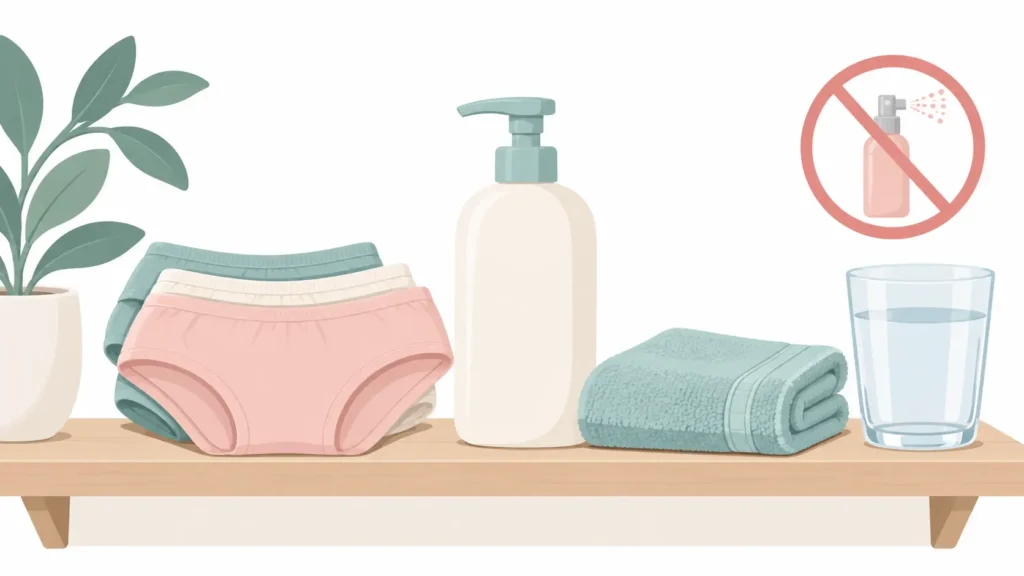
- Keep the area clean and dry. Rinse with plain water instead of soap.
- Take a warm, not hot, bath, then pat dry. A hair dryer on a cool setting can be gentler than a towel.
- Wear loose clothing and cotton underwear. Skip pantyhose and tight pants.
- Use pads rather than tampons while you have an infection.
- Wipe from front to back.
- Avoid douching, vaginal steaming, sprays, powders and fragrances.
- If you have diabetes, keep your blood sugar under control.
When an over-the-counter yeast treatment is reasonable
Antifungal creams and suppositories sold without a prescription work for many uncomplicated yeast infections. A single 150 mg dose of fluconazole, a prescription pill, is another option. The CDC adds three cautions:
- Self-diagnosis isn’t reliable, even for women who’ve had yeast infections before.
- Get checked if symptoms don’t go away after an over-the-counter treatment, or come back within two months.
- Single-dose fluconazole isn’t advised in pregnancy, so pregnant women should see their provider.
Yeast treatment won’t help a UTI, BV or an STI, and antibiotics for a UTI won’t help yeast. When you’re unsure, a quick exam and swab are cheaper than weeks of the wrong treatment.
What not to do
- Don’t use leftover antibiotics or a friend’s prescription.
- Don’t keep using over-the-counter yeast products if they haven’t worked.
- Don’t scratch, scrub or use hot water, which makes irritated skin worse.
- Don’t use anti-itch creams with fragrance or numbing agents on broken skin without asking a pharmacist.
When to see a doctor
See a provider if:
- You have burning when you pee, peeing often or urgency, with or without itching
- You have discharge that’s new, changed, yellow, green, gray or fishy-smelling
- You have sores, blisters, white patches or a rash
- You might have been exposed to an STI
- Itching doesn’t improve within a week of home care, or a yeast treatment didn’t work
- You’re pregnant
- You’re a man with urinary symptoms or discharge
Get care the same day for fever, chills, back or side pain, nausea or vomiting, which can mean a UTI has reached the kidneys. Our UTI guide lists the warning signs that a UTI is getting worse, and our guide to why it burns when you pee covers every cause of that burning.
The bottom line
A UTI burns inside when you pee; it doesn’t usually itch. Itching on the outside points to a yeast infection, BV, an STI, irritated skin or dryness after menopause, and these often show up alongside a UTI or after its antibiotics. Where you feel it, whether there’s discharge and what it looks like are your best clues. Treating the right cause is the only way to stop the itch, so if you’re not sure which one you have, a urine test and a vaginal swab will tell you.
Frequently asked questions
Can a UTI cause a rash?
No, a UTI doesn’t cause a skin rash. A genital rash points to irritation from products, a yeast infection, jock itch or, if blisters form, herpes. A rash that starts on antibiotics may be an allergy, so tell your prescriber.
Can a UTI make you smell down there?
A UTI can make urine smell strong or foul. A fishy vaginal odor, worse after sex, points to bacterial vaginosis instead, according to the CDC. Yeast infections usually don’t cause a strong smell.
Can a yeast infection cause a UTI?
No. A yeast infection is a fungus growing in the vagina, while a UTI is usually bacteria in the bladder. One doesn’t turn into the other, though both share risk factors such as diabetes and pregnancy.
Sources
- Centers for Disease Control and Prevention. Urinary Tract Infection Basics
- Centers for Disease Control and Prevention. Vulvovaginal Candidiasis, STI Treatment Guidelines
- Centers for Disease Control and Prevention. Urethritis and Cervicitis, STI Treatment Guidelines
- Centers for Disease Control and Prevention. About Trichomoniasis
- Centers for Disease Control and Prevention. About Bacterial Vaginosis
- Mayo Clinic. Urinary tract infection (UTI): Symptoms and causes
- MedlinePlus. Vaginal itching and discharge, adult and adolescent
- MedlinePlus. Vaginal dryness
- American Academy of Dermatology. Herpes simplex: Signs and symptoms
- Canadian Medical Association Journal. Vulvar lichen sclerosus, 2014
- UNC Urology. New AUA guideline on genitourinary syndrome of menopause (AUA/SUFU/AUGS, 2025)
- Pirotta M, et al. Effect of lactobacillus in preventing post-antibiotic vulvovaginal candidiasis: a randomised controlled trial. BMJ, 2004
- Baptist Health. UTI vs. Yeast Infection
- MyAlly Health. Infection Checks (jock itch)
Disclaimer
This blog is for informational and educational purposes only, and does not intend to substitute any professional medical advice or consultation. For any health related concerns, please consult with your physician, or call 911.