Urinalysis Results Explained: Normal Ranges and What Abnormal Results Mean
A urinalysis checks the appearance, chemistry and cells of a urine sample. Most results come back as “negative” or inside a reference range. One abnormal value is common and often harmless; doctors look at the pattern of results together with your symptoms before deciding what it means.
This guide explains what a urinalysis is, how to read each part of the report, what normal results look like, and what each abnormal finding can mean in the visual, dipstick and microscopic exams. It then covers the results that point to a urinary tract infection (UTI), the red flags that need prompt care, the factors that can make results inaccurate, the tests that usually follow an abnormal result, how results differ in pregnancy and in children, and when to talk to a doctor.
Key takeaways
- Normal ranges differ slightly between labs, so always compare your result with the range printed on your own report.
- A “trace” result is often not serious, especially for protein or blood after exercise or in concentrated urine.
- A UTI is diagnosed from a pattern of results plus symptoms, not from one marker.
- A positive dipstick for blood must be confirmed by looking at the urine under a microscope.
- Most abnormal results lead to a repeat test or one follow-up test, not to an immediate diagnosis.
What is a urinalysis?
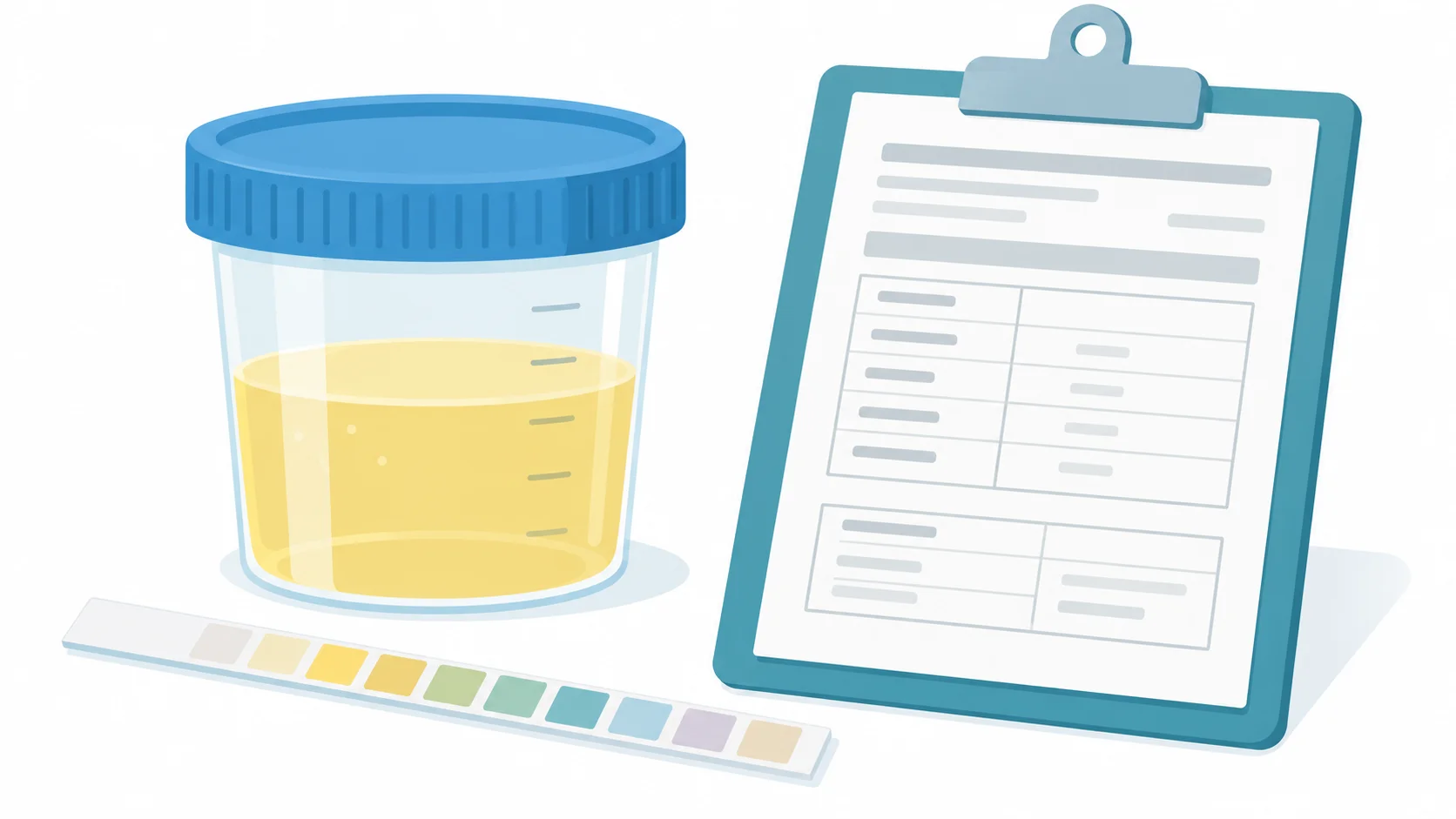
A urinalysis (UA) is a lab test that examines a urine sample in three ways: a visual exam, a chemical exam with a dipstick, and a microscopic exam. Together, these three parts screen for infection, kidney disease, diabetes, liver problems and other conditions.
There are 3 parts to a complete urinalysis:
- Visual exam: the lab notes the color and clarity of the urine.
- Dipstick (chemical) exam: a plastic strip with small chemical pads changes color to show specific gravity, pH, protein, glucose, ketones, blood, bilirubin, urobilinogen, nitrites and leukocyte esterase.
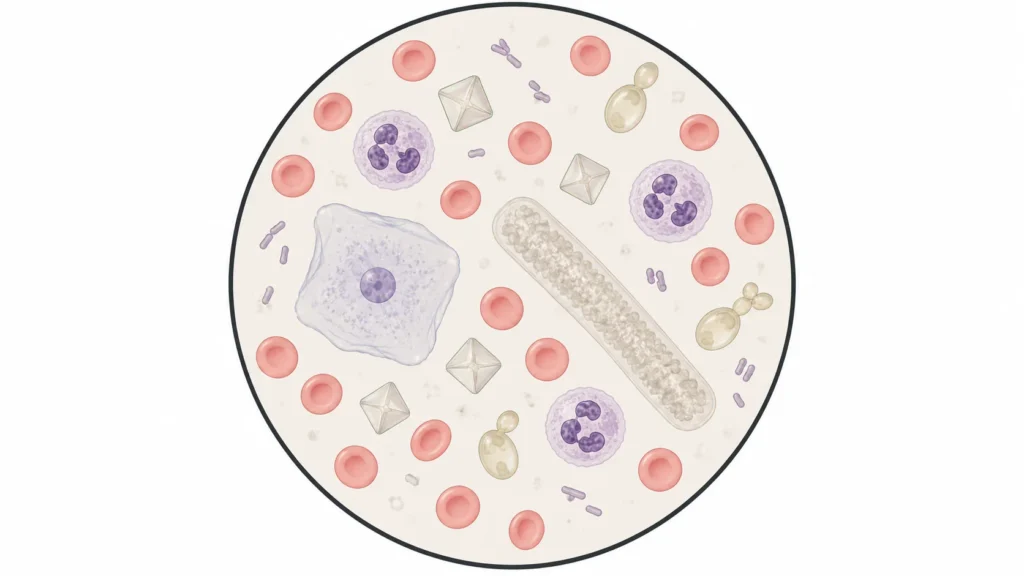
- Microscopic exam: a spun-down sample is checked under a microscope for cells, casts, crystals, bacteria, yeast and mucus.
Many labs run the microscopic exam only when the dipstick shows something abnormal. Doctors order a urinalysis during routine checkups, when you have urinary symptoms such as burning or frequent urination, during pregnancy, before some surgeries, and to monitor diabetes or kidney disease.
How do you read a urinalysis report?
A urinalysis report lists each test on its own line, with your result, the lab’s reference range and a flag if the result is outside that range. Reading the report line by line, and comparing each result to the range next to it, is the fastest way to see what needs attention.

What do the result, reference range and flag columns mean?
The result column shows your value, the reference range column shows the values the lab considers normal, and the flag column marks results outside that range. Flags usually appear as “H” for high, “L” for low or “A” for abnormal.
Reference ranges differ between labs because labs use different equipment and test strips. A result flagged by one lab may sit inside the range at another. Always judge your result against the range printed on your own report, not against a chart from another source.
What do trace, 1+, 2+ and 3+ mean?
“Trace”, “1+”, “2+”, “3+” and “4+” describe how strongly a dipstick pad changed color, from a very small amount to a large amount. “Negative” means the pad did not detect the substance.
For protein, Medscape lists these approximate amounts:
| Dipstick result | Approximate protein amount |
|---|---|
| Trace | 10-30 mg/dL |
| 1+ | 30 mg/dL |
| 2+ | 100 mg/dL |
| 3+ | 300 mg/dL |
| 4+ | 1,000 mg/dL or more |
A trace or 1+ result in a single sample is often temporary. Results of 2+ or higher, or results that stay positive on repeat tests, usually lead to more testing.
What do hpf, lpf, cells/uL and “few” or “many” mean?
These terms describe how the lab counted what it saw under the microscope. “Per hpf” means per high-power field, the area seen through the microscope at high magnification. “Per lpf” means per low-power field, used for larger items such as casts.
Some automated analyzers report cells per microliter (cells/uL) instead of per field. The numbers on these two scales are not interchangeable, so compare your result only with the range on the same report. Elements such as epithelial cells, bacteria, crystals and mucus are often reported in words: rare, few, moderate or many.
What are normal urinalysis results?
A normal urinalysis shows pale yellow to amber urine, a specific gravity between 1.005 and 1.030, a pH between about 4.5 and 8.0, negative results for most dipstick tests, and few or no cells under the microscope. Labs print slightly different ranges, so the table below gives the range most US labs use.
The table below lists typical normal results for adults, based on Medscape and MedlinePlus.
| Test | Typical normal result | Note |
|---|---|---|
| Color | Pale yellow to deep amber | Changes with hydration, food and medicines |
| Clarity | Clear | Slightly cloudy can be normal |
| Specific gravity | 1.005-1.030 | Lower after drinking a lot of fluid |
| pH | About 4.5-8.0 | Average about 6; some labs print 4.6-8.0 |
| Protein | Negative | Trace can be temporary |
| Glucose | Negative | |
| Ketones | Negative | |
| Blood | Negative | Must be confirmed by microscopy if positive |
| Bilirubin | Negative | |
| Urobilinogen | Small amount (about 0.2-1.0 mg/dL) | |
| Nitrites | Negative | |
| Leukocyte esterase | Negative | |
| Red blood cells | 0-2 per hpf | 3 or more per hpf is microhematuria |
| White blood cells | 0-5 per hpf | Some labs print 0-4 |
| Squamous epithelial cells | Few | Many suggests a contaminated sample |
| Casts | None to a few hyaline casts | Other cast types are not normal |
| Crystals | None to occasional | Type matters |
| Bacteria | None | |
| Yeast | None | |
| Mucus | Small to moderate amount |
What do visual exam results mean?
The visual exam records the color and clarity of the urine, and sometimes its odor. These findings rarely make a diagnosis alone, but they can point to dehydration, blood, infection, liver problems or the effects of food and medicines.
What does urine color mean?
Urine color reflects how concentrated the urine is and whether foods, medicines or medical conditions have added pigment. Normal urine ranges from pale yellow to deep amber because of a pigment called urochrome.
The table below shows common causes of each urine color, based on Medscape and MedlinePlus.
| Color | Common harmless causes | Causes to check with a doctor |
|---|---|---|
| Pale yellow to amber | Normal hydration | Very dark amber with thirst or dizziness can mean dehydration |
| Bright or neon yellow | B vitamins, especially riboflavin (vitamin B2) | Rarely a concern |
| Red or pink | Beets, blackberries, rhubarb, some medicines | Blood from the urinary tract |
| Orange | Carrots, vitamin C, rifampin, phenazopyridine | Bilirubin from liver or bile duct problems |
| Green or blue | Asparagus, methylene blue, amitriptyline, propofol | Some urinary tract infections |
| Brown or cola-colored | Fava beans, metronidazole, nitrofurantoin, levodopa | Liver disease, muscle breakdown (rhabdomyolysis), kidney bleeding |
| Purple | Rare | Bacteria reacting with a urinary catheter bag (“purple urine bag syndrome”) |
If your urine is bright yellow after starting a multivitamin, read our guide to neon yellow pee and its causes.
What does cloudy urine mean?
Cloudy urine is often harmless and caused by phosphate crystals, which form in alkaline urine. According to the American Academy of Family Physicians (AAFP), white blood cells (pyuria) can also cause cloudiness. Other causes include bacteria, mucus, semen and vaginal discharge mixed into the sample.
Cloudy urine together with burning, frequent urination or fever needs a check for infection.
Does urine odor matter?
Urine odor rarely leads to a diagnosis, and many labs do not report it. Strong-smelling urine is usually concentrated urine. A sweet or fruity smell can come from ketones, and a foul smell may come with an infection. Foods such as asparagus change the smell without any health effect.
What do dipstick (chemical) results mean?
The dipstick is a plastic strip with up to 10 chemical pads that change color when they touch specific substances in urine. A technician or an automated reader compares each pad with a color chart at set times, usually within about 1 to 2 minutes.

What does urine specific gravity mean?
Specific gravity shows how concentrated your urine is, and the normal range is 1.005 to 1.030, according to MedlinePlus. Pure water has a specific gravity of 1.000, so higher numbers mean more dissolved substances.
High specific gravity usually means concentrated urine from not drinking enough, vomiting, diarrhea or heavy sweating. Glucose, protein and X-ray contrast dye can raise it as well. Low specific gravity means dilute urine, which can follow drinking a lot of fluid or taking diuretics. Medscape notes that a value of 1.003 or lower means maximally dilute urine, which in some people points to diabetes insipidus or a kidney concentrating problem.
What does urine pH mean?
Urine pH measures how acidic or alkaline urine is, and a normal result falls between about 4.5 and 8.0, with an average near 6. Diet changes urine pH: high-protein diets and cranberries make urine more acidic, while diets rich in fruits and vegetables make it more alkaline.
pH helps doctors with kidney stones and infections. Uric acid and cystine stones form more easily in acidic urine. Struvite stones form in alkaline urine, often with infections caused by bacteria such as Proteus and Klebsiella. For a full breakdown by number, see our guide to normal urine pH.
What does protein in urine mean?
A negative dipstick for protein is normal; a positive result means more protein than usual is leaving through the kidneys. According to Medscape, healthy people excrete less than 150 mg of protein per day, an amount too small for a dipstick to detect.
Protein in urine is either temporary or persistent:
- Temporary (transient) proteinuria can follow fever, intense exercise, emotional stress or long periods of standing. It usually disappears on a repeat test.
- Persistent proteinuria stays on repeat tests and can point to kidney damage from diabetes, high blood pressure or kidney disease.
The dipstick mainly detects albumin and misses small amounts of it. For people with diabetes or high blood pressure, doctors use the urine albumin-to-creatinine ratio (UACR) instead. According to the National Kidney Foundation, a UACR under 30 mg/g is normal, 30 to 299 mg/g is moderately increased, and 300 mg/g or more is severely increased. One high UACR is usually repeated within 3 to 6 months before a diagnosis is made.
What does glucose in urine mean?
Glucose in urine (glycosuria) usually means blood sugar is high enough to spill into the urine. According to Medscape, this happens when blood glucose rises above about 180 mg/dL (10 mmol/L), the level at which the kidneys stop reabsorbing it.
The most common cause is diabetes. Glucose can appear in urine during pregnancy, and in people taking SGLT2 inhibitor medicines for diabetes, such as empagliflozin or dapagliflozin, which work by sending glucose into the urine. A positive urine glucose result leads to a blood glucose or HbA1c test, because urine glucose cannot diagnose diabetes on its own.
What do ketones in urine mean?
Ketones in urine mean the body is burning fat for energy instead of glucose. Small amounts can follow fasting, a ketogenic (very low-carbohydrate) diet, prolonged vomiting or intense exercise.
Ketones together with high glucose in a person with diabetes can signal diabetic ketoacidosis (DKA), a medical emergency. Nausea, vomiting, belly pain, fast breathing or confusion with these results need emergency care.
What does blood in urine mean on a dipstick?
A positive dipstick for blood means the pad detected hemoglobin, but it cannot tell whether whole red blood cells are present. Medscape explains that the pad reacts to red blood cells, free hemoglobin and myoglobin, a protein released by damaged muscle.
Contamination causes false positives as well, including menstrual blood, semen and some cleansing wipes. For this reason, the American Urological Association (AUA) states that a positive dipstick alone should not be called microhematuria and should be followed by a microscopic exam. To learn more about blood that only a test can see, read our guide to occult blood in urine.
What does bilirubin in urine mean?
Bilirubin should not appear in urine; a positive result points to a liver or bile duct problem. Medscape notes that conditions such as hepatitis and bile duct blockage can put bilirubin in the urine before the skin or eyes turn yellow (jaundice). A positive result is usually followed by blood tests of liver function.
What does urobilinogen in urine mean?
A small amount of urobilinogen, about 0.2 to 1.0 mg/dL, is normal. Urobilinogen forms when gut bacteria break down bilirubin, and a little of it is reabsorbed and passed in urine.
High levels can come with liver disease or with the fast breakdown of red blood cells (hemolysis). Very low or absent urobilinogen can point to a blocked bile duct. Our guide to urobilinogen in urine explains each result in detail.
What do nitrites in urine mean?
A positive nitrite test suggests bacteria in the urinary tract, because certain bacteria convert nitrate in urine into nitrite. According to Medscape, bacteria such as Escherichia coli (E. coli), Klebsiella and Proteus make this change.
A negative nitrite test does not rule out a UTI. Some bacteria, including Staphylococcus and Streptococcus species, cannot make nitrite. Read more in our guide to nitrites in urine.
What does leukocyte esterase in urine mean?
A positive leukocyte esterase test means white blood cells are present in the urine, because the pad detects an enzyme these cells release. White blood cells in urine (pyuria) usually signal infection or inflammation in the urinary tract.
Leukocyte esterase can be positive without a urinary infection. Medscape lists causes of “sterile pyuria”, including sexually transmitted infections such as chlamydia, kidney inflammation and contamination from vaginal discharge. For the full list of causes, see our guide to leukocytes in urine.
What do microscopic exam results mean?
The microscopic exam counts and identifies the solid elements in urine, including cells, casts, crystals, bacteria, yeast and mucus. The lab spins the urine in a centrifuge, places the sediment on a slide and counts what it sees per high-power or low-power field.
What do red blood cells in urine mean?
Up to 2 red blood cells per high-power field is normal. The AUA defines microhematuria as 3 or more red blood cells per high-power field on a single, properly collected sample, in its guideline published in 2020 and amended in 2025.
Common causes include urinary infections, kidney stones, hard exercise, menstrual contamination and an enlarged prostate. Less common causes include kidney disease and cancers of the bladder or kidney. The AUA sorts people with microhematuria into low, intermediate and high risk using the red blood cell count (3-10, 11-25 or more than 25 per high-power field), age, sex and smoking history, and the follow-up depends on that risk. If you have seen clots rather than invisible blood, read our guide to small blood clots in urine.
What do white blood cells in urine mean?
Up to about 5 white blood cells per high-power field is normal; higher counts usually mean infection or inflammation. Medscape lists infection, inflammation and sample contamination as the main causes of a high count.
A high white blood cell count with nitrites, leukocyte esterase and bacteria strongly suggests a UTI. A high count without bacteria can come from sexually transmitted infections, kidney inflammation or contamination.
What do epithelial cells in urine mean?
Epithelial cells are cells that line the urinary tract and skin, and a few of them in urine are normal. The type of cell matters more than the number:
- Squamous epithelial cells come from the skin around the urethra. Medscape notes that 15 to 20 or more per high-power field suggests the sample was contaminated.
- Transitional epithelial cells line the bladder and are usually harmless in small numbers.
- Renal tubular epithelial cells come from the kidneys, and larger numbers can signal kidney injury.
A contaminated sample often grows several types of bacteria on culture; our guide to mixed urogenital flora in urine explains this result.
What do casts in urine mean?
Casts are tube-shaped particles formed inside the kidney’s small tubules, and a few hyaline casts can be normal. Medscape notes that hyaline casts increase after hard exercise, dehydration or diuretic use.
Other cast types point to kidney problems:
- Red blood cell casts: inflammation of the kidney filters (glomerulonephritis) or blood vessels (vasculitis)
- White blood cell casts: kidney infection (pyelonephritis) or kidney inflammation (interstitial nephritis)
- Granular “muddy brown” casts: injury to the kidney tubules (acute tubular necrosis)
- Waxy casts: advanced kidney disease
- Fatty casts: nephrotic syndrome, a condition with heavy protein loss
What do crystals in urine mean?
Crystals form when substances in urine become concentrated, and occasional crystals are often normal. The type of crystal matters more than their presence.
- Calcium oxalate crystals are common and often harmless, but they are linked to the most common type of kidney stone.
- Uric acid crystals form in acidic urine and can come with gout or kidney stones.
- Struvite crystals form in alkaline urine, often with infections caused by bacteria such as Proteus.
- Cystine crystals are never normal and signal an inherited condition called cystinuria.
What does bacteria in urine mean?
Bacteria in urine can mean an infection or a contaminated sample. Medscape explains that bacteria multiply quickly when urine sits at room temperature, so a delayed sample can show bacteria that were not there at collection.
Bacteria without symptoms is called asymptomatic bacteriuria. The US Preventive Services Task Force (USPSTF) recommends against screening for it in non-pregnant adults, because treatment does not help them. Pregnancy is the main exception.
What does yeast in urine mean?
Yeast in urine is not normal and is most often Candida, the same yeast that causes vaginal yeast infections. Medscape notes that yeast in urine can be a true infection or contamination from vaginal discharge. Our guide to yeast in urine covers who is most at risk and how it is treated.
What does mucus in urine mean?
A small or moderate amount of mucus in urine is normal, according to MedlinePlus. Mucus comes from the lining of the urinary tract and helps protect it. Large amounts can come with a UTI or other irritation of the urinary tract. Read more in our guide to mucus in urine.
Which urinalysis results suggest a UTI?
No single result proves a urinary tract infection; doctors look at leukocyte esterase, nitrites, white blood cells and bacteria together, along with symptoms. A positive result for all four, with burning or frequent urination, strongly suggests a UTI.
The table below shows how doctors generally read common combinations. Only a clinician can interpret your specific result.
| Leukocyte esterase | Nitrites | What it usually suggests |
|---|---|---|
| Positive | Positive | UTI likely, especially with symptoms |
| Positive | Negative | UTI possible (bacteria that do not make nitrite), or inflammation, an STI or contamination |
| Negative | Positive | Possible early UTI or a contaminated or delayed sample |
| Negative | Negative | UTI unlikely if there are no symptoms |
A urine culture confirms the infection and shows which antibiotic will work. Medscape notes that 100,000 or more colony-forming units per milliliter (CFU/mL) of a single type of bacteria usually reflects a true infection, while several types of bacteria usually mean contamination. Lower counts can still matter in people with clear symptoms.
What is a red flag on a urine test?
A red flag is a result that needs prompt follow-up rather than a routine recheck. The results below matter most, especially when they come with symptoms.
Get emergency care (call 911 or go to the ER) if:
- Glucose and ketones are both high and you have vomiting, belly pain, fast breathing or confusion (possible diabetic ketoacidosis)
- You pass large blood clots and cannot urinate
- You have fever with confusion, a very fast heartbeat or trouble breathing
Contact a doctor the same day if:
- You see red, pink or cola-colored urine that is not explained by food or medicine
- Your results suggest a UTI and you have fever, chills or pain in your back or side (possible kidney infection)
- Bilirubin is positive and your skin or eyes look yellow
Schedule a follow-up visit if:
- Protein is 2+ or higher, or stays positive on repeat tests
- Red blood cells are 3 or more per high-power field, especially in adults over 50 or people who smoke
- Your report lists red blood cell casts, white blood cell casts or other abnormal casts
- Glucose is positive and you do not have known diabetes
Results are also easier to trust when the sample was collected and handled correctly, which is the focus of the next part.
What can make urinalysis results inaccurate?
Contamination, a delay before testing and very dilute or very concentrated urine are the most common reasons for misleading results. Medicines, supplements and recent activities can affect the dipstick pads as well.
There are 8 common factors that can change results:
- Contamination from skin, vaginal discharge or menstrual blood can add bacteria, white blood cells, red blood cells and squamous epithelial cells.
- Delay before testing: bacteria multiply in urine left at room temperature. Medscape advises testing within 30 to 60 minutes, and the AAFP notes that delays of more than 2 hours often give unreliable results.
- Very dilute urine from drinking a lot of water can hide small amounts of protein, blood or bacteria.
- Very concentrated urine, such as first-morning urine, can make trace results look stronger.
- Hard exercise in the previous day or two can cause temporary protein, blood and hyaline casts. The AAFP notes that exercise-related blood in urine should clear on a repeat test after 48 to 72 hours.
- High doses of vitamin C can cause false-negative results on some dipstick pads, including blood and glucose.
- Phenazopyridine, a bladder pain medicine, turns urine orange and can interfere with the color of several dipstick pads.
- X-ray contrast dye given within the previous 24 hours can cause a false-positive protein result and a high specific gravity, according to Medscape.
Tell your provider about any medicines, supplements, recent exercise or your menstrual period before the test.
How should you collect a urine sample?
A “clean-catch” midstream sample gives the most accurate results. Follow the steps your lab gives you; the general process is:
- Wash your hands.
- Open the sterile cup without touching the inside.
- Clean the genital area with the wipe provided, front to back for women.
- Start urinating into the toilet, then move the cup into the stream.
- Collect the requested amount without letting the cup touch your skin.
- Finish urinating into the toilet, cap the cup and return it within 1 to 2 hours, or refrigerate it if your lab tells you to.
Your provider may ask for a first-morning sample, which is the most concentrated urine of the day and is better for detecting small amounts of some substances.
What tests come after an abnormal urinalysis?
The most common next step is a repeat urinalysis, because many abnormal results are temporary or caused by contamination. If the abnormal result stays, your provider chooses the next test based on which result is abnormal.
The table below shows common follow-up tests.
| Abnormal result | Common next tests |
|---|---|
| Signs of infection | Urine culture |
| Protein | Urine albumin-to-creatinine ratio or protein-to-creatinine ratio, 24-hour urine collection, blood creatinine and eGFR |
| Glucose or ketones | Blood glucose, HbA1c, blood ketones |
| Bilirubin or high urobilinogen | Liver function blood tests |
| Red blood cells (microhematuria) | Repeat urinalysis with microscopy, kidney function tests, imaging (ultrasound or CT), and cystoscopy depending on AUA risk level |
| Abnormal casts | Kidney function tests, referral to a kidney specialist |
If a dipstick or microscopic test found blood once and you are waiting for a repeat test, our guide on whether blood in urine can go away on its own explains which causes are temporary.
How are urinalysis results read in pregnancy and in children?
Pregnancy and childhood change how doctors collect urine and interpret some results. The core reference ranges stay similar, but the follow-up rules differ.
During pregnancy:
- The USPSTF recommends screening pregnant people for bacteria with a urine culture at the first prenatal visit or at 12 to 16 weeks of pregnancy, whichever comes first. Bacteria without symptoms is treated in pregnancy, unlike in other adults.
- Protein in urine is checked together with blood pressure, because the combination can be a sign of preeclampsia.
- Glucose appears in urine more often during pregnancy, according to Medscape. Gestational diabetes is diagnosed with blood glucose tests, not urine.
In children:
- Infants who are not toilet trained often give samples through a collection bag, which is more easily contaminated. In a UK lab study, 33.6% of bag samples showed mixed bacterial growth, compared with 10.4% of midstream samples.
- Newborns have more dilute urine. Medscape lists a normal specific gravity of 1.001 to 1.020 in newborns, compared with 1.005 to 1.030 in adults.
- When a UTI is suspected in a young child, a catheter sample is often used for culture.
How is a urinalysis different from a urine culture and at-home test strips?
A urinalysis screens for many substances at once, a urine culture identifies the exact bacteria in an infection, and at-home test strips check only a few dipstick markers. Each one answers a different question.
The table below compares the three tests.
| Urinalysis | Urine culture | At-home test strips | |
|---|---|---|---|
| What it checks | Color, 10 chemical markers, cells, casts, crystals | Type and amount of bacteria; which antibiotics work | Usually nitrites and leukocyte esterase, sometimes more |
| Where it is done | Lab or clinic | Lab | Home |
| Time to result | Minutes to 1-2 days | Usually 1-3 days | 1-2 minutes |
| Best use | Screening and first evaluation | Confirming a UTI and choosing treatment | Quick check before calling a provider |
| Main limit | Cannot name the bacteria | Slower; needs a lab | Can miss an infection |
MedlinePlus notes that at-home UTI strips are quick and easy to use but do not always give accurate results, and a negative strip can miss an infection that is present.
When should you talk to a doctor about your results?
Talk to your doctor about any result flagged outside the reference range, even if you feel well. Most flagged results need only a conversation or a repeat test, but the decision belongs with someone who knows your health history.
Contact a doctor the same day if an abnormal result comes with fever of 100.4°F (38°C) or higher, pain in your back or side, visible blood, vomiting, or a new burning feeling when you urinate. Call 911 or go to the nearest emergency room for confusion, trouble breathing, a very fast heartbeat, severe belly pain, or if you cannot pass urine. Pregnant people, young children and older adults should be checked promptly for any urinary symptoms.
Frequently asked questions
How long does it take to get urinalysis results back?
A dipstick result is ready within minutes. A full lab urinalysis usually takes a few hours to 1-2 days, and a urine culture usually takes 1-3 days.
Do you need to fast before a urinalysis?
No, a standard urinalysis does not require fasting. You can eat and drink normally unless your provider asks for a first-morning sample or gives other instructions.
What does "urinalysis with reflex to culture" mean?
It means the lab runs a urine culture automatically only if the urinalysis shows signs of infection, such as positive nitrites, leukocyte esterase or many white blood cells. Criteria vary by lab.
Can a urinalysis detect STDs?
No, a standard urinalysis cannot diagnose sexually transmitted infections. Chlamydia and gonorrhea need specific tests, which can use a urine sample but must be ordered separately.
Does a routine urinalysis test for drugs?
No, a routine urinalysis does not test for drugs. A urine drug screen is a separate test that looks for different substances and must be ordered on its own.
Can a urinalysis detect pregnancy?
No, a routine urinalysis does not include a pregnancy test. Pregnancy is detected by measuring the hormone hCG in a separate urine or blood test.
Can white blood cells in urine mean cancer?
Yes, but rarely. White blood cells in urine are much more often caused by infection or inflammation. Bladder and kidney cancers more often cause blood in the urine than white blood cells.
Sources
- Medscape. Urinalysis: Reference Range, Interpretation, Collection and Panels
- MedlinePlus. Urine concentration test
- MedlinePlus. Nitrites in Urine
- MedlinePlus. Mucus in Urine
- MedlinePlus. Epithelial Cells in Urine
- American Urological Association. Microhematuria: AUA/SUFU Guideline
- National Kidney Foundation. Albuminuria (Proteinuria)
- U.S. Preventive Services Task Force. Asymptomatic Bacteriuria in Adults: Screening
- Simerville JA, Maxted WC, Pahira JJ. Urinalysis review. American Family Physician, 2005
- Clinical and microbiological investigation into mixed growth urine cultures. Journal of Medical Microbiology
Disclaimer
This blog is for informational and educational purposes only, and does not intend to substitute any professional medical advice or consultation. For any health related concerns, please consult with your physician, or call 911.