What Can Mimic Kidney Stone Pain? 15 Conditions and How to Tell Them Apart
Kidney infections, bladder infections, pulled back muscles, appendicitis, diverticulitis, gallbladder attacks, ovarian cysts or torsion, ectopic pregnancy, testicular torsion, shingles and an abdominal aortic aneurysm can all feel like a kidney stone. Stone pain starts in the side or back below the ribs, comes in waves, spreads toward the groin and won’t let you sit still. Fever, fainting or a possible pregnancy changes the picture: get care now.
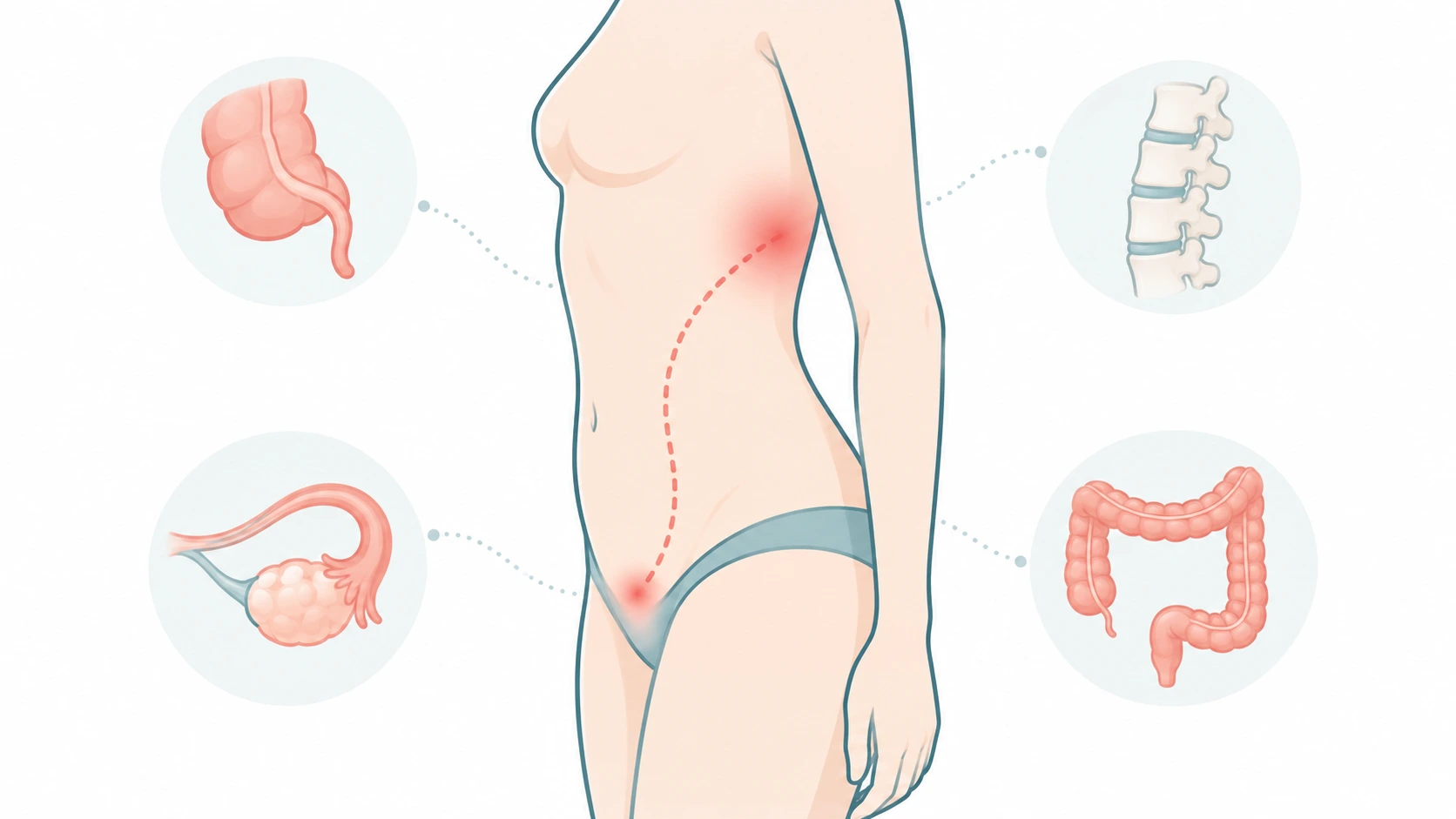
Sudden pain in your side or back sends a lot of people straight to one thought: kidney stone. Often that’s right. But the kidneys share space with the spine, the bowel, the gallbladder, the pancreas, the ovaries and the body’s largest blood vessel, and trouble in any of them can feel much the same. This guide explains what stone pain feels like, how to tell it from back pain, the 15 conditions that most often copy it and the signs that mean you shouldn’t wait.
What kidney stone pain feels like
A kidney stone usually causes no pain while it sits still in the kidney. Mayo Clinic says symptoms start when it moves around inside the kidney or slips into a ureter, one of the two thin tubes that carry urine down to the bladder. If it gets stuck there, the ureter spasms and urine backs up. That’s the pain doctors call renal colic.
According to Mayo Clinic and the National Institute of Diabetes and Digestive and Kidney Diseases (NIDDK), kidney stone pain is:
- Sharp and severe, in the side and back below the ribs
- Spreading to the lower belly and groin
- Coming in waves, with the strength rising and falling
- Hard to escape. You may pace, shift or curl up and still not find a comfortable position.
Other symptoms often come with it:
- Pain or burning when you pee
- Pink, red or brown urine from blood in your urine
- Cloudy or bad-smelling urine
- A constant need to pee, peeing often or only passing small amounts
- Nausea and vomiting
- Fever and chills, if an infection is present
Stones are common. A 2024 analysis of national survey data from 2007 to 2020, published in JU Open Plus, found that about 9.25% of US adults have had one.
Where kidney stone pain is felt
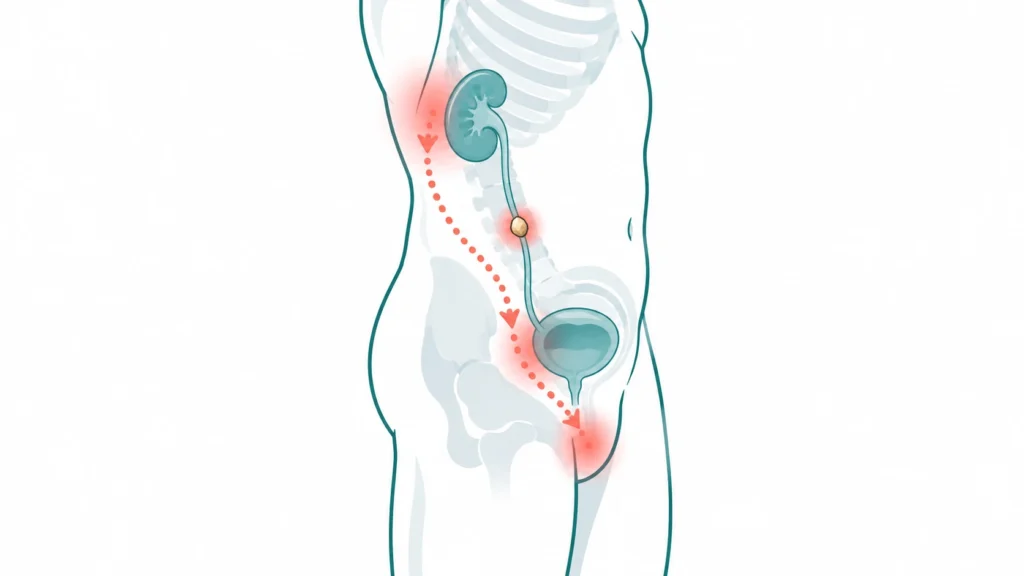
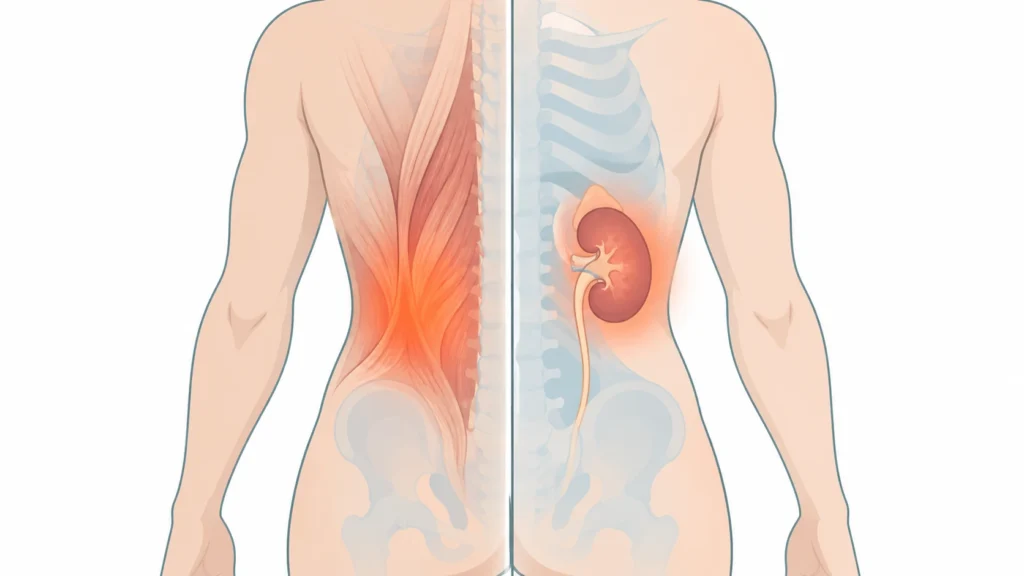
Most stone pain starts on one side of the back, in the soft area just below the lowest rib. Doctors call this the flank. From there it often wraps around to the front and travels down toward the lower belly and the groin.
Mayo Clinic notes that the pain can change as the stone moves through your urinary tract, shifting to a new spot or getting stronger. Pain that reaches the groin can feel as if it’s in the top of the leg, which is why “can kidney stones cause leg pain” is a common question. Pain that shoots down the back of one leg with numbness or tingling points more toward a pinched nerve in the spine.
Kidney stone pain vs back pain
Back pain is the most common thing people mistake for a stone, and the reverse is also true. Grady Health lists a few clues that help.
Kidney stone pain is more likely to:
- Start suddenly, with no clear trigger
- Feel sharp, severe or cramping
- Come and go in waves
- Sit in the side or back below the ribs and move toward the groin
- Come with nausea, vomiting or changes in how you pee
Muscle or back pain is more likely to:
- Start after lifting, exercise, a twist or an injury
- Feel sore, stiff or achy
- Stay in one spot
- Get worse when you bend, twist or lift
- Get better when you rest or change position
| Clue | Kidney stone | Muscle or back pain |
|---|---|---|
| Sharp pain in the side or back | Common | Less common |
| Pain moves toward the groin | Common | Uncommon |
| Pain comes in waves | Common | Less common |
| Pain starts after lifting or twisting | Less common | Common |
| Pain changes with movement | Less common | Common |
| Blood or burning when you pee | Possible | Not expected |
| Fever or chills | Possible with infection | Not expected |
Source: Grady Health
Is kidney pain worse when lying down? Not as a rule. Hartford HealthCare points out that changing position doesn’t relieve stone pain, so lying down, sitting or standing all feel about the same. A strained back muscle is the opposite: it often hurts more when you move and eases when you lie still. If you can find one position that takes the pain away, a muscle is the likelier cause.
Pressing on the sore spot is another quick check. A pulled muscle usually hurts more when you press on it or stretch it. Stone pain comes from deep inside and doesn’t change much with touch.
Quick guide: conditions that mimic kidney stone pain
| Condition | Where it hurts | Telling clue | How urgent |
|---|---|---|---|
| Kidney infection | Side, back or groin | Fever, chills, feeling sick | Same day |
| Bladder infection (UTI) | Low belly | Burning, urgency, little pain in the side | Within a day or two |
| Bladder stones | Low belly | Stop-start stream, older men | Book a visit |
| Pulled back muscle | Low or mid back | Starts after lifting, worse with movement | Book a visit if it lasts |
| Appendicitis | Belly button, then lower right | Worse walking or coughing, no appetite | ER |
| Diverticulitis | Lower left | Fever, constipation or diarrhea | Same day |
| Gallbladder attack | Upper right | After a big meal, lasts hours | Same day; ER with fever or yellow skin |
| Pancreatitis | Upper belly into the back | Gallstones or heavy drinking | ER |
| Gas or constipation | Anywhere in the belly | Bloating, relief after passing gas or stool | Usually home care |
| Ruptured ovarian cyst | One side, low pelvis | Mid-cycle, sometimes after sex | Same day; ER if severe |
| Ovarian torsion | Low belly, one side | Sudden, severe, with vomiting | ER |
| Ectopic pregnancy | Low belly, one side | Possible pregnancy, bleeding, shoulder tip pain | ER |
| Testicular torsion | Scrotum and lower belly | Sudden, severe, teen boys | ER |
| Abdominal aortic aneurysm | Belly, side or back | Over 65, smoker, pulsing near the navel | ER or 911 |
| Shingles | One side of the back or chest | Tingling first, rash days later | Within a few days |
Urinary problems that feel like a kidney stone
These cause pain in the same part of the body as a stone, and they can cause the same urine changes, so they’re the hardest to tell apart without a test.
Kidney infection
A kidney infection (pyelonephritis) causes pain in the back, side or groin, according to the NIDDK. It also brings fever and chills, cloudy or bad-smelling urine, frequent or painful peeing, and nausea or vomiting.
Fever is the main difference. A 2017 review of renal colic mimics on emDocs, an emergency medicine education site, notes that fever is rare with a stone unless an infection is also present. A kidney infection usually builds more gradually and makes you feel ill all over. Stone pain hits suddenly and comes in waves.
The NIDDK warns that a kidney infection can lead to sepsis, which can be life-threatening. Seek care right away for kidney infection symptoms.
Bladder infection (UTI)
A bladder infection causes burning when you pee, a strong urge to go even when little comes out, and pressure or cramping low in the belly. A stone close to the bladder can cause the same urge and burning, which is where the confusion starts.
The difference is the pain. A bladder infection rarely causes the severe, wave-like pain in the side that a stone does. If you have burning plus sharp side pain, it could be a stone, or a bladder infection that has climbed into the kidney. A urine test answers the question.
Bladder stones
Bladder stones form in the bladder itself, not the kidney. Mayo Clinic says they can cause lower belly pain, pain when you pee, peeing more often, a flow that stops and starts, blood in the urine and cloudy or dark urine. The pain sits low and in the middle rather than in the side.
In men, the main cause is an enlarged prostate that keeps the bladder from emptying fully. Some bladder stones cause no symptoms at all.
Digestive problems that mimic kidney stone pain
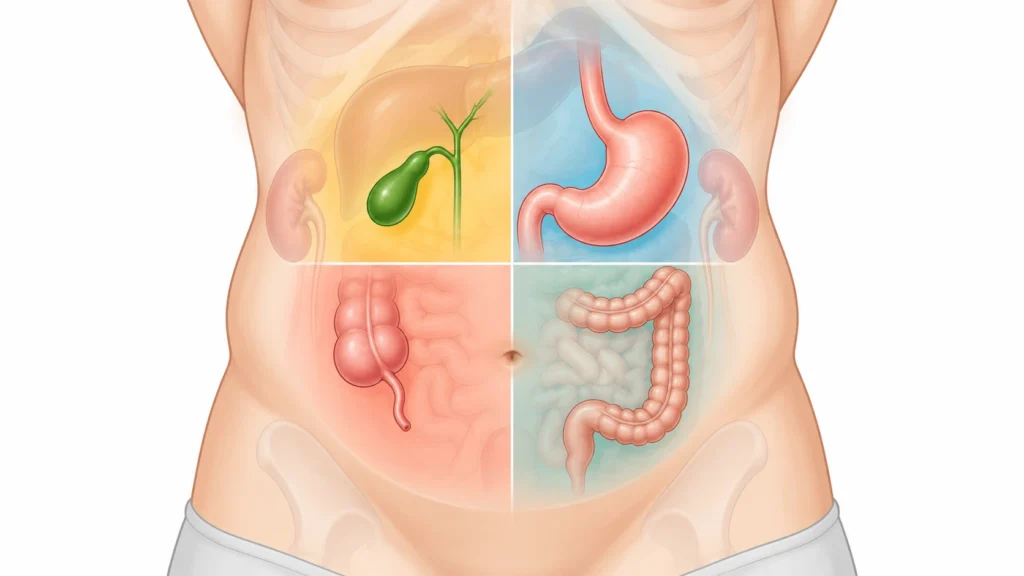
The bowel, gallbladder and pancreas sit right in front of the kidneys. Bowel changes, pain after eating and the exact spot of the pain are the best clues.
Appendicitis
Appendicitis is the classic right-sided mimic. MedlinePlus says the first symptom is often pain around the belly button or the upper middle belly. Over the next 12 to 24 hours, it moves to the lower right side and settles there.
Clues that point to appendicitis:
- Pain that gets worse when you walk, cough or move suddenly
- Loss of appetite
- Nausea, vomiting and a mild fever
Stone pain makes people restless. Appendicitis makes them want to lie still. emDocs notes that the classic shifting pain is missing in nearly half of people with appendicitis, and an appendix that sits low in the pelvis can even cause burning and urgency. Appendicitis is an emergency, so go to the ER if you suspect it.
Diverticulitis
Diverticulitis is inflammation of small pouches in the wall of the colon. The NIDDK says the pain is most often in the lower left side of the belly. It can come on suddenly and severely, or start mild and get worse over several days. Fever, chills, nausea, vomiting and constipation or diarrhea may come with it.
It’s the most common answer to “what can mimic kidney stone pain on the left side.” According to emDocs, 85% of cases are on the left. Pain that builds over days with fever and bowel changes points to diverticulitis rather than a stone.
Gallbladder attack
A gallstone that blocks the duct leading out of the gallbladder causes a gallbladder attack. The NIDDK says the pain sits in the upper right belly, can last several hours and often comes after a large meal, in the evening or overnight. emDocs notes the pain can spread to the back, which is why it’s mistaken for a right-sided stone.
See a doctor right away if the pain lasts for hours or comes with:
- Nausea and vomiting
- Fever or chills
- Jaundice, a yellowing of the skin or the whites of the eyes
- Dark, tea-colored urine and pale stools
Pancreatitis
The pancreas lies deep in the upper belly, right in front of the spine. The NIDDK says acute pancreatitis pain begins slowly or suddenly in the upper belly and sometimes spreads to the back. Gallstones are the most common cause, and heavy drinking is another. It sits higher and more central than stone pain, and it needs prompt care.
Gas and constipation
Trapped gas and constipation can cause sharp, crampy pain that comes and goes, much like a stone. The difference is what comes with it: bloating, a change in bowel habits, and relief once you pass gas or have a bowel movement. Gas pain also tends to move around the belly rather than starting in the back.
Conditions in women that feel like a kidney stone
The ovaries and fallopian tubes sit low in the pelvis, close to the lower ureters. If there’s any chance you’re pregnant, a pregnancy test is one of the first things a doctor will do.
Ruptured ovarian cyst
When an ovarian cyst bursts, emDocs describes sudden, severe pain on one side of the pelvis, often in the middle of the menstrual cycle and sometimes after sex. The pain sits lower than stone pain and doesn’t start in the back. Nausea can come with it. Many settle without surgery, but severe pain, dizziness or fainting needs the ER.
Ovarian torsion
Ovarian torsion means the ovary twists on the tissue that holds it, cutting off its blood supply. Cleveland Clinic says the main symptom is sudden, severe, sharp pain in the lower belly that can spread to the thighs, sides or lower back. Nausea and vomiting are common.
Most people with torsion are between 29 and 34, and up to 85% have an ovarian cyst or other benign mass, according to Cleveland Clinic. The risk rises when a cyst is about 5 centimeters (2 inches) or larger. Go to the ER right away: fast surgery can often save the ovary. Pain that comes and goes still needs to be checked, because a twisted ovary may not untwist on its own.
Ectopic pregnancy
An ectopic pregnancy grows outside the uterus, most often in a fallopian tube. The NHS says symptoms usually start between the 4th and 12th weeks of pregnancy and can include:
- Pain low on one side of the belly
- Vaginal bleeding that may look like a light period
- Shoulder tip pain, where the shoulder meets the arm, which can be a sign of internal bleeding
- Pain or pressure when peeing or having a bowel movement
Sudden, severe, sharp belly pain with dizziness or fainting can mean the tube has ruptured. Call 911. A rupture is life-threatening and needs surgery right away.
Testicular torsion in boys and men
Testicular torsion happens when a testicle twists on the cord that carries its blood supply. Mayo Clinic lists sudden, severe pain in the scrotum, swelling, belly pain, nausea and vomiting, a testicle that sits higher than normal and peeing more often. It’s most common between ages 12 and 18 but can happen at any age.
Because the pain can spread to the lower belly and groin, it can be confused with a stone moving down the ureter. Always check the scrotum. Mayo Clinic warns that blocked blood flow for several hours can cause permanent damage, so sudden testicle pain needs the ER, not a wait-and-see approach.
Blood vessel and nerve causes
These two are the least likely to come to mind. One is the most dangerous mimic on this list, and the other is easy to spot once the rash appears.
Abdominal aortic aneurysm
An abdominal aortic aneurysm (AAA) is a bulge in the aorta, the main blood vessel running through the belly. Mayo Clinic says most cause no symptoms. A growing aneurysm can cause deep, constant pain in the belly or the side of the belly, back pain and a pulsing feeling near the navel. A rupture causes sudden, severe pain in the belly or back that may feel like ripping or tearing, along with low blood pressure and a fast pulse.
Mayo Clinic says most cases are in people 65 and older, men are affected far more often, and smoking is the strongest risk factor. An aneurysm is easy to miss. A 2005 Internal Medicine News report on an emergency medicine conference talk noted that a quarter to half of AAA cases are misdiagnosed at first, most often as a kidney stone.
If you’re 65 or older, smoke or used to smoke, and have new side or back pain that feels like your first kidney stone, tell the doctor about those risk factors. Mayo Clinic advises a one-time screening ultrasound for men 65 to 75 who have ever smoked.
Shingles
Shingles can cause burning, stabbing pain along one side of the back or chest days before anything shows on the skin. The Centers for Disease Control and Prevention (CDC) says pain, itching or tingling often starts 1 to 5 days before the rash. The rash then appears as a single stripe around either the left or the right side of the body.
Before the rash, shingles pain can feel like a stone in the flank. The clue is pain with normal urine and no nausea or fever. Once the band of blisters shows up, the cause is clear.
Left side vs right side: what else could it be?
Kidney stones can happen on either side. The spot where you hurt points to different look-alikes:
| Where it hurts | Kidney stone | Other causes to consider |
|---|---|---|
| Right side of the back or flank | Right kidney stone | Kidney infection, muscle strain, shingles |
| Upper right belly | Less likely | Gallbladder attack, pancreatitis |
| Lower right belly | Stone low in the right ureter | Appendicitis, ovarian cyst or torsion, ectopic pregnancy |
| Left side of the back or flank | Left kidney stone | Kidney infection, muscle strain, shingles, aortic aneurysm |
| Lower left belly | Stone low in the left ureter | Diverticulitis, ovarian cyst or torsion, ectopic pregnancy, constipation |
| Low and central | Stone near the bladder | Bladder infection, bladder stones |
| Groin or testicle | Stone low in the ureter | Testicular torsion |
How doctors tell a kidney stone from something else
Your answers come first. A doctor will ask where the pain started, whether it moves or comes in waves, whether you have fever, burning or blood in your urine, whether you’re vomiting, whether pregnancy is possible, whether it began after lifting and whether you’ve had stones before. Then:
- Urine test. A urinalysis looks for blood, which points toward a stone, and white blood cells and bacteria, which point toward infection.
- Pregnancy test, for anyone who could be pregnant
- Blood tests, to check for infection and kidney function
- Imaging. The UK’s National Institute for Health and Care Excellence (NICE) guideline advises a low-dose CT scan without contrast dye within 24 hours for adults with suspected renal colic. Pregnant women get an ultrasound instead, and children and young people get an ultrasound first.
A CT scan that shows no stone is useful in its own right. emDocs advises doctors to look for the other causes on this list when the scan is clear. Other tests depend on what’s suspected: a pelvic ultrasound for the ovaries, a Doppler ultrasound for the testicles, or a CT with contrast for the aorta or appendix.
When to go to the ER
Mayo Clinic advises getting checked right away if you have:
- Pain so bad you can’t sit still or find a comfortable position
- Pain with nausea and vomiting
- Pain with fever and chills
- Blood in your urine
- Trouble passing urine
Fever with stone pain needs special mention. A stone that blocks a kidney while infected urine is trapped behind it is a urologic emergency. Antibiotics alone can’t clear an infection that has nowhere to drain, so doctors place a small tube (a stent) in the ureter or drain the kidney through the skin (a nephrostomy). Go to the ER the same day, without waiting to see if it passes.
Call 911 or go to the ER right away for any of these, whatever you think the cause is:
- Sudden, tearing belly or back pain, mainly if you’re older or smoke
- Fainting, dizziness or a racing heart with belly pain
- Severe one-sided pelvic pain with a chance of pregnancy
- Sudden testicle pain
- Confusion, fast breathing or shortness of breath with fever
- You can’t keep fluids down or can’t pee at all
The bottom line
Kidney stone pain has a pattern: sudden, sharp pain below the ribs in the side or back, coming in waves, moving toward the groin, with no position that helps. Pain that started after lifting and changes with movement points to a muscle. Fever points to infection. Pain in the lower right, upper right or lower left belly points toward the appendix, gallbladder or colon. A possible pregnancy, testicle pain, or tearing pain in an older smoker needs the ER first. When in doubt, a urine test and a scan will settle it.
Frequently asked questions
How painful are kidney stones on a scale of 1 to 10?
There’s no single number, but many people rate it near the top. In a small 2017 study, 12 of 19 women who’d had both said a kidney stone hurt more than childbirth.
Can you have a kidney stone with no blood in your urine?
Yes. About 95% of people with a stone show blood in their urine on the first day of pain, but only about 65% still do by day three. A clear sample doesn’t rule a stone out.
How can you tell if a kidney stone is moving?
Pain that shifts lower, from the flank toward the groin, is a sign it’s moving down. As it nears the bladder, you may feel a stronger urge to pee and burning.
What can calm kidney stone pain?
Anti-inflammatory pain relievers such as ibuprofen are the first choice for stone pain under UK guidelines. Ask first if you have kidney disease, ulcers or take blood thinners, and get care for pain they don’t control.
Can kidney stones feel like period cramps?
Sometimes. Both bring crampy waves low in the abdomen. Period cramps arrive with your cycle and stay central, while a stone often begins up near the ribs. A late period plus new one-sided pain needs a pregnancy test.
Sources
- Mayo Clinic. Kidney stones: Symptoms and causes
- National Institute of Diabetes and Digestive and Kidney Diseases. Symptoms & Causes of Kidney Stones
- Alibrahim H, et al. Kidney Stone Prevalence Among US Population: Updated Estimation from NHANES Data Set. JU Open Plus, 2024
- Miah S, et al. Renal colic and childbirth pain: female experience versus male perception. Journal of Pain Research, 2017
- Grady Health. Kidney Stone or Back Pain? How to Tell the Difference
- Hartford HealthCare. 3 Signs Your Back Pain Is Actually From Kidney Stones, 2025
- National Institute of Diabetes and Digestive and Kidney Diseases. Symptoms & Causes of Kidney Infection (Pyelonephritis)
- Crain N. Renal colic mimics: Differential diagnosis and approach to management. emDocs, 2017
- Mayo Clinic. Bladder stones: Symptoms and causes
- MedlinePlus. Appendicitis
- National Institute of Diabetes and Digestive and Kidney Diseases. Symptoms & Causes of Diverticular Disease
- National Institute of Diabetes and Digestive and Kidney Diseases. Symptoms & Causes of Gallstones
- National Institute of Diabetes and Digestive and Kidney Diseases. Symptoms & Causes of Pancreatitis
- Cleveland Clinic. Ovarian Torsion
- NHS. Ectopic pregnancy: Symptoms
- Mayo Clinic. Testicular torsion: Symptoms and causes
- Mayo Clinic. Abdominal aortic aneurysm: Symptoms and causes
- Ault A. Flank Pain Rarely AAA, Usually Kidney Stone. Internal Medicine News, 2005
- Centers for Disease Control and Prevention. Shingles: Signs & Symptoms (archived)
- National Institute for Health and Care Excellence. Renal and ureteric stones: assessment and management (NG118)
- iatroX. Obstructed infected ureteric stone (based on NICE NG118)
Disclaimer
This blog is for informational and educational purposes only, and does not intend to substitute any professional medical advice or consultation. For any health related concerns, please consult with your physician, or call 911.