Can Blood in Urine Go Away on Its Own? What It Means When It Stops
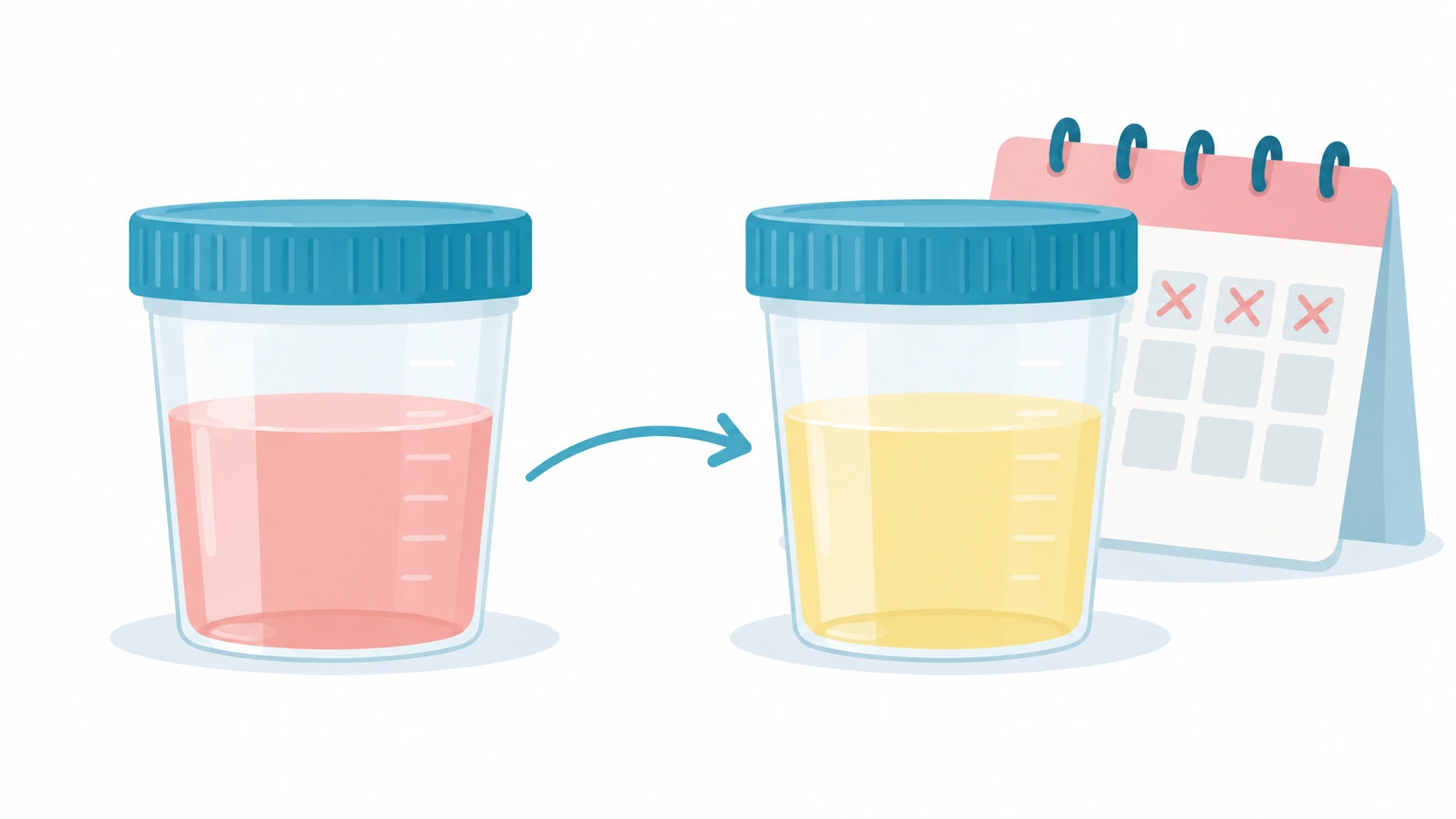
Yes, blood in urine often goes away on its own, sometimes within a day or two. Hard exercise, a period, a urinary tract infection that’s being treated, a kidney stone that has passed and a recent urology procedure can all cause bleeding that stops. But the blood stopping doesn’t prove the cause is gone. Bladder and kidney cancers, an enlarged prostate and some kidney diseases can bleed for a few days and then go quiet for weeks, so you still need a urine test and a doctor’s opinion.
You saw pink or red in the toilet, maybe once, and now your urine looks normal again. It’s tempting to call it a fluke and move on. Sometimes it is a fluke. The trouble is that a harmless cause and a serious one can look the same from the bathroom, and both can stop by themselves.
Below you’ll find how long blood in urine usually lasts for each common cause, why it can come and go, who should get checked even when it has cleared, and what the checkup looks like.
The short answer: yes, but stopping isn’t the same as healing
Doctors call blood in urine hematuria. When it shows up and then clears within a short time, it’s called transient hematuria. It is common, and much of it is harmless.
The National Kidney Foundation (NKF) puts it this way: when the cause isn’t known and the blood goes away on its own, there is usually no problem, and this is more common in people under 35. For people over 35, transient blood in urine may be a sign of cancer, even though it went away.
Two more facts change how you should read “it stopped”:
- The amount of blood doesn’t tell you how serious it is. UCLA Health notes that a little blood or a lot, visible or microscopic, doesn’t show whether the problem is serious or whether there is a problem at all.
- Cancer can bleed briefly and stop. A review in American Family Physician (AAFP) notes that kidney cancer and tumors of the bladder lining can show up as transient hematuria. The American Cancer Society says the blood from bladder cancer “might go away and then come back.”
So the honest answer has two halves: yes, it can go away, and no, that alone doesn’t mean you’re in the clear.
Visible blood vs blood found only on a lab test
Visible blood (gross hematuria) turns urine pink, red or the color of tea or cola. It takes only a small amount of blood to change the color, according to Mayo Clinic. Visible blood carries the higher cancer risk of the two. A University of Wisconsin urology teaching module puts the rate of cancer at about 23% of people who come in with visible blood, compared with 3% to 5% of people with blood seen only under a microscope.
Microscopic blood (microhematuria) means the urine looks normal, but a lab finds 3 or more red blood cells per high-power field under the microscope. A dipstick alone can’t diagnose it, because at least 1 in 5 positive dipsticks show no red blood cells when the urine is examined. If your blood was found on a routine test rather than seen in the toilet, our guide to occult blood in urine explains what the dipstick result means.
How long does blood in urine usually last?
It depends on the cause. This table pulls together the usual timelines from urology and kidney sources, along with when a repeat urine test makes sense and what should send you back sooner.
| Cause | How long the blood usually lasts | When to recheck the urine | Red flag |
|---|---|---|---|
| Hard exercise (long runs, contact sports) | Often 48 to 72 hours; Mayo Clinic says it may take up to a week | About 48 hours after stopping hard exercise | Still there after a few days of rest, or comes back without exercise |
| Sex | Brief | About 48 hours later | Comes back, or comes with pain |
| Period or spotting mixing with the sample | Only while you’re bleeding | After your period has fully ended | Still there after the period |
| Urinary tract infection | Often fades soon after antibiotics start | With microscopy, 3 weeks to 3 months after the infection clears | Fever, back pain, or blood still present on the recheck |
| Kidney stone | Usually stops once the stone passes | As your doctor advises | Fever with stone pain, or blood after the stone has passed |
| After a cystoscopy | Pink urine for 1 to 2 days, sometimes a few days | Not needed for this alone | Still red after several trips to the bathroom, or clots |
| After a prostate biopsy | Up to 2 weeks (blood in semen up to 2 months) | Not needed for this alone | Heavy bleeding, bleeding that won’t stop, or many clots |
| After prostate surgery (TURP) | First 1 to 2 days, then possible bleeding around 2 weeks as scabs come off, on and off for up to 3 months | At follow-up | Heavy bleeding with clots, or trouble peeing |
| IgA nephropathy flare | A few days, around a cold or sore throat | Needs a kidney doctor | Repeats with each cold, swelling, foamy urine |
| Food or medicine that colors urine (not blood) | Until the food or drug is out of your system | Urine test if you aren’t sure | Red color with no food or drug to explain it |
After hard exercise
Exercise-induced hematuria, sometimes called runner’s hematuria, follows long-distance running, marathons and contact sports like football. Mayo Clinic links it to bladder bruising from impact in contact sports. For distance running, the reason is less clear. One review in The Sport Journal says exercise-related blood in urine in endurance athletes is often self-limiting and resolves within 48 to 72 hours.
The practical test comes from AAFP: after you stop the activity, a follow-up urine test should be clear within 48 hours. If it isn’t, exercise isn’t the explanation. Mayo Clinic adds a warning worth repeating: if you see blood after a workout, don’t assume it’s from exercising.

During or near your period
Menstrual blood can mix with urine as you pee, and the sample will test positive for blood even though the bladder isn’t bleeding. Conrad Pearson Clinic, a urology practice, notes that women often test positive for blood during or shortly after a period for this reason. Doctors sometimes use a catheter to take urine straight from the bladder to rule out contamination.
The American Urological Association (AUA) guideline says to repeat the urinalysis once a gynecologic cause like this has resolved. If the blood is still there after your period has ended, it needs a closer look.
With a urinary tract infection
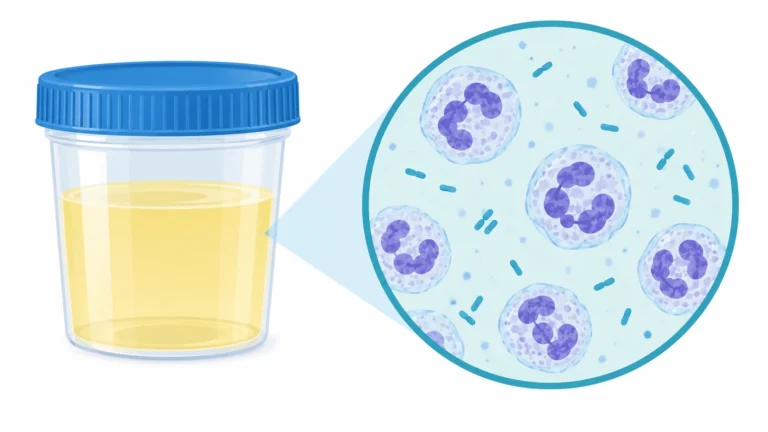
A bladder infection irritates the bladder lining, and that lining bleeds. Once antibiotics start working, visible blood often fades soon after. Iowa Urology notes that UTI bleeding usually goes away once the infection is treated. If you’re waiting on lab results, our guides to nitrites in urine and leukocytes in urine cover the other signs of infection on the report.
Here is the part most people skip. The AUA wants a repeat urine test with microscopy after the infection is treated, to confirm the blood is gone. The 2025 version of its guideline says to wait at least 3 weeks after the infection resolves and no more than 3 months. Blood that is still there after a cured UTI was not caused by the UTI.
From a kidney stone
A stone scrapes the lining of the kidney, ureter or bladder as it moves, which causes bleeding along with the familiar pain in the back, side or groin. Iowa Urology says the bleeding usually goes away once the stone has passed. Blood that continues after the stone is out can mean an infection that came along with it.
Fever or chills with stone pain is a different story. A stone that blocks an infected kidney needs care the same day.
After a urology procedure
Some bleeding is expected after procedures on the urinary tract, and the timelines are longer than many people expect:
- Cystoscopy: Kaiser Permanente’s aftercare advice says urine may be pink for 1 to 2 days, and a pinkish color can last a few days. Call your doctor if the urine is still red after you’ve peed several times or you see clots.
- Prostate biopsy: An NHS aftercare leaflet says blood in urine is normal for up to two weeks after a transrectal biopsy, and blood in semen for up to two months.
- TURP (prostate surgery): An NHS leaflet describes blood in the urine for the first 1 to 2 days. About 2 weeks later, as scabs on the prostate come away, bleeding can start again and come and go for up to 3 months.
Blood after a procedure that turns heavy, won’t stop or brings clots needs a call to the team that did it. Our guide to small blood clots in urine explains when clots become an emergency.
Why does blood in urine come and go?
Many sources of bleeding in the urinary tract don’t bleed all the time. A tumor, a swollen prostate or an inflamed kidney filter can leak blood one day and none the next. The AUA guideline refers directly to “the intermittent nature of hematuria (both with regards to presence and degree).” This is why one clean urine test after a bleeding episode doesn’t settle anything.
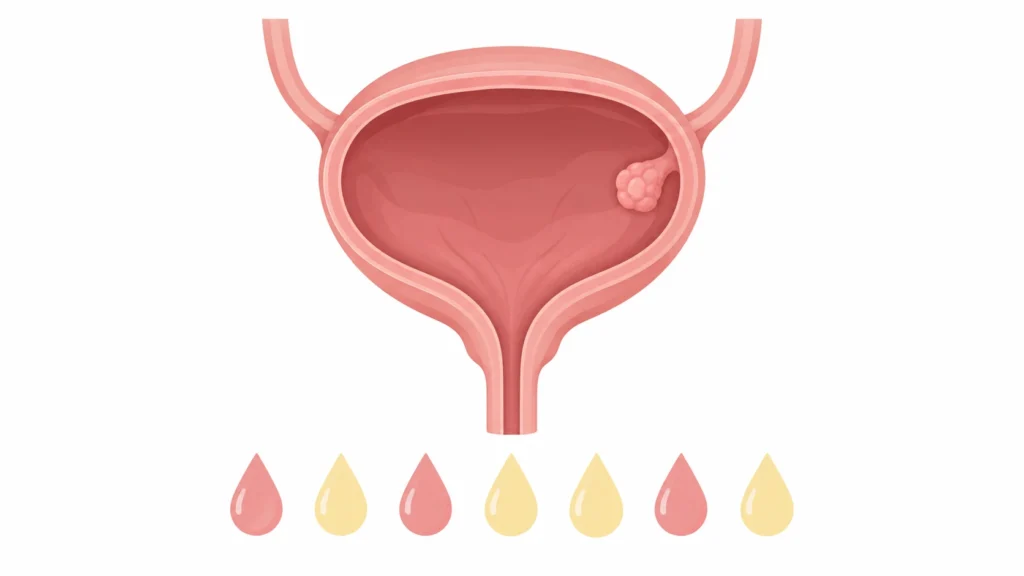
Bladder and kidney cancers bleed on and off
The American Cancer Society says blood in urine is most often the first sign of bladder cancer, and that early, small tumors still confined to the bladder usually cause bleeding with little or no pain. That bleeding can stop and restart. MD Anderson Cancer Center gives a plain example: a small tumor may cause blood in the urine just one time.
Blood in urine usually isn’t cancer, and the cancer society says so too. But painless visible blood that stops on its own is the pattern doctors least want people to ignore.
Enlarged prostate and prostatitis
An enlarged prostate (benign prostatic hyperplasia, or BPH) is common in men from middle age on. Mayo Clinic notes it can cause trouble peeing, a strong or lasting urge to go, and blood in the urine. Infection of the prostate (prostatitis) can do the same. Bleeding from the prostate can stop for weeks and then start again.
BPH is a common cause of blood in urine in older men, but it’s also a diagnosis your doctor makes after checking for other causes, not before.
Kidney filter disease, like IgA nephropathy
Sometimes the blood comes from the kidney’s own filters, the glomeruli. In IgA nephropathy, one of the most common of these conditions, visible blood can appear at the time of a cold or sore throat. The UK Kidney Association says these episodes usually last a few days. The urine clears, and then the next infection brings it back.
Clues that point to the kidney filters rather than the bladder include protein in the urine, swelling in the legs or face, high blood pressure and a rising creatinine on blood tests. The NKF notes that protein in the urine along with blood usually means a problem with the kidneys. These conditions are managed by a nephrologist, a kidney specialist.
Can dehydration cause blood in urine?
No. Dehydration doesn’t cause blood in urine, according to Brown University Health, though it can make urine cloudy, dark, concentrated or strong-smelling. Concentrated urine can also irritate the bladder. Dark amber urine can look alarming, but it isn’t blood.
Some websites, and some AI search summaries, list “mild dehydration” as a cause of blood in urine that goes away. The urologists who write about this disagree. If your urine looked red or pink, not just dark yellow, dehydration isn’t the explanation.
There is one dehydration-related trap to know about. During extreme exercise, and more so in heat, damaged muscle can release a protein called myoglobin into the blood. The kidneys filter it into the urine, where it turns the urine dark brown or cola-colored and can make a dipstick read positive for blood even though there are no red blood cells. MedlinePlus notes that high myoglobin levels can damage the kidneys. Dark brown urine after a hard workout with severe muscle pain or weakness needs urgent care, not more water at home.
Red urine that isn’t blood
Some red or pink urine has no blood in it at all. That kind of color change does go away on its own, once the cause is out of your system. Common culprits, according to the NKF and Mayo Clinic:
- Foods: beets, rhubarb, blackberries and the herb senna
- Food dyes: red dye 40
- Medicines: phenazopyridine (a bladder pain reliever that turns urine orange-red), rifampin, nitrofurantoin, phenytoin, ibuprofen, iron pills and hydroxocobalamin, a form of vitamin B12
You can’t tell blood from dye by looking. A urine test with microscopy answers it quickly, so if you’re not sure, get it tested rather than guessing.
Who should get checked even if the blood is gone?
Everyone who sees blood in their urine should tell a doctor, even once, even without pain. The groups below shouldn’t wait to see whether it comes back:
- People over 35 to 40, since the NKF notes that transient blood in urine in people over 35 may be a sign of cancer
- Anyone who saw visible blood, at any age
- Current or former smokers, since the American Cancer Society says people who smoke are at least 3 times as likely to get bladder cancer
- People who have worked with dyes, rubber, leather, paint or printing chemicals, which involve aromatic amines linked to bladder cancer
- Anyone who has had pelvic radiation or the chemotherapy drug cyclophosphamide
- People who have taken the diabetes drug pioglitazone (Actos)
- People with a family history of kidney disease or urinary tract cancer
- Anyone who has been treated for “UTIs” again and again
Age matters for bladder cancer: about 9 in 10 people diagnosed are older than 55, according to the American Cancer Society. It is more common in men than in women.
The repeat-UTI trap for women
Women who see blood in their urine are often told it’s a UTI and given antibiotics, sometimes over and over. An AAFP review of the AUA guideline reports that about 1 in 10 women and 1 in 20 men with bladder cancer had more than three courses of antibiotics for UTIs before their cancer was found.
If you’ve had blood in your urine blamed on infections more than once, ask whether a urine culture confirmed each one, and ask for a repeat urinalysis with microscopy once you’re well. Brown Health makes the same point: women are more likely to assume blood in the urine is from a UTI or their period and dismiss it.
What the 2025 guideline update changed for women
The AUA and the Society of Urodynamics, Female Pelvic Medicine and Urogenital Reconstruction (SUFU) updated their microhematuria guideline in 2025. The biggest change for women is the age line:
- Women under 60 now fall in the low/negligible-risk group if everything else is low risk (the 2020 version used under 50).
- Women 60 and older are intermediate risk, and women are no longer placed in the high-risk group by age alone.
- Men stay the same: low risk under 40, intermediate 40 to 59, high risk 60 and older.
For people in the low/negligible-risk group, the guideline now recommends a repeat urinalysis within 6 months rather than going straight to cystoscopy or imaging. Low risk also requires 3 to 10 red blood cells per high-power field, never smoking or fewer than 10 pack-years, and no other risk factors.
This applies to blood seen only under the microscope. Any history of visible blood puts a person in the high-risk group, whatever their age or sex.
On blood thinners? Get the same checkup
Many people on warfarin, apixaban, rivaroxaban, heparin or aspirin assume their blood thinner explains the blood in their urine and that it will settle down. Urologists disagree. The AUA says people on antiplatelet or anticoagulant drugs need the same evaluation as everyone else, and AAFP notes that warfarin at normal levels shouldn’t cause hematuria unless something in the urinary tract is already bleeding.
Thinners can make an existing source bleed more and longer. That can work in your favor: AAFP reports that people on these drugs are diagnosed with bladder cancer more often, possibly because the drug makes a tumor bleed sooner. Don’t stop a blood thinner on your own, but don’t let it explain away the blood either.
When is blood in urine an emergency?
Most blood in urine is not an emergency, even when it’s frightening. Go to the ER or call 911 if you have:
- Blood in your urine and you can’t pee, or only dribble, with a full, painful lower belly
- Several clots, or blood so thick you can’t see through the urine
- Fever, chills, nausea or vomiting along with the blood
- Severe pain in your side or back with fever
- Dizziness, fainting or a racing heartbeat
- Blood after a fall, car accident or hard blow to the back or belly
MD Anderson lists several clots, being unable to urinate, fever, chills, nausea and vomiting as reasons to go to the emergency room. The NKF warns that large clots can block urine flow and that heavy bleeding can lead to low blood pressure and shock.
One or two small clots and thin, pinkish urine you can see through are less urgent, but you still need a doctor within days.
What helps at home while you wait for an appointment?
No home remedy stops the cause of blood in urine. What you can do at home is avoid making the next urine test harder to read, and keep track of what happened.
- Drink normally. MD Anderson notes that drinking more water will help wash blood out as your body makes more urine, but it won’t fix the cause. There is no need to force huge amounts.
- Pause hard exercise before your recheck, so exercise doesn’t muddy the result.
- Don’t take leftover antibiotics. A partly treated infection can hide on a urine culture, and the blood may not be from infection anyway.
- Ask before taking phenazopyridine (sold as Azo and similar products) right before a urine test. It turns urine orange-red.
- Keep a short log: the date, the color (pink, red, brown), whether there were clots, any pain or burning, exercise, sex, your period, new medicines and what you ate.
- Keep taking prescribed blood thinners unless your doctor tells you otherwise.
That log is useful. Doctors use the timing and pattern of the blood to narrow down where it is coming from.
What will your doctor do?
The goal of the workup, as UCLA Health puts it, is to make sure urinary tract cancers aren’t missed. The tests you get depend on your age, your symptoms, whether the blood was visible and your risk factors.
The first visit
Expect questions about the color, timing, pain, recent infections, exercise, procedures, smoking and work exposures, plus a physical exam. In men, that may include a prostate exam.
The first tests are usually:
- Urinalysis with microscopy, to count red blood cells and look for white blood cells, protein and crystals. Our urinalysis results explained guide covers each line of the report.
- Urine culture, to confirm or rule out infection.
- Blood tests, including creatinine to check kidney function, and sometimes a complete blood count.
- Urine protein, which helps tell kidney filter bleeding from bladder or prostate bleeding.

The full workup: imaging and cystoscopy
If the blood was visible, or your risk is intermediate or high, the doctor will refer you to a urologist. The workup looks at both ends of the urinary tract:
- Kidney ultrasound for intermediate risk, or CT urography for high risk, to look at the kidneys and ureters. The AUA prefers ultrasound for lower-risk patients to avoid extra cost and radiation.
- Cystoscopy, a thin, flexible scope passed through the urethra into the bladder. It’s done in the office with numbing jelly. Conrad Pearson Clinic notes the scope is usually inside for less than 60 seconds, and that CT can’t reliably show bladder problems, which is why both tests are used.
Blood found only under the microscope in a low-risk person usually starts with a repeat urinalysis instead.
Getting a clean recheck sample
A sloppy sample can show blood that isn’t there, or force you to repeat the test. To get it right:
- Schedule the test after your period has fully ended.
- Avoid hard exercise and sex for about 48 hours before.
- Clean the opening of the urethra, let the first part of the stream go into the toilet, and catch the middle part in the cup.
- Ask for urinalysis with microscopy, not just a dipstick.
If past results came back with mixed skin and genital bacteria, our guide to mixed urogenital flora explains what a contaminated sample looks like on the report.
What if the tests come back normal?
A normal workup is common. Sometimes the blood came from a passing irritation, a small stone or an infection that was never caught on a urine culture, and no cause is ever named. That is a good outcome, not a failed one.
The risk of cancer after a full negative evaluation is low. In one study cited by AAFP, only two bladder cancers were found in 258 people followed for 14 years after a negative workup.
What happens next:
- For blood seen only under the microscope, the AUA recommends a shared decision with your doctor about whether to repeat the urinalysis in the future, and says evaluation can stop if the blood has cleared.
- If blood keeps showing up on tests, the NKF advises yearly checkups to watch for kidney disease. Some urologists repeat the full workup every few years for persistent, unexplained blood.
- If you see visible blood again after a normal workup, the AUA says the evaluation should start again. A new episode is new information.
The bottom line
Blood in urine can and often does go away on its own. Exercise, a period, sex, a treated infection, a passed stone and a recent procedure all cause bleeding that stops within hours to weeks. But cancers, prostate disease and kidney filter disease also bleed on and off, so a clear toilet bowl isn’t a clean bill of health. Tell your doctor about any blood you saw, get a repeat urine test with microscopy at the right time, and get a full evaluation if you’re over 35 to 40, smoke, saw visible blood or have other risk factors.
Frequently asked questions
How can I tell if the blood is from my urine or from spotting?
Blood that shows up only on the toilet paper after wiping may come from the vagina rather than the bladder. A midstream sample collected after your period ends, or a catheter sample from the bladder, settles the question.
Does blood in urine mean my kidneys are failing?
Usually not. Most blood comes from the bladder, prostate or urethra. A creatinine blood test checks kidney function, and protein in the urine alongside the blood points toward the kidney filters.
Can cranberry juice clear up blood in urine?
No. The NIH’s integrative health center (NCCIH) says cranberry isn’t recommended as a treatment for an existing UTI, and it does nothing for stones, prostate bleeding or tumors.
Can a fall or a hit to the back cause blood in urine?
Yes. A blow from an accident, a fall or contact sports can bruise a kidney. Mild injuries often heal with rest, but blood after any injury needs same-day care to check for kidney damage.
What kind of doctor should I see for blood in urine?
Start with your primary care doctor, who can test your urine and refer you. A urologist handles bladder, prostate and stone causes; a nephrologist handles kidney filter diseases like IgA nephropathy.
Sources
- American Cancer Society. Bladder Cancer Signs and Symptoms
- American Cancer Society. Bladder Cancer Risk Factors
- American Urological Association and SUFU. Microhematuria: AUA/SUFU Guideline (2020, amended 2025)
- Arnold MJ. Microscopic Hematuria in Adults: Updated Recommendations from the American Urological Association. American Family Physician, 2021
- McDonald MM, Swagerty D, Wetzel L. Assessment of Microscopic Hematuria in Adults. American Family Physician, 2006
- National Kidney Foundation. Hematuria (Blood in the Urine) in Adults
- Mayo Clinic. Blood in urine (hematuria): Symptoms and causes
- MD Anderson Cancer Center. Blood in urine (hematuria): What causes it and what to do about it
- Brown University Health. Blood in Urine: Hematuria Causes, Treatment, and When to See a Doctor
- UCLA Health. Hematuria: The presence of blood in the urine
- Conrad Pearson Clinic. Hematuria
- Iowa Urology. Can Blood in Urine Go Away on Its Own?
- University of Wisconsin Department of Urology. Module 5: Hematuria
- The Sport Journal. The Evaluation of Exercise-Induced Hematuria in Endurance Athletes
- UK Kidney Association. IgA Nephropathy: Patient Information
- Kaiser Permanente. Cystoscopy: What to Expect at Home
- North Tees and Hartlepool NHS Foundation Trust. TRUS Guided Prostate Biopsy Aftercare Information
- Gloucestershire Hospitals NHS Foundation Trust. Trans Urethral Resection of the Prostate (TURP)
- MedlinePlus. Myoglobin urine test
- NCCIH, National Institutes of Health. Cranberry
Disclaimer
This blog is for informational and educational purposes only, and does not intend to substitute any professional medical advice or consultation. For any health related concerns, please consult with your physician, or call 911.