UTI in Children: Symptoms by Age, Treatment and When to Worry
A urinary tract infection (UTI) is one of the most common bacterial infections in children. About 8% of girls and 2% of boys have one by age 7. Babies often show only a fever, fussiness or poor feeding, while older kids may have burning, urgency, accidents or smelly urine. A UTI in a child needs a proper urine test and antibiotics. Under the American Academy of Pediatrics (AAP) 2026 guideline, a young child with an unexplained fever should be checked for a UTI within 72 hours, and sooner if they seem seriously ill.
Most children recover fully from a UTI. The concern is the kidneys. In babies and young children, an infection can reach the kidneys without any obvious urinary signs, and repeated kidney infections can leave scars.
This guide covers the signs at each age, why girls and some boys get more UTIs, how doctors collect urine from a child, how long treatment lasts, when imaging is needed and how to lower the odds of another one.
| Quick facts | |
|---|---|
| How common | About 8% of girls and 2% of boys by age 7 |
| Main cause | E. coli, in up to 85% to 90% of cases |
| Main sign in babies | Fever with no other clear cause |
| How it’s confirmed | A urinalysis plus a urine culture, often from a catheter in children in diapers |
| Treatment | Antibiotics by mouth for most; 7 days or fewer preferred for most children (AAP 2026) |
| Go to the ER for | A baby under 6 months with symptoms, no wet diaper in 6 hours, vomiting everything, yellow skin or a child who looks seriously ill |
How common are UTIs in children?
UTIs are common in kids. StatPearls, a medical reference from the National Library of Medicine, reports that 8.4% of girls and 1.7% of boys have a UTI before age 7. About 7% of infants with a fever turn out to have a UTI as the cause. Rates peak in the first year of life, again around potty training, and in teenage girls once they become sexually active.
Across childhood, girls get far more UTIs than boys because their urethra, the tube that carries urine out, is shorter and closer to the anus, Cleveland Clinic explains.
Bladder infection vs kidney infection in kids
KidsHealth, the parent site of Nemours Children’s Health, describes three types:
- Urethritis: infection of the urethra only.
- Cystitis (bladder infection): the most common type. It causes discomfort and is usually easy to clear with treatment.
- Pyelonephritis (kidney infection): the more serious type, when bacteria travel up the ureters to the kidneys.
Doctors treat any UTI with a fever in a baby or young child as a possible kidney infection, Medscape notes, because young children can’t point to where it hurts. Our guide to kidney infection vs UTI explains the difference in adults.
UTI symptoms in children by age
No single sign proves a UTI in a child, Medscape says. What you notice depends mostly on age.

Babies and newborns
Babies can’t tell you anything hurts, so the signs are general. Cleveland Clinic, Johns Hopkins and Medscape list:
- Fever, often the only sign
- Irritability, crying or fussiness
- Poor feeding
- Vomiting or diarrhea
- Strong, foul-smelling urine
- Belly pain or a swollen belly
- Poor weight gain or weight loss
- Yellow skin or eyes (jaundice), mainly in newborns
- Unusual sleepiness or tiredness
Medscape notes that in babies up to 2 months old, a kidney infection often shows no urinary signs at all and is found while doctors look for the cause of a fever.
Toddlers, including toddler girls
Toddlers sit in between. They may have a fever and vomiting like a baby, or burning and urgency like an older child. Medscape lists these signs in children aged 2 to 6:
- Fever
- Vomiting
- Belly pain
- Strong-smelling urine
- Pain, urgency or peeing often
- Wetting accidents or bedwetting after being dry
A toddler who can talk may say it hurts or stings when peeing. New daytime accidents after being fully potty trained are a classic sign, Cleveland Clinic says.
Toddler girls are the group most likely to get UTIs at this age. MedlinePlus notes risk rises as children start toilet training, around age 3. Toilet training brings new habits that matter: holding pee to keep playing, wiping back to front, and constipation from holding poop. Scented soaps and bubble bath can also irritate a little girl’s urethra, which can sting even without an infection. That’s why a urine test matters before treatment.
Older children and teens
School-age kids can describe what they feel. Cleveland Clinic and KidsHealth list:
- Pain, burning or stinging when peeing
- Needing to pee often or urgently, even if only a little comes out
- Waking up at night to pee
- Daytime accidents or bedwetting after being dry
- Pain low in the belly, below the belly button
- Pain in the back or side
- Cloudy, bloody or bad-smelling urine
- Nausea, vomiting, fever or chills
Cleveland Clinic notes the symptoms are the same in boys and girls. Our guide to cloudy, foamy or smelly urine explains other causes of urine changes.
Signs of a kidney infection
A child with a kidney infection usually looks sicker. KidsHealth lists high fever, sometimes with shaking chills, pain in the side or back, severe tiredness and vomiting. Call the doctor right away for an unexplained fever with shaking chills, mainly if there’s back pain or pain when peeing.
What causes UTIs in kids?
Bacteria from the bowel cause almost all UTIs in children. E. coli is behind up to 85% to 90% of them, StatPearls reports, with Klebsiella, Proteus, Enterococcus and Enterobacter making up most of the rest. The bacteria live on the skin around the anus, move to the opening of the urethra and travel up into the bladder. Less often, bacteria reach the kidneys through the bloodstream, KidsHealth notes. Our main guide to UTI symptoms, causes and treatment covers how this happens in adults.
Can boys get UTIs?
Yes, but less often than girls. Before age 7, about 1.7% of boys have a UTI compared with 8.4% of girls, according to StatPearls.
The exception is the first months of life. Uncircumcised baby boys have a higher risk. StatPearls reports that among boys under 3 months old with a fever, 20% of uncircumcised boys have a UTI compared with 2.4% of circumcised boys. KidsHealth says this higher risk applies mainly in the first year.
Cleveland Clinic adds that boys are more likely to get UTIs when something in the urinary tract makes urine back up, such as posterior urethral valves, a birth defect that partly blocks the urethra. For uncircumcised boys, Boston Children’s Hospital advises teaching gentle cleaning under the foreskin, without ever pulling it back by force.
Other risk factors
- Vesicoureteral reflux (VUR). Urine flows backward from the bladder toward the kidneys. KidsHealth notes that many children with a UTI are found to have it. It’s covered in its own section below.
- Constipation. A full bowel presses on the bladder and stops it from emptying, StatPearls explains. It also keeps a large supply of bacteria close by.
- Holding pee. Urine that sits in the bladder gives bacteria time to grow.
- Bladder and bowel dysfunction. This term covers constipation, holding, daytime wetting and other toilet habits that work against emptying. StatPearls says it’s an underappreciated cause of repeat UTIs.
- Structural differences in the kidneys, ureters or bladder present from birth.
- A family history of UTIs, KidsHealth notes.
- In teenagers: sexual activity, pregnancy and kidney stones, per StatPearls.
What can be mistaken for a UTI in kids?
Several problems look like a UTI. StatPearls lists viral infections, kidney stones, appendicitis, sexually transmitted infections, pelvic infections and, in boys, swelling of the testicle or the tube behind it (orchitis or epididymitis). In children under 2, an older American Family Physician (AFP) review notes that an ear infection, a stomach bug or a cold can cause the fever instead.
Stinging without infection is common in young girls. Scented soap, bubble bath and shampoo in the bath water can irritate the skin around the urethra. Our guide to why it burns when you pee covers that and other causes. This overlap is the reason doctors confirm a UTI with a urine test rather than treating every sting.
How doctors test a child for a UTI
The doctor will ask about symptoms, examine your child and test a urine sample. Two tests are used:
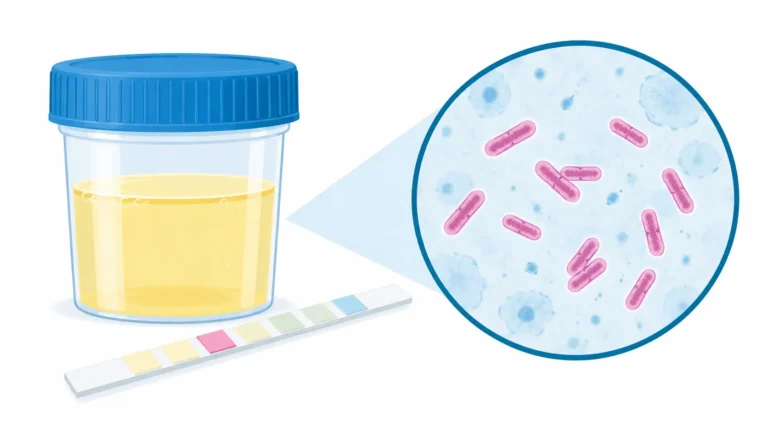
- Urinalysis: checks the urine for white blood cells, blood, nitrite and bacteria. It gives a quick answer.
- Urine culture: grows any bacteria in a lab to name them and find which antibiotics work. StatPearls says growth shows up in 12 to 24 hours, and the full results take 2 to 3 days.
StatPearls describes the AAP definition of a UTI as signs of inflammation on the urinalysis plus a urine culture growing at least 50,000 colony-forming units per milliliter (CFU/mL) of one germ from a catheter sample. Blood tests aren’t routine, but a sick child may need them. Our guide to bacteria in urine explains urine culture counts in more detail.

Why a catheter instead of a bag
How the urine is collected changes how much the result can be trusted.
- Potty-trained children pee into a sterile cup. Wayne State University’s pediatric urology team suggests starting the stream in the toilet and finishing in the cup. Girls should spread their legs, and the skin folds should be held apart if possible. Uncircumcised boys should gently pull back the foreskin if it moves easily, StatPearls adds.
- Babies and toddlers in diapers usually need a catheter, a thin tube passed briefly into the bladder, KidsHealth says. It’s uncomfortable for a moment but gives a clean sample. Less often, doctors use a small needle through the lower belly into the bladder.
- A plastic bag taped over the genitals is painless, but skin bacteria get into the sample easily. StatPearls and Medscape say a bag sample can’t be used to confirm a UTI by urine culture. A negative bag result is reassuring, but a positive one needs a catheter sample to confirm it.
MedlinePlus notes that urine can’t be tested from a wet diaper.
Home test strips
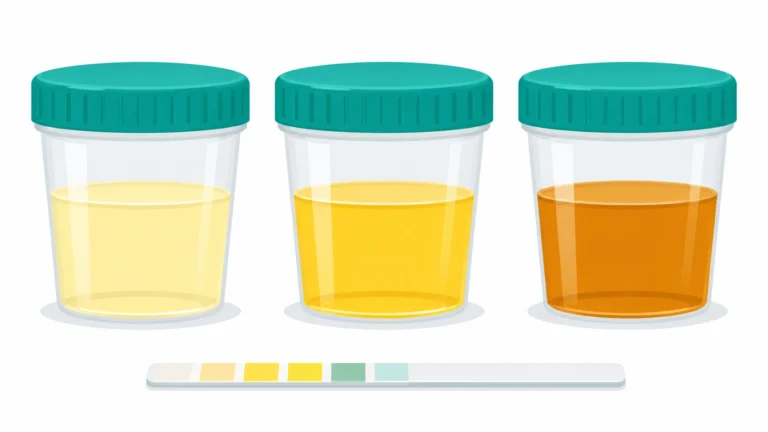
Home UTI strips read the same pads as a clinic dipstick. The AFP review found that in children, a positive nitrite pad points strongly to a UTI, but it catches only about half of infections. The leukocyte pad catches more but gives more false alarms. Babies and toddlers pee so often that the nitrite test is frequently negative, as our guide to nitrites in urine explains. A strip can’t replace a doctor’s urine culture, and a child with a fever needs to be seen whatever it shows. Our UTI test guide compares the options.
How UTIs in children are treated
UTIs in children are treated with antibiotics. Your child’s doctor will usually start one right after the urine sample is taken and switch it, if needed, when the urine culture results come back.
Antibiotics and how long
StatPearls lists second- or third-generation cephalosporins, such as cefdinir, or amoxicillin-clavulanate (Augmentin) as preferred first choices. Cephalexin (Keflex) and trimethoprim-sulfamethoxazole (Bactrim) are also used. Nitrofurantoin works for bladder infections but isn’t used for a kidney infection, because it doesn’t reach the kidneys well. Children’s doses are based on weight. Our guide to antibiotics for UTI covers each drug.
Courses are getting shorter. The AAP’s 2026 guideline says shorter courses of 7 days or less are preferred for most children. Infants, higher-risk children and children who aren’t improving as expected may need longer. In the 2023 SCOUT trial in JAMA Pediatrics, children aged 2 months to 10 years who were improving after 5 days were given either 5 or 10 days in total. Treatment failed in 4.2% of the 5-day group and 0.6% of the 10-day group, and the authors called the short course a reasonable option.
Symptoms should improve within 2 to 3 days of starting antibiotics, KidsHealth says. Cleveland Clinic advises calling the doctor if your child isn’t better after 3 days. Give every dose, even after your child feels well.
When a child needs the hospital
Most children take antibiotics by mouth at home. StatPearls notes that oral antibiotics work as well as IV ones for a child who isn’t seriously ill. Medscape and KidsHealth list reasons for IV antibiotics in the hospital:
- A baby under 2 months old with a fever and a UTI
- Any baby under 1 month with a suspected UTI, even without fever
- A child who looks seriously ill, or may have bacteria in the blood
- Vomiting that stops a child from keeping down fluids or medicine
- Dehydration
- Signs of a blocked urinary tract
KidsHealth also mentions babies younger than 6 months. Once a child improves and can take medicine by mouth, the doctor switches to oral antibiotics to finish the course.
Easing pain at home
Johns Hopkins and Medscape list extra fluids, a heating pad on the belly and pain relievers such as acetaminophen (Tylenol) or ibuprofen, dosed for your child’s weight. Don’t give AZO (phenazopyridine) to a child without asking the doctor first; the AZO label tells parents to ask a doctor before giving it to children under 12. Our guide to getting rid of a UTI fast covers comfort measures for adults.
Routine repeat urine tests after the infection clears aren’t needed for most children, StatPearls says, though your doctor may want one in some cases.
Will my child need a kidney ultrasound or other tests?
Not every child does. Imaging looks for a cause that makes UTIs more likely or more harmful.
- Kidney and bladder ultrasound. StatPearls says it’s advised for young children after a first UTI with fever, and for older children with repeat UTIs. It’s painless and uses no radiation. Medscape adds that a first bladder infection without fever doesn’t usually need imaging.
- Voiding cystourethrogram (VCUG). A catheter fills the bladder with dye, and X-rays show whether urine flows back toward the kidneys. StatPearls says it’s NOT routine after a first UTI. It’s considered when the ultrasound shows a problem or after a second UTI with fever. A contrast ultrasound version avoids radiation.
- DMSA kidney scan. A nuclear scan that shows kidney scarring. StatPearls says it’s used only in selected children, about 6 months after the infection.
Some older advice says every child with a UTI needs both an ultrasound and a VCUG. Current guidance is more selective, to spare children tests they don’t need.
Vesicoureteral reflux and repeat UTIs
Vesicoureteral reflux (VUR) means urine flows backward from the bladder up the ureters toward the kidneys. That lets bacteria reach the kidneys more easily. Doctors grade it from I (mild) to V (severe), StatPearls explains. Most kids outgrow mild VUR, KidsHealth says, but some develop kidney damage later.

Repeat UTIs are common. StatPearls defines recurrent UTI in children as 2 or more in 6 months, or 3 in a year, and says more than 30% of children who have one UTI get another. The two strongest risk factors are VUR and bladder and bowel dysfunction, and the combination raises the risk most.
Management depends on the cause:
- Treating constipation and toilet habits. StatPearls calls this safe, effective and underused. It includes drinking enough, peeing on a schedule and more fiber. The AAP’s 2026 guideline also puts more weight on constipation and bladder-bowel problems.
- Daily low-dose antibiotics. StatPearls says these are used for higher grades of VUR and some other cases. Trimethoprim-sulfamethoxazole can cut repeat UTIs by about 50%, but it doesn’t prevent scarring, and long-term use breeds resistant bacteria.
- Surgery. For children who keep getting infections despite preventive antibiotics, options include an injection of a bulking gel near the ureter opening during cystoscopy, or an operation to reattach the ureter.
The 2026 AAP guideline also gives clearer advice on when to refer a child to a pediatric urologist or nephrologist. Our guide to why you keep getting UTIs covers repeat UTIs in adults.
Complications of UTIs in children
Most children who have a UTI recover with no lasting harm, StatPearls says. Problems come mainly from kidney infections that are missed, delayed or repeated:
- Dehydration, from fever and vomiting
- Spread to the blood (urosepsis), and rarely meningitis, mainly in newborns
- Kidney scarring. About 15% of children develop scarring after a UTI with fever, StatPearls reports.
- Reflux nephropathy, kidney damage from VUR and repeated infection, which can lead to high blood pressure, protein in the urine or chronic kidney disease later in life
- Growth faltering, when a child doesn’t grow as expected, Cleveland Clinic notes
This is why prompt testing and treatment matter most in babies and young children.
How to prevent UTIs in children
You can’t prevent every UTI, but these habits lower the odds. They come from Cleveland Clinic, KidsHealth, MedlinePlus and NI Direct, the NHS site for Northern Ireland:
- Change dirty diapers right away
- Teach your child to wipe from front to back after using the toilet
- Encourage bathroom breaks every 2 to 3 hours, and don’t let your child “hold it”
- Treat constipation; talk to your doctor if your child often has hard or infrequent poops
- Offer water through the day
- Use cotton underwear and loose clothing
- Use gentle, unscented soap; school-age girls may do better with showers than baths
- Teach uncircumcised boys to clean gently under the foreskin without forcing it back
- If possible, breastfeed for the first 6 months, NI Direct suggests
On bubble baths and wiping, the evidence is mixed. MedlinePlus and NI Direct advise avoiding bubble baths. StatPearls says neither bubble baths nor wiping direction has been proven to cause UTIs, and Cleveland Clinic says bubble baths don’t cause UTIs but scented products can irritate. Skipping them is easy and does no harm.
When to call the doctor or go to the ER
Call your child’s doctor the same day if you think your child has a UTI. The AAP’s 2026 guideline advises checking children aged 2 months to 5 years for a UTI within 72 hours when they have an unexplained fever or urinary symptoms, and sooner for higher-risk children.
KidsHealth defines a fever as:
- 100.4°F (38°C) or higher taken in the bottom, ear or across the forehead
- 100°F (37.8°C) or higher by mouth
- 99°F (37.2°C) or higher under the arm
Go to the ER if your child, per Cleveland Clinic:
- Is under 6 months old and has symptoms of a UTI
- Has a fever along with UTI symptoms
- Isn’t eating or drinking, or can’t keep food or liquids down
- Hasn’t had a wet diaper in 6 hours
- Has yellow skin or eyes
- Has severe pain
- Has bloody urine
KidsHealth also advises calling right away for shaking chills, mainly with back pain.
The bottom line
UTIs are common in children, mainly girls, uncircumcised baby boys and kids with reflux, constipation or a habit of holding pee. Babies may show only a fever or fussiness, toddlers may have new accidents or pain when peeing, and older kids can describe burning and urgency. A UTI is confirmed with a properly collected urine sample, often by catheter in children in diapers, and treated with antibiotics, now usually for 7 days or less. Most children recover fully. Prompt care for any unexplained fever in a young child is the best way to protect the kidneys.
Frequently asked questions
Can a UTI in a child go away on its own?
Don’t count on it. KidsHealth says these infections won’t get better without treatment, and Cleveland Clinic warns an untreated UTI can spread to the kidneys. A child with symptoms needs a urine test and, if confirmed, antibiotics.
What is the best drink for a child with a UTI?
Plain water is best, given often through the day. KidsHealth advises skipping drinks with caffeine, such as soda and iced tea, because caffeine can irritate the bladder while it heals.
Can sitting in a wet diaper cause a UTI?
Cleveland Clinic advises changing wet diapers often and dirty ones as soon as possible. The E. coli behind most UTIs comes from poop, so keeping the diaper area clean lowers the chance it reaches the urethra.
Is there a liquid or syrup UTI medicine for kids?
Yes. Many children’s antibiotics come as a liquid, and Cleveland Clinic notes kids can take them as a pill or liquid. They need a prescription; no over-the-counter syrup cures a UTI.
Does cranberry juice help prevent UTIs in kids?
The evidence is weak. An American Family Physician review found cranberry juice helps some women with repeat UTIs, but its benefit in children is less certain, and many kids in studies stopped drinking it.
Sources
- HealthyChildren.org (American Academy of Pediatrics). Updated AAP Guidance on Urinary Tract Infections (UTIs) in Young Children, 2026
- American Academy of Pediatrics. Clinical Practice Guideline for the Diagnosis and Treatment of Urinary Tract Infection in Children From 8 Days to 5 Years of Age. Pediatrics, 2026
- Barola S, Grossman OK, Abdelhalim A. Urinary Tract Infections in Children. StatPearls, 2024
- Cleveland Clinic. Urinary Tract Infection (UTI) in Kids, 2025
- Nemours KidsHealth. Urinary Tract Infections (UTIs) in Kids, 2026
- Johns Hopkins Medicine. Urinary Tract Infections (UTI) in Children
- Boston Children’s Hospital. Urinary Tract Infection (UTI) in Children and Babies
- Fisher DJ. Pediatric Urinary Tract Infection. Medscape, 2024
- White B. Diagnosis and Treatment of Urinary Tract Infections in Children. American Family Physician, 2011
- Wayne State University Pediatric Urology. Urinary Tract Infections in Children
- MedlinePlus. Urinary tract infection – children
- NI Direct. Urinary tract infections in children
- The SGEM. Short-course therapy for pediatric UTIs (SCOUT trial review), 2024
- AZO Urinary Pain Relief Maximum Strength, Drug Facts label
Disclaimer
This blog is for informational and educational purposes only, and does not intend to substitute any professional medical advice or consultation. For any health related concerns, please consult with your physician, or call 911.