Crystals in Urine: Types, What They Mean and How to Get Rid of Them
Crystals in urine (crystalluria) form when urine holds more minerals than it can keep dissolved, often because you’re low on fluids or your urine is more acidic or alkaline than usual. A few crystals are common and usually harmless, and some form only after the sample sits. What matters is the crystal type, how many there are and your urine pH. Cystine crystals are always abnormal. Drinking more water is the main fix.
Seeing “crystals present” on a urinalysis can be unsettling, mainly if you link crystals with kidney stones. Most of the time, though, it isn’t a sign of disease. StatPearls notes that uric acid, calcium oxalate, calcium phosphate and drug crystals can all turn up in healthy people.
This guide explains what crystals in urine are, how to read them on a lab report, what each type means, what causes them, when they’re serious and how to prevent them.
| Crystal | Urine pH where it forms | Usually harmless? | Linked with |
|---|---|---|---|
| Calcium oxalate | Acidic to neutral | Often | Most kidney stones, high-oxalate diet, low fluids |
| Uric acid and urates | Acidic | Often | Gout, type 2 diabetes, high-purine diet |
| Amorphous urates or phosphates | Acidic (urates), alkaline (phosphates) | Yes | Stored or chilled samples |
| Calcium phosphate | Alkaline | Often | Alkaline urine, some stones |
| Triple phosphate (struvite) | Alkaline | No | Urinary infection with certain bacteria |
| Cystine | Acidic | No | Cystinuria, an inherited condition |
| Leucine, tyrosine, bilirubin | Acidic | No | Liver disease, high bilirubin |
| Drug crystals | Depends on the drug | Depends | Sulfa drugs, amoxicillin, acyclovir and others |
What are crystals in urine?
Urine is water carrying dissolved waste, including minerals and acids your body doesn’t need. When there’s more of a substance than the water can hold, the extra comes out of solution as tiny solid pieces. Doctors call this supersaturation, and the crystals that form are called crystalluria.
Cleveland Clinic describes the cause simply: too many minerals and not enough liquid. Some crystals don’t cause any problems. Others can clump together and grow into kidney stones that block part of the urinary tract.
Crystals are a fairly common finding. StatPearls reports that several studies found crystals in about 8% of urine samples, with calcium oxalate, uric acid and amorphous urates making up most of them. Every kidney stone starts as crystals, but most crystals never become stones. Your body has natural stone blockers in urine, such as citrate and magnesium, that keep crystals small and moving.
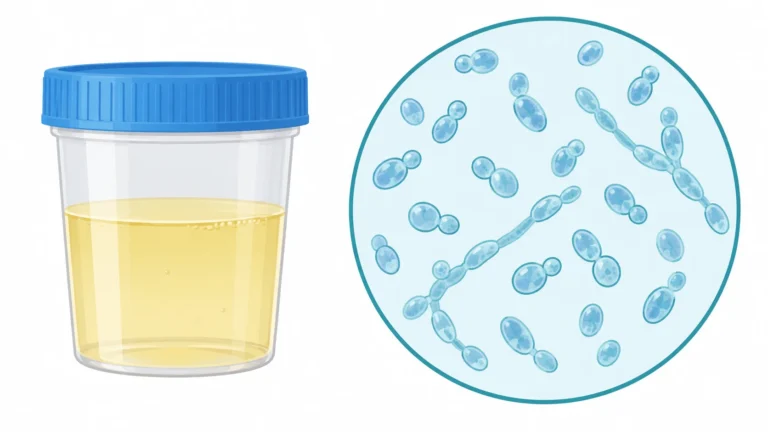
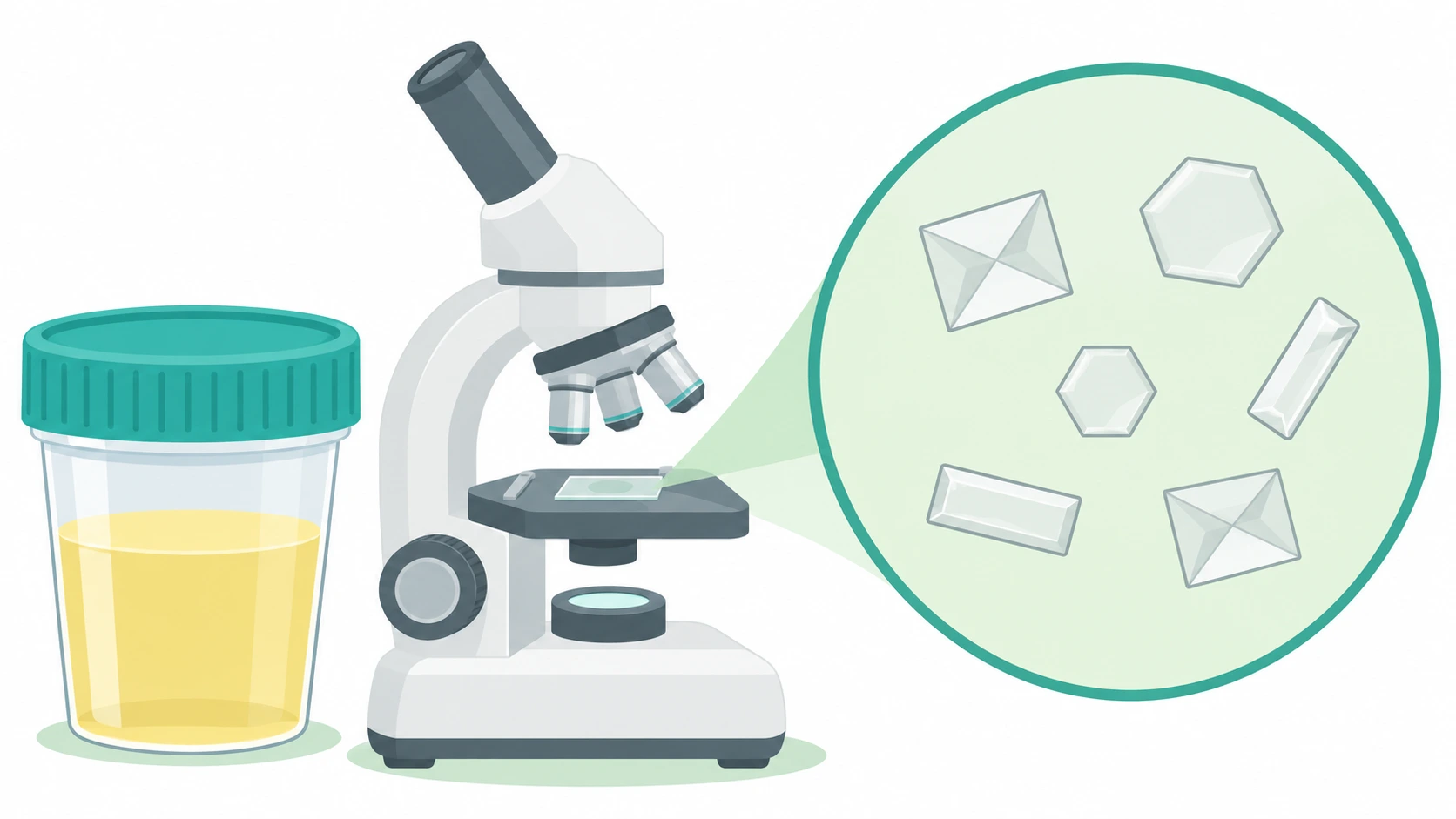
Crystals are only seen under a microscope. They’re part of the microscopic exam of a urinalysis, which MedlinePlus says shows what the crystals are made of, how large they are and how many are present.
How to read crystals on a urinalysis report
A crystal line on a lab report rarely means much on its own. Three things together decide what it means.
Type, amount and pH together
- The type. Labs identify crystals by shape. Some types, such as cystine, always need follow-up. Others, such as amorphous urates, almost never do.
- The amount. A few crystals are normal, MedlinePlus says, while large amounts of certain types can be a sign of a health problem.
- The urine pH. Each crystal forms in a certain pH range, so the pH line on the same report is a useful cross-check. StatPearls explains that calcium phosphate, struvite and ciprofloxacin crystals form in alkaline urine, while uric acid, cystine and most other drug crystals form in acidic urine. Our guide to normal urine pH explains what each reading means.
A mismatch, such as struvite crystals in acidic urine, can be a reason to recheck a fresh sample.
Crystals in urine normal range
There’s no single normal number of crystals. Labs report them in different ways, often as none, few, moderate or many, sometimes counted per high-power field (one view through the microscope). “Few” of a common type with no symptoms is usually nothing to act on. “Many,” a rare type, or crystals alongside blood, white blood cells or kidney symptoms is worth discussing with your doctor. Our guide to urinalysis results covers the rest of the report line by line.
Crystals that form after the sample is collected
Some crystals aren’t in your body at all. They form in the cup after you pee. StatPearls recommends getting a urine sample to the lab within 2 hours, because uric acid and phosphate can crystallize if urine sits longer. Chilling a sample can do the same: the Cellwiki urine atlas notes that amorphous deposits often form in refrigerated samples.
This is why a first-morning sample, which is the most concentrated of the day, can show crystals that clear on a fresh repeat test.
Types of crystals in urine
Cleveland Clinic lists the main types a lab may see: ammonium biurate, bilirubin, calcium oxalate, calcium phosphate, cystine, hippuric acid, leucine, struvite, tyrosine, uric acid and xanthine. Some crystals have no clear shape at all, and those are called amorphous.
Calcium oxalate crystals in urine
Calcium oxalate crystals are the most common type, and calcium oxalate stones make up as many as 80% of all kidney stones, according to StatPearls. They come in two main forms:
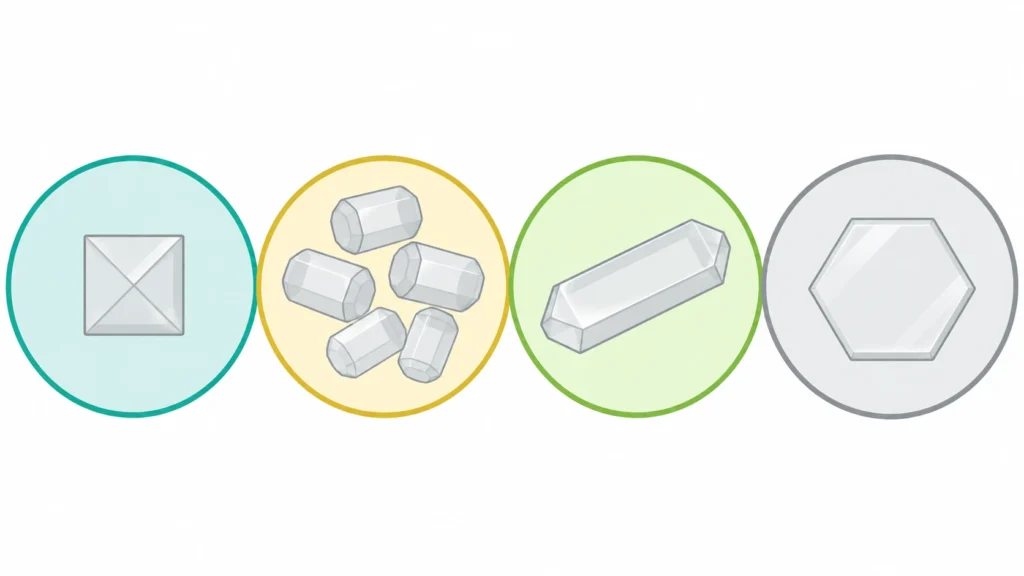
- Dihydrate: small, colorless crystals shaped like an envelope or a square with an X across it. StatPearls links them to high levels of calcium in the urine.
- Monohydrate: oval, dumbbell or rod-shaped crystals, linked more to high levels of oxalate.
Finding calcium oxalate crystals isn’t automatically abnormal. StatPearls notes they can show up in people who eat a lot of high-oxalate food. Foods rich in oxalate include spinach, rhubarb, almonds, cashews, peanuts, star fruit and black iced tea. High-dose vitamin C can raise oxalate too, because the body turns some of it into oxalate.
More oxalate can also be absorbed from the gut in people with fat malabsorption, such as after intestinal bypass surgery or with Crohn’s disease, celiac disease or chronic pancreatitis. A rare but dangerous cause is ethylene glycol, the main ingredient in antifreeze, which causes narrow, diamond-like oxalate crystals. That’s a medical emergency.
Calcium oxalate crystals tend to form in urine with a pH of about 5.0 to 6.5. Repeated or heavy calcium oxalate crystals, mainly in someone who has had a stone, may lead your doctor to order a 24-hour urine test.
Uric acid crystals in urine
Uric acid is a waste product of purines, compounds found in red meat, organ meats, some seafood and beer. Uric acid crystals form only in acidic urine, StatPearls explains, because uric acid dissolves much better as urine pH rises. Under the microscope they’re often amber-colored and can look like barrels, rosettes, diamonds or needles.
MedlinePlus links large amounts of uric acid crystals to metabolic problems such as gout and type 2 diabetes, which make urine too acidic. StatPearls adds metabolic syndrome, chronic diarrhea, tumor lysis syndrome and chemotherapy. A surprising point: more than half of people with uric acid stones have normal uric acid levels in the blood. Acidic urine, not high blood uric acid, is the main driver.
Urate crystals and ammonium biurate crystals are related forms. StatPearls describes ammonium biurate crystals as rare in human urine. They can look like other crystals under the microscope.
Amorphous crystals in urine
Amorphous means “without shape.” These crystals show up as fine granules instead of clear geometric pieces. There are two kinds that look alike under the microscope:
- Amorphous urates form in acidic urine. A large amount can leave a pink to reddish-orange sediment, sometimes called “brick dust,” at the bottom of the container.
- Amorphous phosphates form in alkaline urine and can make a sample look cloudy or white.
The Cellwiki urine atlas notes that both often form when a sample is refrigerated before testing and usually have no clinical significance. If your report shows amorphous crystals and nothing else unusual, it’s almost always a harmless finding.
Calcium phosphate crystals in urine
Calcium phosphate crystals are colorless and form in alkaline urine. StatPearls says calcium phosphate stones are the second most common type, about 10% to 20% of all stones. These crystals can also be found under normal conditions, mainly after meals rich in fruit and vegetables that make urine more alkaline. Phosphate crystals are one reason a sample can look milky; our guide to cloudy urine covers the other causes.
Repeated calcium phosphate crystals in someone who forms stones can prompt tests for high calcium or phosphate in the urine, or for conditions that keep urine alkaline.
Triple phosphate (struvite) crystals
Struvite, also called triple phosphate, is made of magnesium, ammonium and phosphate. Under the microscope these crystals often look like the lid of a coffin, though they can also look like feathers or prisms.
Unlike most crystals, struvite usually points to a problem. StatPearls explains that struvite is almost always tied to a urinary tract infection with bacteria that split urea, such as Proteus, Klebsiella and some Staphylococcus species. These bacteria turn urea into ammonia, which makes urine alkaline and lets struvite form. Struvite stones can grow large enough to fill the inside of the kidney in a branching “staghorn” shape.
If struvite crystals show up, your doctor will likely check for infection with a urine culture. Our guides to bacteria in urine and UTI symptoms and treatment explain what comes next.
Cystine crystals
Cystine crystals are flat, six-sided plates that look like hexagons. They’re one of the few crystals that always matter. Cleveland Clinic notes that cystine crystals point to a rare inherited disorder called cystinuria, in which the kidneys leak an amino acid called cystine into the urine.
Cystine doesn’t dissolve well in acidic urine, so people with cystinuria can form stones again and again. Treatment centers on drinking large amounts of water and, often, medicine that raises urine pH or binds cystine. Finding cystine crystals even once is a reason to see a kidney specialist or urologist.
Bilirubin, leucine and tyrosine crystals
These rare crystals usually point to the liver, not the kidneys.
- Bilirubin crystals look like clumps of yellow needles or granules. StatPearls says they appear when bilirubin is high in the blood, as with some liver and bile duct diseases. Our guide to bilirubin in urine explains what a positive dipstick result means.
- Leucine crystals are yellow-brown spheres with rings, like an oil drop. Tyrosine crystals are thin needles in bundles or rosettes. Both are linked to severe liver disease, according to StatPearls and the Renal Fellow Network, and tyrosine crystals can also show up with some inherited problems of amino acid metabolism.
If one of these appears on your report, your doctor will usually check liver blood tests next.
Cholesterol crystals
Cholesterol crystals are thin, clear plates with sharp, cut edges. StatPearls links them to nephrotic syndrome, a kidney condition in which large amounts of protein leak into the urine. They usually show up alongside other signs of kidney damage, such as heavy protein on the dipstick. Our guide to protein in urine explains those results.
Drug crystals, including sulfa crystals
Some medicines can crystallize in urine, mainly at high doses, with long use or when you’re dehydrated. Cleveland Clinic lists:
- Amoxicillin, an antibiotic
- Acyclovir, an antiviral used for herpes and shingles
- Sulfonamides (sulfa drugs), such as sulfamethoxazole in the antibiotic Bactrim
- Atazanavir, an HIV medicine
- Methotrexate, used for some cancers and for rheumatoid arthritis
StatPearls adds ciprofloxacin, which crystallizes in alkaline urine, and notes that drug crystals cause only 1% to 2% of kidney stones.
Don’t stop a prescribed medicine on your own. If crystals appear while you’re taking one of these drugs, your doctor may advise more fluids, change the dose or switch to another medicine.
Hippuric acid, xanthine and other rare crystals
Cleveland Clinic includes hippuric acid among the crystals a lab may see; it’s uncommon, and StatPearls notes it can be mistaken for other types. Xanthine crystals are another matter. They point to xanthinuria, a rare inherited disorder, and StatPearls notes they can also appear in people taking allopurinol during cancer treatment. An even rarer type, 2,8-dihydroxyadenine (2,8-DHA), comes from an inherited enzyme problem and can damage the kidneys if missed.
What causes crystals in urine?
Most crystals come from everyday factors that make urine more concentrated or shift its pH. Cleveland Clinic lists these causes:
- Not drinking enough water. Less fluid means more concentrated urine.
- Diet. Large amounts of protein, salt, fruits and vegetables can all shift what’s in your urine. MedlinePlus singles out animal protein such as fish, shellfish and organ meats.
- Medicines, including those listed above. MedlinePlus adds calcium-based antacids and diuretics (water pills).
- Urinary tract infections, mainly for struvite.
- Tumor lysis syndrome, when many cancer cells die at once during treatment and release uric acid.
- Ethylene glycol poisoning.
Inherited conditions such as cystinuria, primary hyperoxaluria and xanthinuria cause a small share of cases. Liver disease explains bilirubin, leucine and tyrosine crystals. And as noted above, some crystals form in the sample cup after you’ve peed.
Crystals in urine symptoms
Crystals on their own almost never cause symptoms. They’re usually found by chance on a routine urine test. When symptoms do appear, they come from a stone, an infection or irritation. Cleveland Clinic lists:
- Pain in the back, side or lower belly
- Fever
- Cloudy or foamy urine
- Needing to pee more often than usual
- Blood in the urine
- Bad-smelling urine
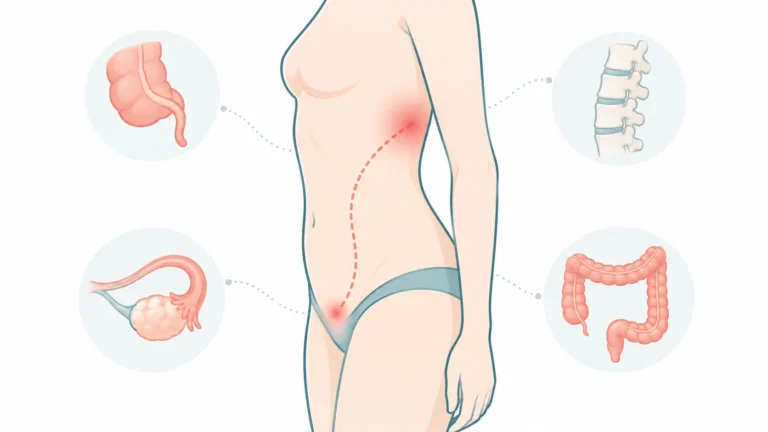
Sharp pain that comes in waves, in the side or back and sometimes spreading to the groin, is the classic sign of a moving stone. Our guide to the stages of passing a kidney stone explains what to expect. Not all side pain is a stone, though; see what can mimic kidney stone pain. Visible red or pink urine has its own list of causes, covered in our guide to blood in urine.
Are crystals in urine serious?
Usually not. Cleveland Clinic calls crystals in urine relatively common and says the outlook is good. They can be found in people who are completely healthy.
Crystals are more likely to matter when:
- The type is cystine, xanthine, 2,8-DHA, leucine or tyrosine, which point to an inherited or liver condition
- Struvite crystals appear, since they suggest an infection that can build stones
- Crystals show up in large amounts, again and again, in someone who has had kidney stones
- They come with blood, white blood cells or protein in the urine
- You have kidney symptoms or a rising creatinine while taking a drug known to form crystals
StatPearls explains that crystals can also deposit inside the kidney itself in rare cases, causing acute kidney injury or, over the long term, chronic kidney disease. That’s why heavy crystals with signs of kidney trouble get prompt attention.
How doctors test and treat crystals in urine
If the finding is minor and you feel well, the first step is often just a repeat test on a fresh sample. A doctor may also ask about your fluid intake, diet, medicines and stone history.
Further testing depends on the type and your history:
- Fresh urine sample: checked within 2 hours to rule out crystals that formed in the cup
- 24-hour urine collection: measures urine volume, pH, calcium, oxalate, citrate, uric acid, sodium and other stone risks, according to StatPearls
- Urine culture: for struvite crystals or infection signs
- Blood tests: kidney function, calcium, uric acid, or liver tests for liver-related crystals
- Imaging: an ultrasound or CT scan if a stone is suspected
- Stone analysis: if you pass a stone, catching and testing it gives the clearest answer
Treatment depends on the cause. Cleveland Clinic says that often, you may only need to drink more water or cut back on certain foods. If a medicine is to blame, your doctor may adjust it. If crystals point to a disease, such as an infection, gout or cystinuria, that condition is what gets treated.
How to get rid of crystals in urine
There’s no quick flush. Crystals clear when the conditions that formed them change, which mostly means more fluid and a few diet changes.

Drink enough fluids
The NIDDK calls drinking enough liquid, mainly water, the most important thing you can do to prevent kidney stones. Many health professionals suggest six to eight 8-ounce glasses a day, unless you have kidney failure or a doctor has told you to limit fluids. For people who have already had stones, the National Kidney Foundation advises drinking enough to make at least 2 liters (about 8 cups) of urine a day.
Pale yellow urine is a simple sign you’re drinking enough. Drink more on hot days and when you exercise, since sweat takes water away from your urine.
Cut back on salt and animal protein
More sodium in your diet means more calcium in your urine. The NIDDK advises adults to keep sodium under 2,300 mg a day and to check food labels for sodium. Eating a lot of animal protein can also raise stone risk. The NIDDK suggests swapping some meat for beans, dried peas and lentils.
Keep your calcium, and pair it with oxalate foods
Cutting calcium is a common mistake. The NIDDK explains that calcium isn’t the cause of calcium stones; in the right amounts, it binds oxalate in the gut so less reaches the urine. The National Kidney Foundation suggests eating calcium-rich foods with meals that include high-oxalate foods, and not stopping calcium unless your doctor tells you to. You may not need to avoid oxalate foods completely. Ask before taking high-dose vitamin C supplements.
Limit sugary drinks
In a study of more than 194,000 people published in the Clinical Journal of the American Society of Nephrology in 2013, Ferraro and colleagues found that one or more sugary colas a day was linked with a 23% higher risk of kidney stones. The National Kidney Foundation advises limiting sugary drinks, regular soda and sweetened tea.
Steps for specific crystal types
- Uric acid: the National Kidney Foundation suggests limiting high-purine foods such as red meat, organ meats, shellfish, sardines, anchovies, meat-based gravies and beer. The NIDDK adds that losing weight matters for people who have had uric acid stones. A doctor may prescribe medicine to make urine less acidic.
- Struvite: treating the infection and removing any stone is the key step.
- Cystine: large amounts of water, plus medicine from a specialist.
- Drug crystals: more fluids, or a dose change or switch, decided with your doctor.
When to see a doctor
Call your doctor to go over the result if your report shows a rare crystal type (cystine, struvite, leucine, tyrosine, bilirubin or cholesterol), large amounts of crystals on more than one test, or crystals along with blood, protein or white blood cells. Book a visit too if you’ve had kidney stones before or crystals appear while you’re taking a medicine known to form them.
Get care the same day for pain in your side or back with fever or chills, burning when you pee, or vomiting. Go to the ER for severe pain that won’t ease, fever with shaking chills, or little or no urine. If you’re not sure whether your pain comes from a stone or an infection, our guide to kidney stone vs UTI can help you sort the symptoms.
The bottom line
Crystals in urine are common and usually harmless. Most come from concentrated urine, diet or a sample that sat too long, and many clear on a fresh repeat test. The type, the amount and the urine pH together decide what a result means. Cystine, struvite and liver-related crystals need follow-up, as do heavy crystals in people who form stones. For nearly everyone, more water, less salt and animal protein, and steady calcium with meals are the best ways to keep crystals from coming back.
Frequently asked questions
Do crystals in urine mean diabetes?
No, crystals can’t diagnose diabetes. Type 2 diabetes can make urine more acidic, which favors uric acid crystals, so doctors may check blood sugar. Sugar on the dipstick, not crystals, is the usual diabetes clue.
What dissolves urine crystals fast?
Nothing works overnight. Extra water dilutes urine within hours, but crystal-forming habits take days to weeks to change. For uric acid or cystine, a doctor may prescribe medicine that makes urine less acidic.
What color is urine high in uric acid?
The urine itself usually looks normal. When a lot of urate settles out, it can leave a pink, orange or reddish layer at the bottom of a cup, often called brick dust sediment.
What is the number one drink linked to kidney stones?
In a large US study, sugar-sweetened cola had the clearest link, with one or more a day tied to higher stone risk. Coffee, tea and orange juice were tied to lower risk.
Are crystals in urine contagious?
No. Cleveland Clinic notes that crystalluria isn’t contagious, and even when crystals come with a urinary tract infection, that infection doesn’t spread to other people through everyday contact.
Will a home urine test strip show crystals?
No. Dipstick strips detect chemicals such as protein, blood, sugar and nitrites. Crystals can only be seen when a lab looks at urine sediment under a microscope.
Sources
- Simhadri PK, Rout P, Leslie SW. Urinary Crystals Identification and Analysis. StatPearls, 2024
- Cleveland Clinic. Crystals in Urine: Types, Causes, Symptoms and Treatment
- MedlinePlus. Crystals in Urine
- National Institute of Diabetes and Digestive and Kidney Diseases. Eating, Diet and Nutrition for Kidney Stones
- National Kidney Foundation. Kidney Stones Diet and Prevention
- American Society of Nephrology. Sugar-sweetened beverages associated with increased kidney stone risk (Ferraro PM, et al., Clinical Journal of the American Society of Nephrology), 2013
- Poloni JAT. Urine Sediment of the Month: Pathologic Crystals in the Urine. Renal Fellow Network, 2021
- Cellwiki. Urine: Amorphous crystals
Disclaimer
This blog is for informational and educational purposes only, and does not intend to substitute any professional medical advice or consultation. For any health related concerns, please consult with your physician, or call 911.