Small Blood Clots in Urine: Causes, What They Look Like and When It’s an Emergency
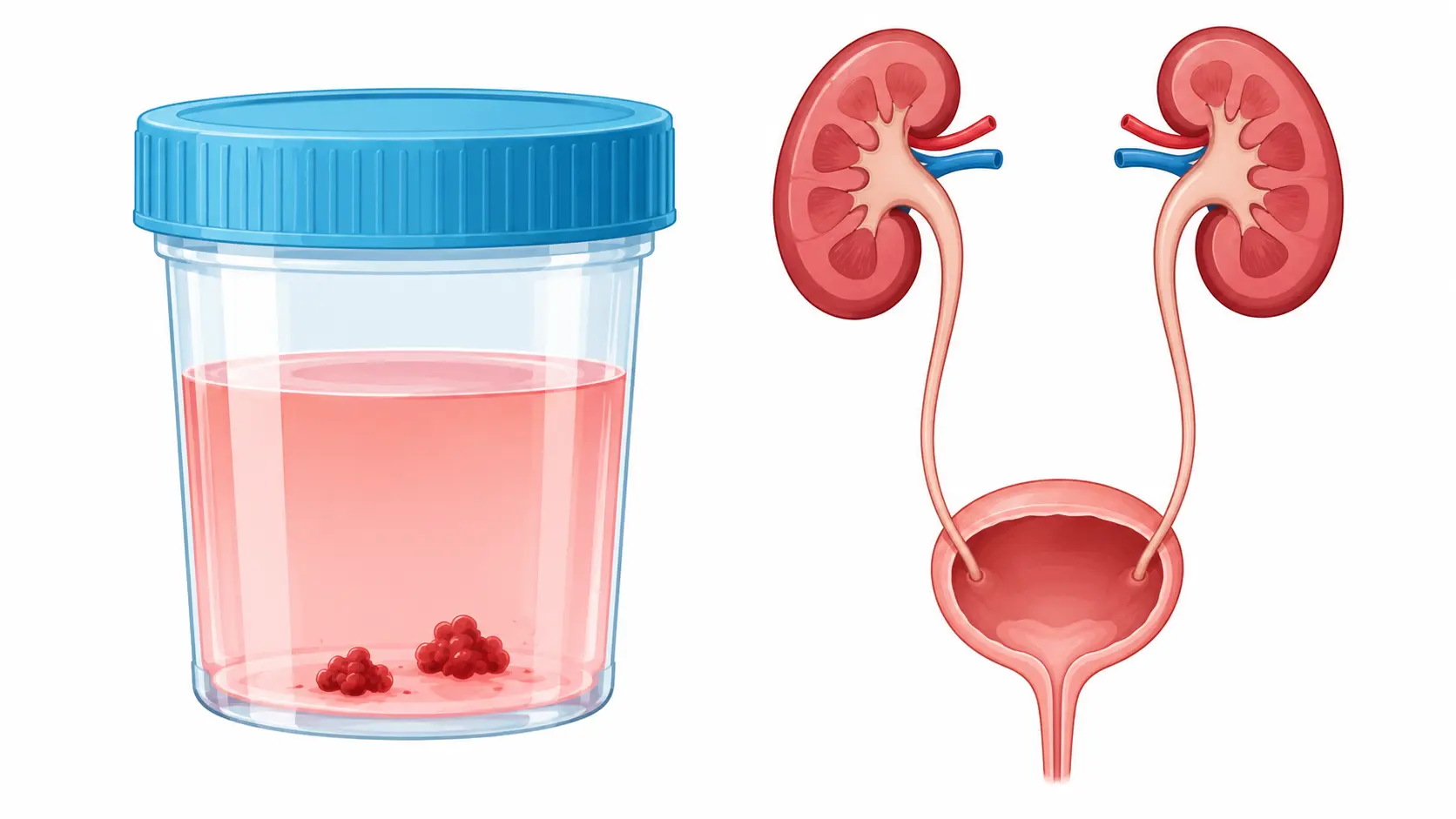
Small blood clots in urine mean there has been enough bleeding somewhere in the urinary tract for blood to clump before it leaves your body. Infections, kidney stones and an enlarged prostate are common causes, but clots always need a doctor’s check, and painless clots most of all. If you can’t pee, it’s an emergency.
Maybe you saw a small dark red clump in the toilet, a thin stringy piece, or something that looked like jelly. It’s frightening, and the first question is whether to go to the emergency room. Below is how to tell, what the clots can reveal about where the blood is coming from, and what a doctor will do.
For the rest of your urine test, our guide to urinalysis results explained walks through every line.
Is peeing blood clots an emergency?
Sometimes. Clots are an emergency when they stop you from peeing, when the bleeding is heavy or when you feel faint. One or two small clots with no pain and no trouble peeing usually aren’t an ER visit, but they still need a doctor within days, according to MD Anderson.
| Call 911 or go to the ER | Get care the same day | See a doctor within a few days |
|---|---|---|
| You can’t pee at all, or only dribble, with a painful, swollen lower belly | Fever or chills with blood in your urine | One or two small clots, no pain, peeing normally |
| Heavy bleeding: urine looks like red wine or ketchup, or you keep passing clots | Clots with pain in your side, back or groin | Clots that came once and stopped |
| You feel dizzy, faint or have a racing heartbeat | Clots after a fall, accident or blow to the back or belly | Clots with mild burning when you pee and no fever |
| Severe belly, side or back pain that won’t let up | Clots that keep coming after recent surgery, a catheter or a procedure | Blood in your urine that you can see but no clots |
| Ongoing bleeding while you take a blood thinner |
Passing blood in your urine is not normal, even if it stops on its own. Clots point to more bleeding than the hidden blood found only on a lab test, so they always deserve an evaluation.
What is clot retention?
Clot retention happens when clots collect in the bladder and block urine from getting out. The bladder keeps filling but can’t empty. You feel a strong, painful urge to pee, but little or nothing comes out, and the area above your pubic bone may swell and hurt.
This is an emergency. In the hospital, a doctor places a wide catheter with three channels into the bladder. Through it, clots are washed out by hand, and a steady flow of salt water is run in and drained out to keep new clots from forming, according to guidance from the British Association of Urological Surgeons (BAUS). If clots won’t clear, a urologist may remove them with a scope in the operating room.
What do blood clots in urine look like?
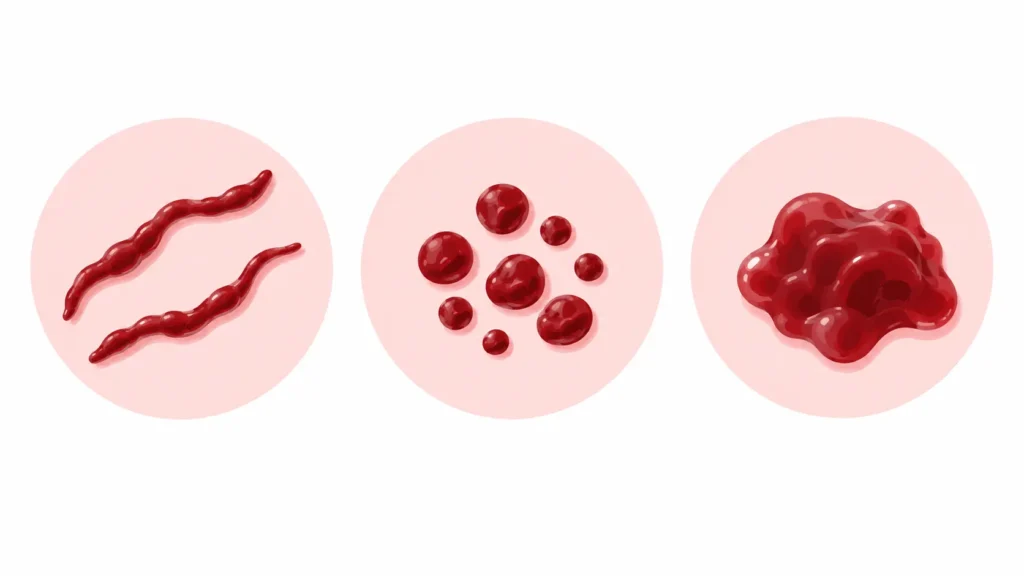
Most blood clots in urine look like small dark red or brown clumps floating in pink, red or even normal-colored urine. Some are stringy and thin, and some look like jelly. Their shape, and when they appear during peeing, can hint at where the bleeding started.
Stringy or worm-like clots
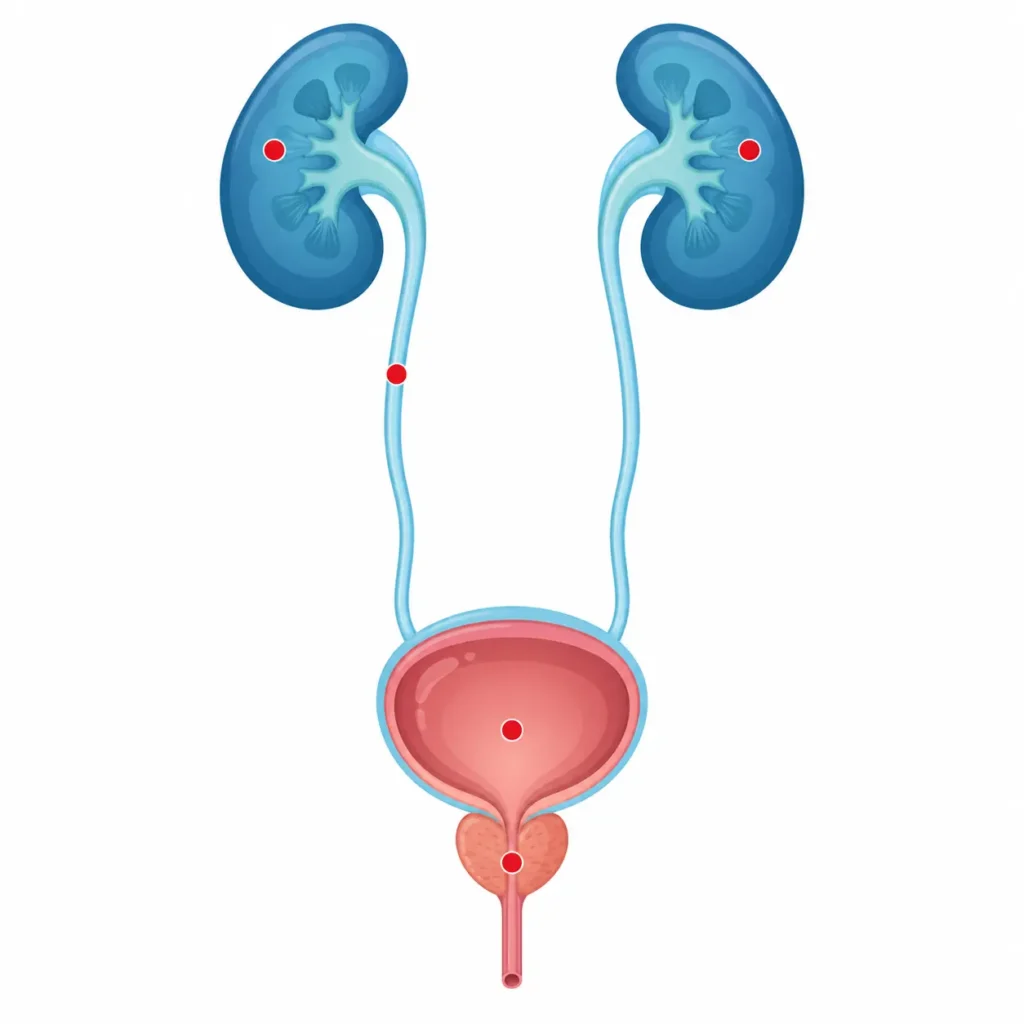
Long, thin clots that look like worms or strings take that shape because the blood clotted inside a narrow tube. The most common tube is a ureter, one of the two thin tubes that carry urine from each kidney to the bladder. So worm-like clots can point to bleeding from a kidney or ureter, above the bladder. They can also form in the urethra, the tube that carries urine out of the body.
Small round clots and jelly-like clumps
Small round clots, larger shapeless clumps and jelly-like pieces usually form in the bladder, where blood pools before you pee. Clotted blood points to bleeding from the urinary tract itself. Bleeding from the kidney’s tiny filters tends to make urine dark brown or cola-colored without clots.
When during peeing does the blood appear?
Notice when the blood shows up. It helps your doctor narrow down the source, according to clinical references such as AMBOSS and WikEM.
| When you see blood | Where it usually comes from |
|---|---|
| Only at the start, then the stream clears | The urethra |
| Only at the end of peeing | The bladder neck or the prostate |
| All the way through | The bladder, ureters or kidneys |
Is it a blood clot or something else?
Not every clump or chunk in the toilet is a blood clot. Some look alike but mean something different:
- Kidney stone pieces. Hard, gritty or sandy bits, often after an attack of side pain. Catch them with a strainer so they can be tested.
- Kidney tissue. In rare cases, a small piece of kidney tissue breaks off and passes in urine, most often in people with diabetes, sickle cell disease or long-term heavy use of pain relievers.
- Mucus. Clear, white or cloudy strands, not red. Our guide to mucus in urine explains it.
- Menstrual blood or tissue. In women, period blood can mix with urine in the toilet or the sample cup.
- Red urine from food or medicine. Beets, rhubarb, blackberries and the bladder pain medicine phenazopyridine can tint urine red or orange, according to Mayo Clinic and the National Kidney Foundation, but they don’t form clots.
- Parasites. The giant kidney worm, caught from eating raw fish or frogs, is almost never seen in the U.S.
If you’re not sure what you saw, save it in a clean container if you can and bring it to your appointment.
What causes small blood clots in urine?
Most small clots come from an infection, a stone, an enlarged prostate or a recent procedure. Cancer is less common but is the cause doctors most want to rule out, because it often bleeds without pain.
Urinary tract and kidney infections
A bladder infection can inflame the lining enough to bleed, and some bladder infections cause heavy bleeding with small clots. Burning, an urgent need to pee and peeing often usually come with it. A kidney infection adds fever, chills and back or side pain. Our guides to nitrites in urine and leukocytes in urine explain the urine test results that point to infection.
Small clots with a UTI are common enough that many people see them, but they still need treatment. If the bleeding continues after the infection clears, it needs its own workup.
Kidney and bladder stones
Stones scrape the lining as they move, which can cause visible blood and small clots. Stones in the kidney or ureter usually cause sharp, wave-like pain in the side or back that moves toward the groin. Bladder stones cause pain low in the belly and a stop-and-start stream.
Enlarged prostate and prostate problems
An enlarged prostate (benign prostatic hyperplasia, or BPH) grows fragile blood vessels on its surface that can break and bleed, sometimes with clots. It’s a common cause of visible blood in men over 50. Prostate infection (prostatitis) and, less often, prostate cancer can also cause bleeding.
Recent procedures and injuries
Some blood and small clots are expected for days after a catheter, cystoscopy, prostate biopsy, kidney stone procedure or prostate surgery. A blow to the back or belly, a fall or a car accident can injure a kidney or the bladder. Bleeding after an injury needs same-day care.
Bladder, kidney and other cancers
Bladder cancer is the cancer most often found when someone sees blood in their urine. Kidney cancer, cancer of the ureter or the kidney’s drainage system, and prostate cancer can also bleed. These cancers are often painless at first, which is why painless clots get the fastest workup.
Visible blood carries more weight than blood found only on a lab test. In the IDENTIFY study, published in BJU International in 2021, researchers studied 10,896 people sent to hospitals in 26 countries for blood in their urine. Visible blood was the strongest predictor of a urinary tract cancer, with about 3.5 times the odds of microscopic blood. The biggest risk factors are smoking, age over 50, a family history of urologic cancer and workplace exposure to certain dyes and chemicals.
Blood thinners and bleeding disorders
Blood thinners such as warfarin, apixaban, rivaroxaban and heparin, along with aspirin and clopidogrel, can make any bleeding heavier and more likely to clot. But the American Urological Association (AUA) states that taking an anticoagulant doesn’t explain blood in the urine. People on these drugs need the same evaluation as everyone else, and they are more often found to have bladder cancer, possibly because the drug makes a hidden tumor bleed sooner. Don’t stop a blood thinner on your own.
Bleeding disorders such as hemophilia, and sickle cell disease or trait, can also cause bleeding from the kidneys.
Radiation and certain medicines
Radiation to the pelvis for prostate, cervical, bladder or rectal cancer can damage the bladder lining and cause bleeding months or even years later. The chemotherapy drug cyclophosphamide can irritate the bladder and cause bleeding, and some antibiotics have been linked to blood in urine, according to Mayo Clinic.
Blood clots in urine in women
In women, the first question is whether the blood is coming from the urinary tract or from the vagina or uterus. Period blood and clots can mix with urine in the toilet, so it helps to check with a tampon in place or to wait until your period ends and look again.
When the blood is truly urinary, bladder infections are the most common cause in women. Endometriosis that grows on or into the bladder can cause bleeding that comes and goes with the menstrual cycle. Women who smoke or are over 50 need the same cancer workup as men, even when an infection seems likely, because bladder cancer in women is often first treated as repeat UTIs.
Blood clots in urine in men
In men, there’s no menstrual explanation to fall back on, so visible blood in men always gets a full evaluation. Common causes are an enlarged prostate, prostate infection, stones and bladder infection.
Painless clots in men, and above all in men over 50 or men who smoke, are the classic warning sign of bladder cancer. Blood that appears only at the end of peeing often comes from the prostate or the bladder neck. Your doctor may check a PSA blood test and examine your prostate along with the bladder and kidney tests.
Can dehydration cause blood clots in urine?
No. Not drinking enough makes urine darker and more concentrated, but it can’t cause bleeding by itself. If you see clots, something else is causing the bleeding.
Severe dehydration combined with extreme exercise can damage muscle and turn urine dark brown, like cola. That urine has no clots, and it needs emergency care.
Drinking water won’t stop bleeding or dissolve a clot that’s already formed. When bleeding is mild, doctors often suggest drinking more fluids so blood stays diluted and is less likely to clot in the bladder. Ask your doctor first if you have heart or kidney problems that limit how much you can drink.
What will a doctor do about blood clots in urine?
Visible blood puts you in the high-risk group under the AUA’s guideline for blood in urine, so the usual evaluation is a look inside the bladder plus detailed kidney imaging. MD Anderson notes that both tests are needed to find the cause.
- History and exam. Your doctor asks about pain, timing of the blood, recent infections, injuries, procedures, smoking, work exposures and medicines, and may examine your belly, back and, in men, the prostate.
- Urine tests. A urinalysis and urine culture check for infection and kidney problems.
- Blood tests. A blood count to check for blood loss, kidney function, and clotting tests if you take a blood thinner. Men may get a PSA test.
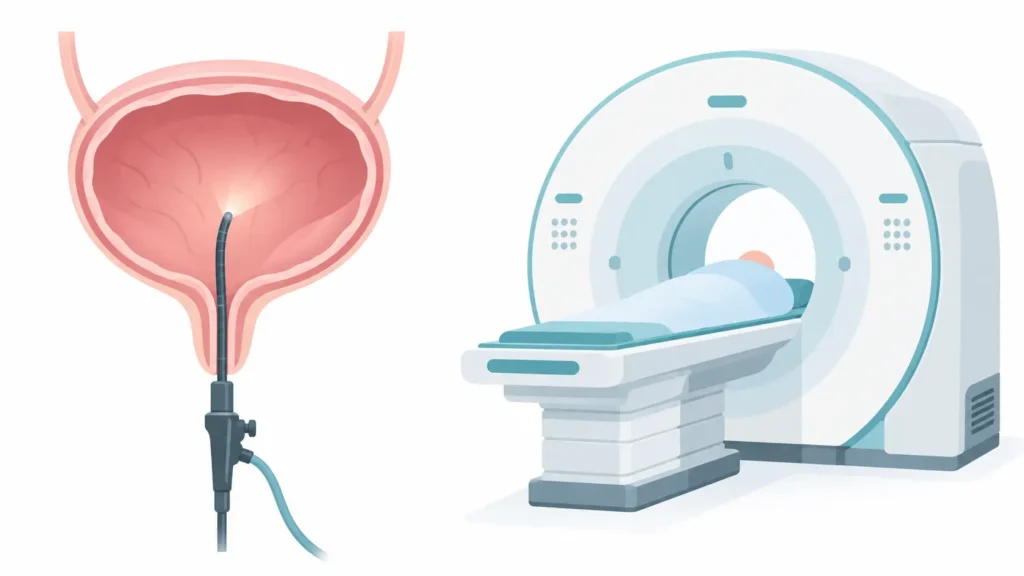
- CT urography. A CT scan with contrast dye timed to show the kidneys, ureters and bladder, looking for stones, tumors and blockages.
- Cystoscopy. A thin camera passed through the urethra into the bladder, usually in the office with numbing gel, to see the bladder lining directly.
If the source isn’t found, your doctor may repeat urine tests over the next months. Our guide to occult blood in urine explains how doctors handle blood that only shows on a urine test.
How are blood clots in urine treated?
Treatment goes to the cause. Clots usually stop once the source of bleeding is treated.
| Cause | Usual treatment |
|---|---|
| Bladder or kidney infection | Antibiotics; a repeat urine test after treatment if blood was visible |
| Kidney or ureter stone | Pain relief and fluids while small stones pass; shock-wave or scope procedures for larger ones |
| Enlarged prostate | Medicines that shrink the gland and reduce bleeding; surgery if bleeding keeps coming back |
| Clot retention | Three-channel catheter, washout and bladder irrigation in the hospital |
| Injury | Rest and monitoring for most kidney injuries; surgery for severe ones |
| Bladder or kidney cancer | Removal of the tumor and other cancer treatment, depending on type and stage |
| Radiation or drug-related bladder bleeding | Bladder irrigation, medicines placed in the bladder, or other procedures from a urologist |
If the bleeding stops before you see the doctor, keep the appointment. A clot that came and went can still come from a cause that needs treatment. Our guide on whether blood in urine can go away on its own explains why.
When to see a doctor about blood clots in urine
See a doctor about any blood clots in your urine, even if they stopped. Use the emergency table near the top of this page to decide how fast: the ER if you can’t pee, are bleeding heavily or feel faint; the same day for fever, pain, injury or bleeding on a blood thinner; and within a few days for small painless clots.
Frequently asked questions
Are blood clots in urine the same as blood clots in the legs?
No. Urine clots are blood that clumped after bleeding in the urinary tract. Leg clots form inside a vein and cause swelling, pain and warmth in one leg, which needs urgent care.
Can exercise cause blood clots in urine?
Long-distance running and contact sports can cause visible blood in urine, though clots are less common. Blood that doesn’t clear within a couple of days, or comes back, still needs a check.
Can sex cause blood clots in urine?
Vigorous sex can irritate the urethra or, in men, the prostate and cause brief bleeding. Clots that come back, or come with pain or fever, need a doctor’s evaluation.
Can stress cause blood in urine?
No direct link has been found. Stress doesn’t make the urinary tract bleed, so visible blood or clots need another explanation and a medical evaluation.
Can children pass blood clots in urine?
It’s uncommon. Infections, injuries and kidney inflammation after a strep throat are more common causes in children. Any visible blood in a child’s urine needs a pediatrician.
Sources
- Mayo Clinic. Blood in urine (hematuria)
- MD Anderson Cancer Center. What causes blood in urine (hematuria) and what to do about it
- National Kidney Foundation. Hematuria (Blood in the Urine) in Adults
- National Institute of Diabetes and Digestive and Kidney Diseases. Hematuria (Blood in the Urine)
- Arnold MJ. Microscopic Hematuria in Adults: Updated Recommendations from the American Urological Association. American Family Physician, 2021
- Khadhouri S, et al. The IDENTIFY study: the investigation and detection of urological neoplasia in patients referred with suspected urinary tract cancer. BJU International, 2021
- British Association of Urological Surgeons. Bladder washout and irrigation
- AMBOSS. Hematuria
- WikEM. Hematuria
Disclaimer
This blog is for informational and educational purposes only, and does not intend to substitute any professional medical advice or consultation. For any health related concerns, please consult with your physician, or call 911.