Kidney Stone vs UTI: How to Tell the Difference (and When It’s Both)
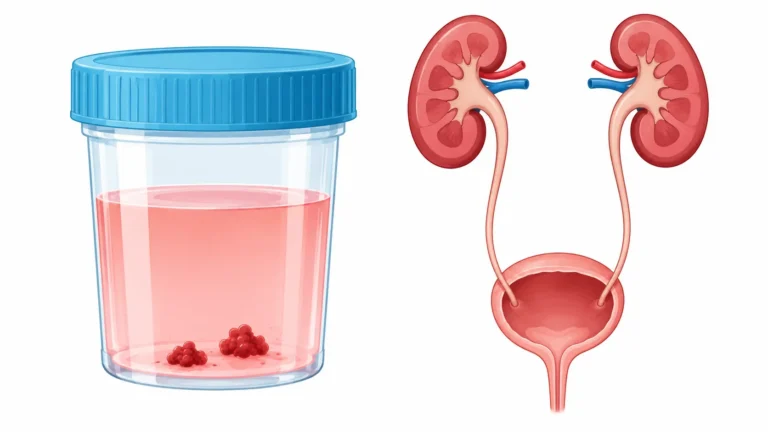
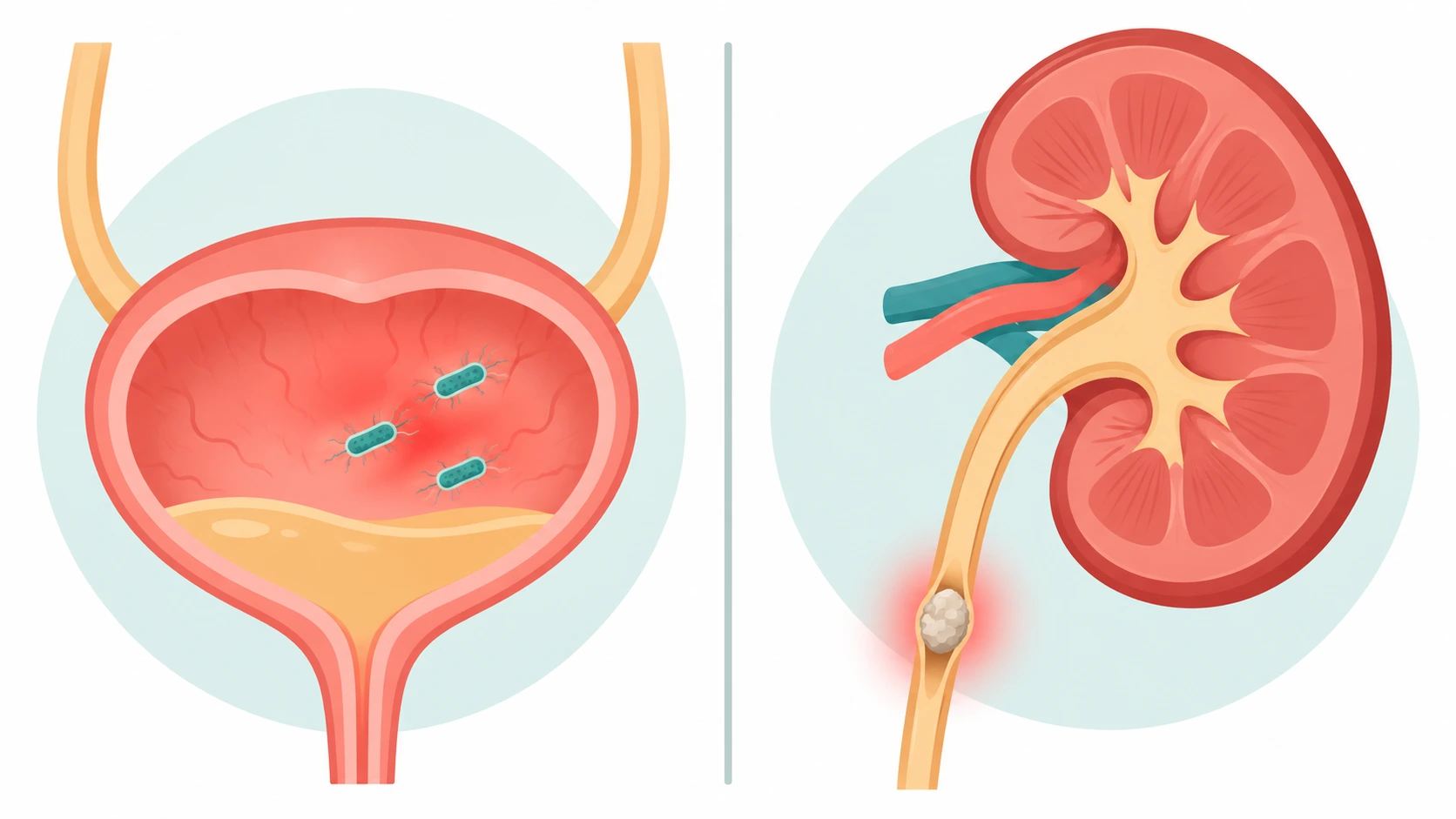
A UTI usually causes burning, a constant urge to pee and pressure low in the belly. A kidney stone causes sudden, sharp pain in the side or back that comes in waves and spreads toward the groin, often with blood in the urine. Fever points to infection. The two can happen together: a stone can trap an infection behind it, and that needs emergency care.
Burning, urgency and pain when you pee can come from an infection or from a stone, and the two share more symptoms than most people expect. Getting it right matters, because they’re treated in different ways. Antibiotics clear a urinary tract infection (UTI) but do nothing for a stone, and a stone that blocks an infected kidney can turn dangerous fast. This guide lays out the differences side by side, the clues that tell them apart, how often they show up together and when to get help right away.
Kidney stone vs UTI at a glance
| UTI (bladder infection) | Kidney stone | |
|---|---|---|
| What it is | Bacteria growing in the bladder or urethra | A hard clump of minerals in the kidney or ureter |
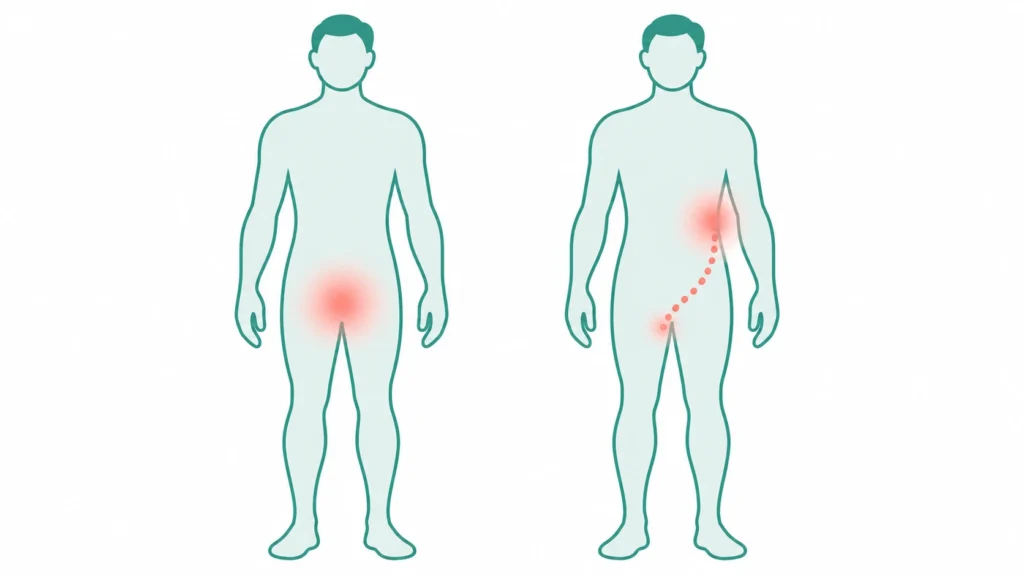
| Main pain | Burning when you pee; pressure low in the belly | Sudden, sharp pain in the side or back, below the ribs |
| How the pain behaves | Fairly steady, worse when peeing | Comes in waves; you can’t get comfortable |
| Where it spreads | Stays low | Moves toward the lower belly and groin |
| Urine | Cloudy, strong-smelling, sometimes bloody | Pink, red or brown from blood; sometimes cloudy |
| Fever | Possible, and a sign it may have reached the kidneys | Rare on its own; with fever, suspect an infection too |
| Nausea or vomiting | Uncommon unless the kidneys are infected | Common with the pain |
| Main test | Urinalysis and urine culture | Urinalysis plus a CT scan or ultrasound |
| Treatment | Antibiotics | Fluids, pain relief, time; sometimes a procedure |
Sources: MedlinePlus, Mayo Clinic, emDocs
Symptoms of a UTI
Most UTIs are bladder infections. MedlinePlus lists these signs:
- Pain or burning when you pee
- A frequent, urgent need to pee, even right after you’ve gone
- Pressure or cramping in the lower belly or lower back
- Cloudy or bloody urine that may smell strong or foul
UTIs are common. The Centers for Disease Control and Prevention (CDC) estimates that 50% to 80% of women will have at least one. Our guide to UTI symptoms and causes covers the full picture, including signs in children and older adults.
If the infection climbs to the kidneys, the symptoms change. MedlinePlus says a kidney infection can bring fever over 101°F (38.3°C), chills or shaking, pain in the side, back or groin, nausea and vomiting, and feeling tired and unwell. In older adults, confusion may be the only sign.
Symptoms of a kidney stone
A stone usually causes no symptoms while it sits still in the kidney. Mayo Clinic says the trouble starts when it moves around or drops into the ureter, the tube that drains urine to the bladder. Then you may have:
- Sharp, severe pain in the side and back, below the ribs
- Pain that spreads to the lower belly and groin
- Pain that comes in waves and changes in strength
- Pain or burning when you pee
- Pink, red or brown urine
- Cloudy or bad-smelling urine
- A constant need to pee, or peeing small amounts
- Nausea and vomiting
- Fever and chills, but only if an infection is also present
A stone on its own rarely causes a fever. Our guide to what kidney stone pain feels like explains how to tell it from back strain and other look-alikes.
How to tell them apart
Four clues do most of the work.
1. The type and place of the pain. A UTI hurts low in the belly and mainly when you pee. A stone hurts in the side or back, below the ribs, and the pain travels toward the groin. If the worst pain is above your waist on one side, a stone or a kidney infection is more likely than a simple bladder infection.
2. How it starts and behaves. Stone pain usually hits suddenly and comes in waves that rise and fall. People pace and shift and still can’t get comfortable. UTI discomfort tends to build over a day or two and stays fairly steady between trips to the bathroom.
3. Blood in the urine. Both can cause it, but it’s far more typical of a stone. A 2017 review on emDocs, an emergency medicine education site, reports that about 95% of people with a stone have blood in their urine, visible or under the microscope, on the first day of pain. That drops to about 65% by the third day.
4. Fever. emDocs notes that fever is rare with a stone unless an infection is also present. Fever plus burning points to a UTI that may have reached the kidney. Fever plus stone pain points to both at once, which needs care the same day.
Can a kidney stone feel like a UTI?
Yes. Once a stone moves low in the ureter, close to the bladder, it irritates the bladder wall. That can cause burning when you pee, a strong urge to go and peeing small amounts, which is exactly what a UTI feels like. The difference is usually what came before: a stone that’s nearing the bladder has often caused side or back pain in the days or hours before the burning started. A urine test sorts it out. If it shows blood but no signs of infection, a stone is more likely.
Kidney stone vs kidney infection
This is the harder comparison, because both cause pain in the side or back. A kidney infection (pyelonephritis) usually starts as a bladder infection that travels up.
| Kidney infection | Kidney stone | |
|---|---|---|
| Pain | Deep ache in the side or back that builds | Sudden, sharp, in waves |
| Fever and chills | Yes, often over 101°F | Not unless an infection is present |
| Feeling sick all over | Common: tired, achy, unwell | Mostly the pain and nausea |
| Burning and urgency | Often came first | Possible when the stone is near the bladder |
| Main treatment | Antibiotics, sometimes through an IV | Pain relief, fluids, time or a procedure |
Sources: MedlinePlus, NIDDK, Mayo Clinic
The National Institute of Diabetes and Digestive and Kidney Diseases (NIDDK) warns that a kidney infection can lead to sepsis, which can be life-threatening, and advises seeking care right away for kidney infection symptoms. Don’t wait to see whether side pain with fever settles down.
Can a kidney stone cause a UTI?
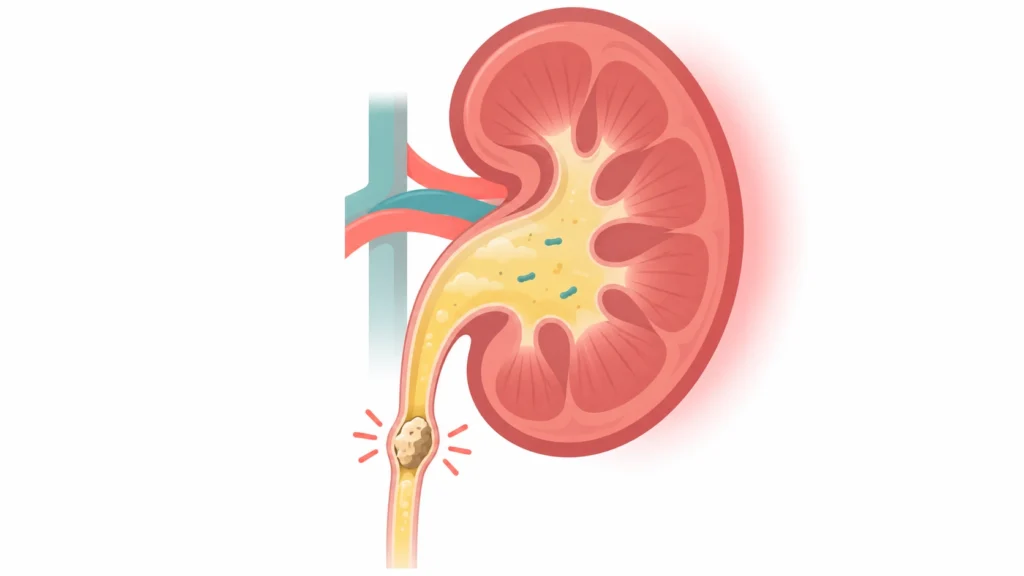
Yes. Urine that can’t flow freely gives bacteria a place to grow. MedlinePlus lists blockages that keep urine from flowing freely, including kidney stones, as a risk factor for UTIs, along with an enlarged prostate, a narrowed urethra and problems emptying the bladder.
A stone can also shelter bacteria, which is one reason a UTI may keep coming back after treatment. If you’ve had repeat infections with no clear cause, ask your doctor whether imaging to look for a stone makes sense.
Can a UTI cause kidney stones?
Some UTIs can. Certain bacteria, such as Proteus and Klebsiella, make an enzyme called urease that turns urine alkaline. Minerals then form struvite stones, also called infection stones. E. coli, the most common cause of UTIs, rarely does this.
According to StatPearls, a medical reference from the National Library of Medicine’s bookshelf:
- Struvite stones make up about 5% to 15% of kidney stones in the US
- Women get them about three times as often as men among first-time stone formers, because they get more UTIs
- People with a long-term catheter or a bladder that doesn’t empty well, such as from a spinal cord injury, are at higher risk
- They grow faster than other stones and can fill the kidney in a branched shape called a staghorn stone
Antibiotics alone don’t clear them, because the bacteria live inside the stone. StatPearls notes that about 85% come back when pieces are left behind, so the whole stone needs to be removed, along with treatment for the infection.
Infected kidney stone: why it’s an emergency
When a stone blocks the ureter and the urine trapped behind it is infected, the kidney can’t drain. Bacteria can then spread into the blood. The European Association of Urology (EAU) advises urgently draining the kidney when there’s sepsis and a blocking stone, either with a stent placed in the ureter or a tube placed through the skin into the kidney.
Antibiotics are given too, but they can’t do the job alone while the infected urine has nowhere to go. The stone itself is usually removed later, once the infection is under control. Fever, chills or shaking with stone pain means going to the ER the same day.
Bladder stones vs kidney stones
Bladder stones form in the bladder rather than the kidney, and they feel more like a UTI than a kidney stone does. Mayo Clinic lists:
- Lower belly pain
- Pain when you pee
- Peeing more often
- A flow that stops and starts, or trouble peeing
- Blood in the urine
- Cloudy or darker urine than usual
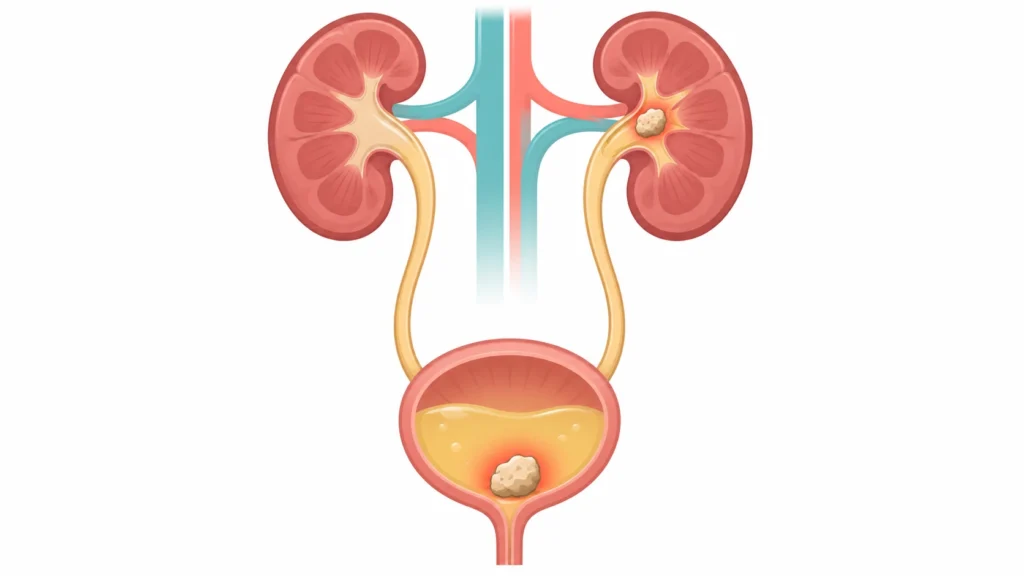
The pain sits low and in the middle instead of in the side. In men, Mayo Clinic says the main cause is an enlarged prostate that keeps the bladder from emptying fully, so minerals settle and harden. Some bladder stones cause no symptoms. A kidney stone that has dropped into the bladder can cause the same urgency and burning for a short time before it passes.
Kidney stone vs UTI in women and men
Women get far more UTIs. The female urethra is short, so bacteria reach the bladder easily. For a woman with burning and frequent peeing, a bladder infection is the most likely cause, but side pain, waves of pain or blood with no sign of infection should raise the question of a stone. Women are also more likely to form infection stones.
Men get UTIs less often, and the NIDDK says men under 50 rarely get bladder infections. A UTI in a man is more likely to have a cause behind it, such as an enlarged prostate or a stone. Our guide to UTIs in men explains the workup. Kidney stones have long been more common in men, though emDocs reports that the male-to-female ratio has dropped from about 3 to 1 to under 2 to 1 as stones in women have risen.
During pregnancy, both UTIs and stones need prompt care. Imaging changes: the UK’s National Institute for Health and Care Excellence (NICE) advises ultrasound instead of CT for pregnant women with suspected stone pain.
How doctors tell a kidney stone from a UTI
- Urinalysis. MedlinePlus says this checks for white and red blood cells, bacteria and chemicals such as nitrites. White blood cells and nitrites point to infection. Blood without signs of infection points toward a stone.
- Urine culture. A urine culture grows the bacteria, names them and shows which antibiotics work. It’s the test that confirms a UTI.
- Imaging. NICE advises a low-dose CT scan without contrast dye within 24 hours for adults with suspected stone pain, and ultrasound for pregnant women. A scan shows the stone’s size and place, and whether the kidney is swollen from a blockage.
- Blood tests, such as a blood count and kidney function, plus a test for bacteria in the blood if you have a fever or look unwell.
When the urine shows both blood and infection, doctors look for a stone and an infection together rather than picking one.
Treatment: antibiotics vs passing the stone
For a UTI, antibiotics are the treatment. MedlinePlus says a simple bladder infection usually needs 1 to 5 days of antibiotics in women and 7 to 14 days in men. Finish the full course even when you feel better. A severe kidney infection may need a hospital stay and antibiotics through an IV. Our guide to antibiotics for a UTI covers the common choices.
For a kidney stone, antibiotics don’t help unless there’s also an infection. Most small stones pass with time. A 2018 analysis in the Journal of Endourology found that about 75% of stones under 5 mm passed on their own. Care focuses on:
- Plenty of fluids
- A nonsteroidal anti-inflammatory drug (NSAID) such as ibuprofen as the first choice for pain, per the EAU, if it’s safe for you
- An alpha-blocker such as tamsulosin for some stones over 5 mm in the lower ureter (EAU)
- A procedure, such as shock wave lithotripsy or ureteroscopy, for stones that don’t pass
Our guide to the stages of passing a kidney stone covers how long it takes and what helps.
For both at once, the infection is treated first. If the stone is blocking the kidney, it’s drained with a stent or a tube, antibiotics are started, and the stone is dealt with once the infection clears. Infection stones need to come out completely.
When to go to the ER
Go to the ER or call 911 if you have:
- Fever, chills or shaking with side or back pain
- Pain so bad you can’t sit still or find a comfortable position
- Vomiting that stops you keeping down fluids or medicine
- Little or no urine
- Confusion, fast breathing or a racing heart, which can be signs of sepsis (NIDDK)
- Any of these while pregnant
The bottom line
A UTI burns, makes you pee often and hurts low in the belly. A kidney stone hits suddenly in the side or back, comes in waves, spreads toward the groin and often puts blood in the urine. Fever is the dividing line: it points to infection, and fever with stone pain means a possible infected, blocked kidney that needs the ER. A urine test and, when needed, a scan settle the question, so get tested before you treat either one.
Frequently asked questions
Can a bladder infection cause back pain without reaching the kidneys?
Yes. MedlinePlus counts back pressure among bladder infection signs, so an ache there doesn’t always mean the kidneys. Fever over 101°F, chills, nausea and pain higher up in the side point to the kidneys instead.
Will antibiotics help a kidney stone?
Not on their own. Antibiotics don’t dissolve or move a stone. Doctors add them when bacteria are found too, alongside fluids, pain relief or a procedure to deal with the stone itself.
What drink helps flush out kidney stones?
Water. No drink dissolves most stones, but MedlinePlus advises drinking enough to make at least 2 liters of urine a day, with light yellow urine as the goal, to help small stones pass.
What should you not do if you think you have a UTI or a stone?
Don’t take leftover antibiotics or someone else’s prescription, and don’t cut back on fluids to pee less. Get a urine test first, since the right treatment depends on which one you have.
Sources
- MedlinePlus. Urinary tract infection – adults
- Centers for Disease Control and Prevention. Urinary Tract Infection Basics
- Mayo Clinic. Kidney stones: Symptoms and causes
- National Institute of Diabetes and Digestive and Kidney Diseases. Symptoms & Causes of Kidney Infection (Pyelonephritis)
- National Institute of Diabetes and Digestive and Kidney Diseases. Definition & Facts of Bladder Infection in Adults
- Crain N. Renal colic mimics: Differential diagnosis and approach to management. emDocs, 2017
- StatPearls. Struvite and Staghorn Calculi
- European Association of Urology. EAU Pocket Guidelines on Urolithiasis, 2026
- National Institute for Health and Care Excellence. Renal and ureteric stones: assessment and management (NG118)
- Mayo Clinic. Bladder stones: Symptoms and causes
- Yallappa S, et al. Natural History of Conservatively Managed Ureteral Stones: Analysis of 6600 Patients. Journal of Endourology, 2018
- MedlinePlus. Kidney stones: self-care
Disclaimer
This blog is for informational and educational purposes only, and does not intend to substitute any professional medical advice or consultation. For any health related concerns, please consult with your physician, or call 911.