Urine Specific Gravity: Normal Range, High and Low Results Explained
Urine specific gravity compares how concentrated your urine is with plain water, which has a specific gravity of 1.000. Most labs call 1.005 to 1.030 normal. A high reading usually means you’re low on fluids, and a low reading usually means you’ve been drinking a lot. Readings that stay high or low no matter how much you drink can point to a kidney, hormone or heart problem, so your symptoms and repeat results matter more than a single number.
Specific gravity is one of the most common lines on a urinalysis, and one of the least explained. It doesn’t diagnose a disease on its own. It tells your doctor how well your kidneys are balancing water and waste at the moment the sample was taken, and it helps them read the rest of your results.
This guide explains what the number means, what counts as normal, what makes it high or low, how it’s measured and what can throw it off.
| Urine specific gravity | What it usually means |
|---|---|
| 1.000 to 1.004 | Highly dilute urine; common after drinking a lot of fluid |
| 1.005 to 1.010 | Dilute to normal; well hydrated |
| 1.010 to 1.020 | Middle of the normal range |
| 1.020 to 1.030 | Concentrated but within the normal range; common in a first-morning sample |
| Above 1.030 | Highly concentrated; dehydration, or glucose, protein or contrast dye in the urine |
| Stuck near 1.010 on every test | The kidneys may not be able to concentrate or dilute urine |
Ranges from UCSF Health, Cleveland Clinic and Mayo Clinic Laboratories. Your lab’s range may differ slightly.
What is urine specific gravity?
Specific gravity is a ratio. It compares the density of your urine with the density of the same amount of pure water. Pure water has a specific gravity of 1.000. Urine is always a little heavier because it carries dissolved waste.
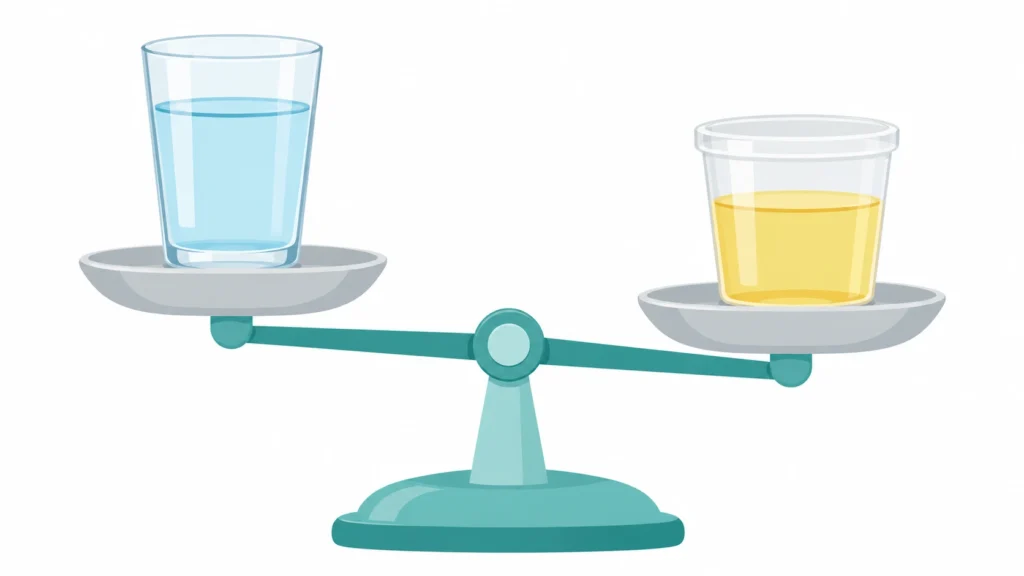
Cleveland Clinic explains that the test measures how well your kidneys balance water and remove waste products from your blood. That waste includes urea from protein, uric acid from purines, salts such as sodium, and amino acids. The more waste there is compared with water, the higher the number.
UCSF Health describes urine specific gravity as a test of the total concentration of all chemical particles in your urine.
Healthy kidneys change urine concentration all day. When you’re short on water, they hold on to it and make small amounts of concentrated urine with a high specific gravity. When you drink a lot, they let the extra water go, and the number drops. A result that moves up and down with what you drink is a sign the kidneys are doing their job.
Urine specific gravity normal range
UCSF Health and Cleveland Clinic both list 1.005 to 1.030 as the normal range for urine specific gravity.
Why labs list different ranges
You may see slightly different ranges on different reports. Mayo Clinic Laboratories uses a reference range of 1.002 to 1.030. A University of Bern teaching resource on urinalysis, UroSurf, lists 1.003 to 1.030. A nursing reference in Nursing2008 notes that results in adults usually fall between 1.010 and 1.020.
These aren’t contradictions. A wide range covers everyone from someone who just drank a liter of water to someone giving a first-morning sample. WebMD notes that if you drink a lot of water, a reading as low as 1.001 may be normal for you, and if you avoid fluids, a reading above 1.030 may be normal. UCSF Health adds that normal ranges vary slightly among labs, so always read your result against the range printed on your report.
What 1.005, 1.010, 1.020, 1.025 and 1.030 mean
- 1.005: at the low edge of normal. Usually just means you’ve been drinking plenty of fluids.
- 1.010: dilute to middle range. Normal for most people.
- 1.020: middle to upper normal. A position stand on exercise and fluid replacement from the American College of Sports Medicine (ACSM) treats a reading below about 1.020 as a sign of adequate hydration.
- 1.025: concentrated but within the normal range. Common in a first-morning sample or after a hot day or a workout.
- 1.030: the top of the usual normal range. Often means you need more fluids, mainly if your urine is also dark.
What “≤1.005” or “≥1.030” on a report means
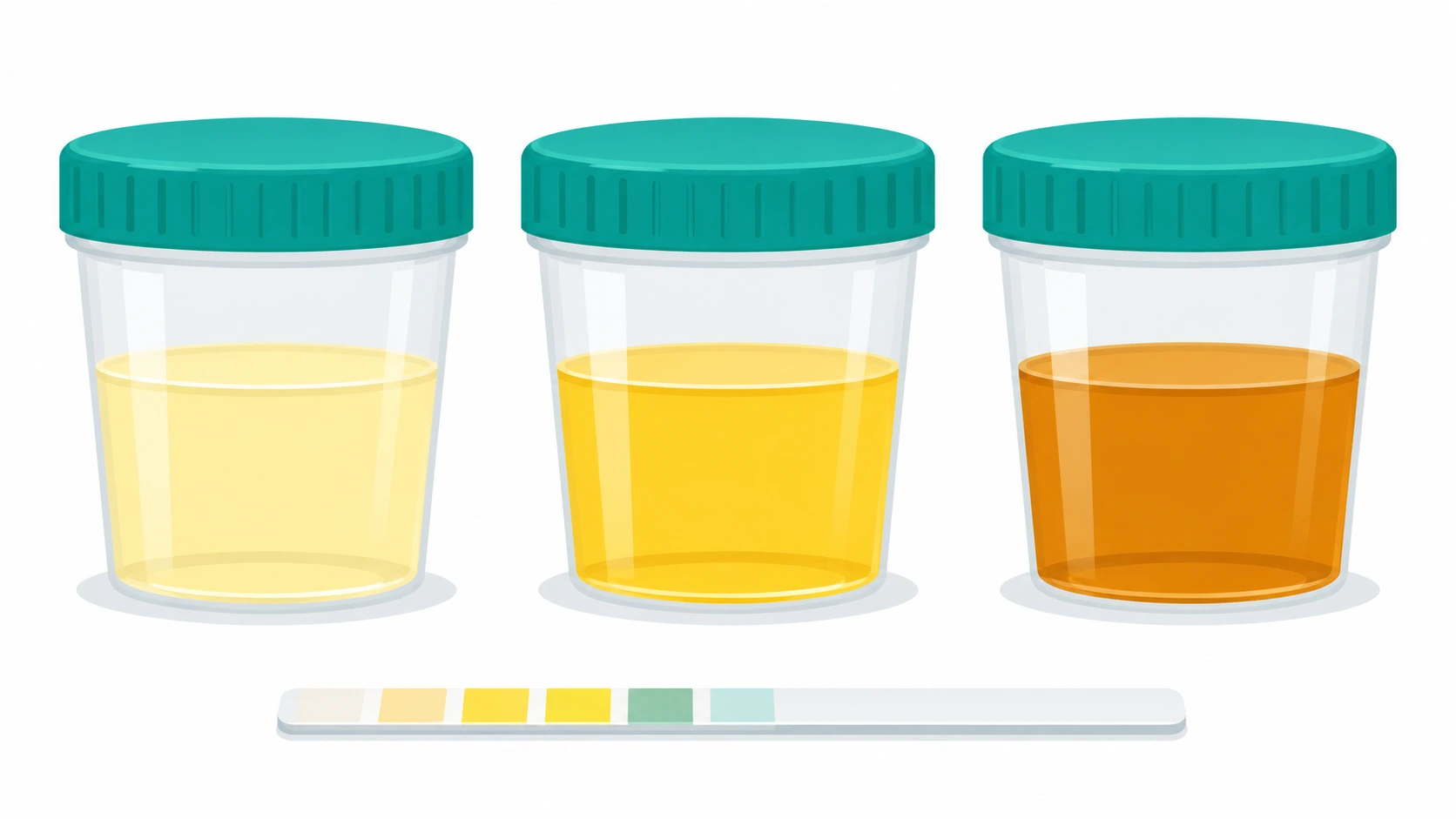
Dipstick strips have a limited scale. The color blocks on a standard strip run from 1.000 to 1.030, so any reading at either end gets reported with a “less than or equal to” or “greater than or equal to” sign. “≥1.030” means the urine is at least that concentrated and could be higher. “≤1.005” means it’s at least that dilute. If the exact number matters, a lab can measure it with a refractometer.
“Spec grav, UA,” “SG” and other report labels
Lab reports and patient portals use short names. “Spec grav, UA,” “specific gravity, UA,” “SG,” “Sp gr” and “urine SG” all mean urine specific gravity on a urinalysis. “UA” stands for urinalysis. Cleveland Clinic lists other names for the same test, including urine density and urine concentration test. Our guide to urinalysis results explains the other lines on the report.
High urine specific gravity
A high specific gravity, above 1.030, means your urine has a lot of dissolved material compared with water. Most of the time, that’s simply because you haven’t had enough to drink.
Causes listed by Cleveland Clinic and UCSF Health include:
- Dehydration from not drinking enough, sweating, fever or hot weather
- Vomiting and diarrhea, which pull water out of the body
- Glucose in the urine, as with uncontrolled diabetes. Our guide to glucose in urine explains what a positive result means.
- Heart failure, which reduces blood flow to the kidneys
- Not enough blood reaching the kidneys (prerenal azotemia) or a narrowed kidney artery (renal artery stenosis)
- SIADH, a condition in which the body makes too much antidiuretic hormone and holds on to water
- Addison’s disease, when the adrenal glands don’t make enough hormones
- High blood sodium (hypernatremia)
- Shock
Large molecules can also push the number up. Mayo Clinic Laboratories notes that protein, glucose and contrast dye have a much bigger effect on specific gravity than the salts that normally fill urine. That’s why a recent CT scan with dye, or heavy protein in the urine, can give a high reading that doesn’t reflect how hydrated you are. Our guide to protein in urine covers that finding.
Age matters too. The Nursing2008 reference notes that excessive water loss raises specific gravity mainly in older adults and young children, who can become dehydrated faster during a stomach bug, a fever or hot weather. If an older relative or a young child has a high reading along with dry mouth, sleepiness or fewer wet diapers or trips to the bathroom, call their doctor.
Concentrated urine often looks darker and can look hazy. Our guide to cloudy, foamy or smelly urine explains those changes.
Low urine specific gravity
A low specific gravity, below 1.005, means your urine is mostly water. The most common reason is simply drinking a lot of fluid. Causes listed by Cleveland Clinic and UCSF Health include:
- Drinking large amounts of fluid (overhydration)
- Diabetes insipidus, a condition in which the body doesn’t make enough antidiuretic hormone or the kidneys don’t respond to it, so they can’t hold on to water
- Kidney infection (pyelonephritis). See our guide to kidney infection vs UTI for the warning signs.
- Chronic kidney disease and kidney failure, when damaged kidneys lose the ability to concentrate urine
- Damage to the kidney tubules (renal tubular necrosis)
- Low blood sodium (hyponatremia)
The Nursing2008 reference adds glomerulonephritis, aldosteronism, swelling after a brain injury and compulsive water drinking. It also notes that lithium and water pills (diuretics) can lower the reading.
Diabetes insipidus is the condition doctors most often test for with special specific gravity tests, WebMD explains. It has two main types. Central diabetes insipidus comes from a problem in the pituitary gland or hypothalamus, which normally release the hormone. Nephrogenic diabetes insipidus comes from kidneys that don’t respond to the hormone. Both cause heavy thirst and large amounts of pale urine.
A fixed specific gravity of 1.010 (isosthenuria)
Healthy kidneys can push urine far above or below the specific gravity of blood plasma, which sits around 1.010. When kidneys are badly damaged, they lose that range. UroSurf explains that with severe kidney impairment, urine density stays at about 1.010 and no longer changes with how much you drink. This is called isosthenuria.
A single reading of 1.010 is perfectly normal. What matters is a reading that stays near 1.010 on every test, even after a night without fluids or after drinking a lot. The Nursing2008 reference also notes that in certain kidney diseases, specific gravity doesn’t vary with fluid intake. If that pattern shows up, your doctor will check kidney function with blood tests. Our guide to the early signs of kidney disease lists other clues.
How urine specific gravity is tested
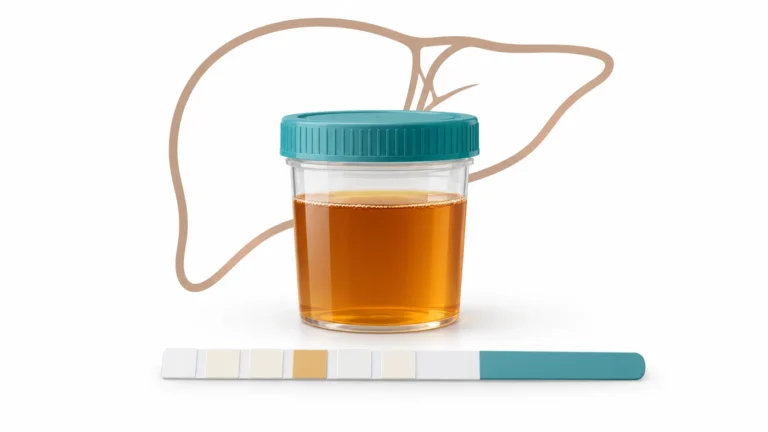
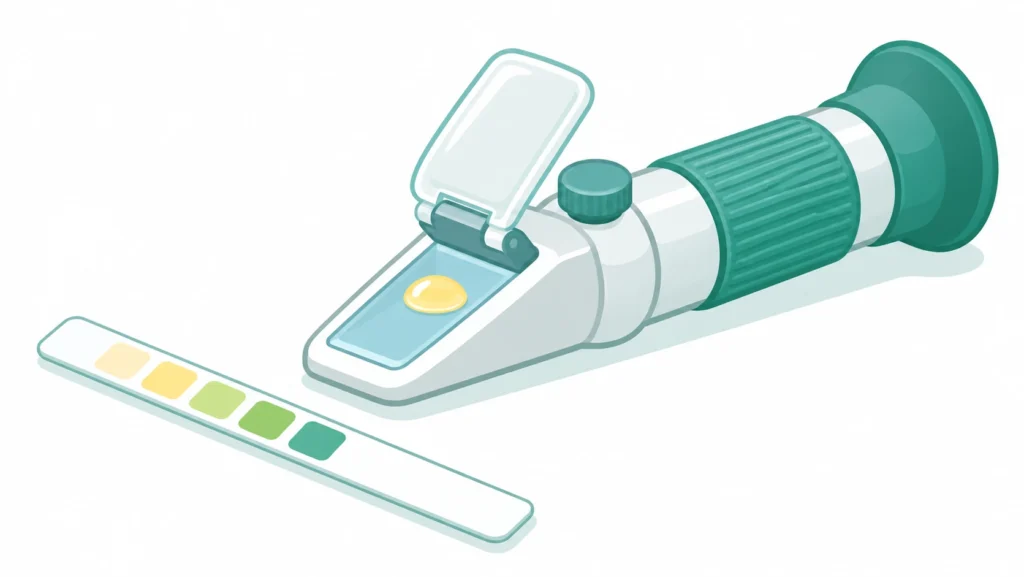
Specific gravity is usually checked as part of a routine urinalysis. You pee into a cup, and the sample is tested right away or sent to a lab.
Why doctors check urine specific gravity
Cleveland Clinic says a provider may order the test when they suspect a condition that affects the kidneys’ ability to balance water or remove waste. In everyday practice, it also helps doctors judge whether you’re dehydrated, check how well the kidneys respond to fluid changes, and decide how much weight to give the other urine results, since a highly concentrated or dilute sample can change them. The Nursing2008 reference notes it’s useful for people with changes in fluid status, kidney problems and conditions such as diabetes insipidus.
Dipstick, refractometer and osmolality
There are three main ways to measure urine concentration:
- Dipstick. A pad on the strip changes color based on the concentration of charged particles in the urine. UCSF Health notes that the dipstick gives only a rough result.
- Refractometer. A lab tech places a drop of urine on a glass plate and measures how much light bends as it passes through. Cleveland Clinic says this method is more accurate than a dipstick. The Nursing2008 reference calls it the most accurate of the common methods, and notes that the older floating urinometer is the least reliable.
- Urine osmolality. This lab test counts dissolved particles directly. UCSF Health describes it as more specific and precise than specific gravity, and Mayo Clinic Laboratories recommends it when urine contains glucose, heavy protein or contrast dye.
The Nursing2008 reference advises using the same method each time when doctors are tracking a trend, since different methods can give slightly different numbers.
What can throw off the result
Several things can make specific gravity read higher or lower than it truly is:
- Alkaline urine. The dipstick reads falsely low when urine is alkaline. UroSurf says to add 0.005 to the strip reading when urine pH is 7 or above. Our guide to normal urine pH explains that line of the report.
- Glucose. UroSurf notes that the dipstick doesn’t pick up the extra density from high glucose (above 1,000 mg/dL), while a refractometer does.
- Protein. Moderate protein can push the reading up, according to the Nursing2008 reference and UroSurf.
- Contrast dye. Dye from a CT or MRI scan raises the refractometer reading, Cleveland Clinic and the Nursing2008 reference note.
- Medicines. The Nursing2008 reference lists isotretinoin, IV albumin, dextran and some penicillin antibiotics as raising the result, and lithium and diuretics as lowering it. UCSF Health also mentions dextran, sucrose and Chinese herbal remedies.
- Anesthesia and menstrual blood. Cleveland Clinic lists both as factors that can affect the reading.
- Sample handling. The Nursing2008 reference warns that leaving a sample unrefrigerated for more than 2 hours can make results unreliable, and that detergent residue in the container can raise the reading.
Water deprivation and water loading tests
When a doctor wants to know whether your kidneys can concentrate or dilute urine, a single random sample isn’t enough. WebMD explains that a urine concentration test may involve either drinking extra water or IV fluids (a water loading test), or going without fluids for a set time (a water deprivation test). Sometimes a dose of antidiuretic hormone is given to see how the kidneys respond. These tests help tell apart the causes of heavy urination, such as diabetes insipidus.
Specific gravity and other urine results
Specific gravity affects how the rest of your urinalysis reads. Highly concentrated urine can make some results look stronger and hide others. Several of our guides list high specific gravity as a reason a test pad can read falsely negative, including occult blood in urine and nitrites in urine. Concentrated urine also makes crystals in urine more likely to show up.
Highly dilute urine has the opposite problem. Small amounts of protein, blood or white cells can fall below what the strip can detect. That’s one reason doctors often prefer a first-morning sample: it’s the most concentrated urine of the day.
How to bring urine specific gravity into range
Most of the time, specific gravity reflects how much you’ve been drinking, so the fix is simple:
- If it’s high from dehydration: drink more water through the day, more on hot days, when you’re sick or when you exercise. Pale yellow urine is a good everyday sign that you’re drinking enough.
- If it’s low from drinking a lot: there’s usually nothing to fix. You don’t need to cut back unless your doctor tells you to.
- If it stays high or low despite changing what you drink: the cause is likely something other than fluid intake, and your doctor will look for it. Cleveland Clinic notes that follow-up may include blood tests such as an osmolality test, a metabolic panel and BUN, imaging such as a kidney ultrasound, and more urine tests.
Treatment then depends on the cause, such as controlling blood sugar, adjusting a medicine, or treating a hormone or kidney problem.
When to see a doctor
A single high or low reading in someone who feels well usually needs nothing more than a glass of water or a repeat test. See a doctor if:
- Your specific gravity stays high or low on repeat tests, even after you change how much you drink
- It stays near 1.010 every time
- You have constant thirst and pass large amounts of pale urine, which can be a sign of diabetes insipidus or high blood sugar
- You have swelling in your legs, shortness of breath, or you’re passing much less urine than usual
- Other results on the same test are abnormal, such as glucose, protein or blood
WebMD notes that conditions that disturb water balance can also upset sodium and potassium levels. Get care promptly for weakness, nausea or vomiting, loss of appetite, muscle cramps or confusion. Go to the ER for signs of severe dehydration, such as dizziness or fainting, a racing heartbeat, dark brown urine or no urine for many hours.
The bottom line
Urine specific gravity is a quick measure of how concentrated your urine is. Most labs call 1.005 to 1.030 normal, and the number moves with how much you drink. High readings usually mean you need more fluids, and low readings usually mean you’ve had plenty. What deserves attention is a number that won’t budge: one that stays high or low no matter what you drink, or stays fixed near 1.010, along with symptoms or other abnormal urine results.
Frequently asked questions
Does high specific gravity mean diabetes?
Not on its own. Dehydration is the usual reason. Sugar in urine can raise the number, so a high reading together with glucose on the same test is a good reason to get your blood sugar checked.
Can a UTI cause low specific gravity?
A bladder infection usually doesn’t change it. An infection that reaches the kidneys can weaken their ability to concentrate urine, which may lower the reading until the infection clears.
Does urine specific gravity have a unit?
No. It’s a ratio between the density of urine and the density of water, so the units cancel out. That’s why it’s written as a plain number, such as 1.015.
Can urine specific gravity be exactly 1.000?
Urine always carries some dissolved waste, so its true value sits above water’s 1.000. A dipstick may still show 1.000, because that’s the lowest block on its color chart.
Should I stop drinking before a specific gravity test?
Not for a routine urinalysis. For a special concentration test, your provider may ask you to limit fluids for 12 to 14 hours beforehand, UCSF Health notes. Follow the instructions you’re given.
Is specific gravity the same as urine osmolality?
No. Osmolality counts the dissolved particles themselves rather than their weight, so a few heavy molecules can’t tip the result. Doctors order it when they need the more exact measure.
Sources
- UCSF Health. Urine Specific Gravity Test, 2025
- Cleveland Clinic. Specific Gravity of Urine, 2025
- Mayo Clinic Laboratories. Specific Gravity, Random, Urine
- WebMD. What Is Urine Specific Gravity? 2025
- Flasar C. What is urine specific gravity? Nursing2008
- UroSurf, University of Bern. Density (Specific Gravity) of Urine
- Sawka MN, et al. American College of Sports Medicine Position Stand: Exercise and Fluid Replacement. Medicine and Science in Sports and Exercise, 2007
Disclaimer
This blog is for informational and educational purposes only, and does not intend to substitute any professional medical advice or consultation. For any health related concerns, please consult with your physician, or call 911.