How Long Does a UTI Last? With Antibiotics, Without Them and When to Worry
A simple bladder infection usually starts to ease within 1 to 2 days of starting an antibiotic, and most people are symptom-free within a week. Without antibiotics, about a third of women feel better within 7 to 10 days, but many don’t, and a few get a kidney infection. Kidney infections take longer. Get care for fever, back pain or no improvement after 48 hours.
How long a urinary tract infection (UTI) lasts depends on where the infection is, who has it and whether it’s treated. This guide gives the day-by-day picture, what the research says about waiting it out, the signs that a UTI is clearing or getting worse, and what it means when one won’t go away. For the basics of symptoms and causes, see our guide to UTI symptoms, causes and treatment.
How long does a UTI last?
Here’s the short version for each situation. The sections below explain where these numbers come from.
| Situation | How long it usually lasts |
|---|---|
| Bladder infection, with antibiotics | Relief within 1 to 2 days; most people symptom-free within a week |
| Bladder infection, no antibiotics | About 1 in 3 women better within 7 to 10 days; many still have symptoms weeks later |
| Kidney infection, with antibiotics | Fever often breaks within 1 to 3 days; feeling better in about 3 to 7 days; a 5 to 7 day course for most |
| UTI in men | About a week of antibiotics; relief within 1 to 2 days |
| UTI in pregnancy | A 3 to 7 day course; never waited out |
| Long-term (chronic) UTI | Weeks to months; needs a specialist |
| Recurrent UTIs | Separate infections, each lasting days, that keep coming back |
How long does a UTI last with antibiotics?
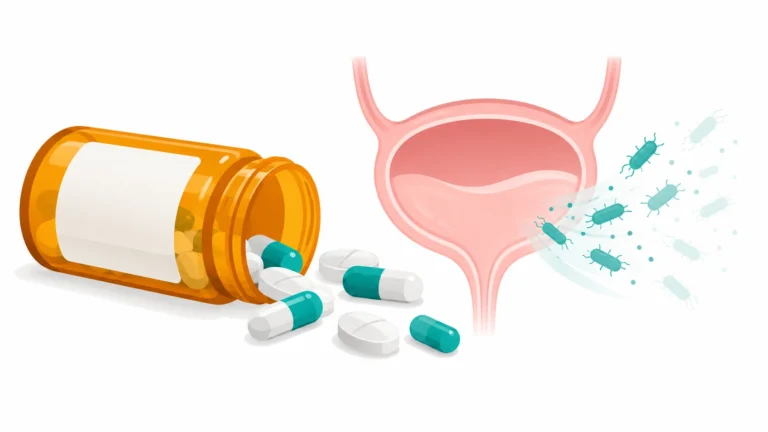
With the right antibiotic, a simple bladder infection clears quickly. GoodRx notes relief often starts 1 to 2 days after the first dose, and the Urology Care Foundation, the patient arm of the American Urological Association (AUA), says pain and urgency often get better within a day or two. The burning tends to fade first. The urge to pee and the pressure low in the belly can take a bit longer.
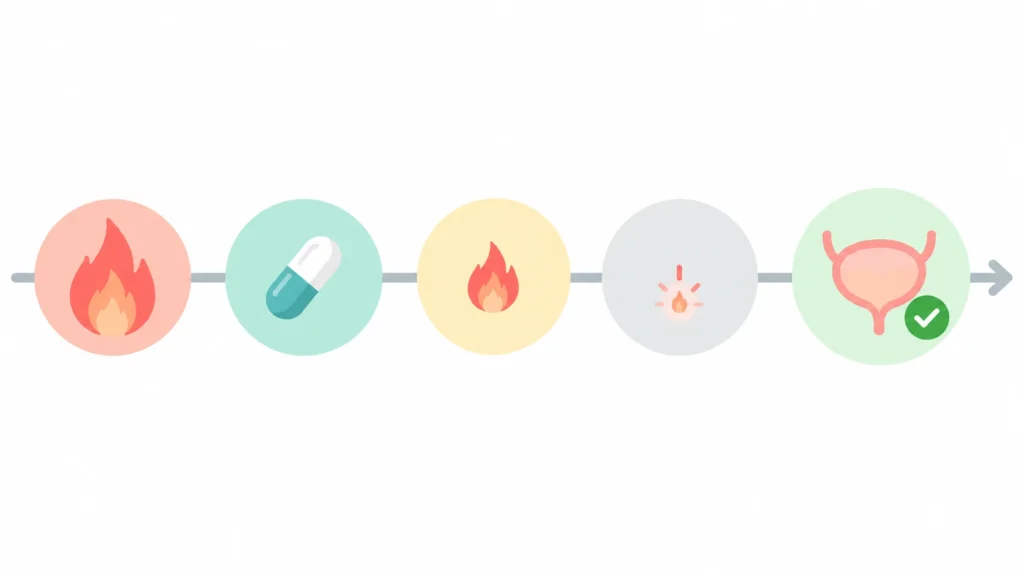
Day-by-day timeline
The clearest numbers come from a 2015 trial in the BMJ that followed 494 women with a simple bladder infection. Among women who took a single dose of the antibiotic fosfomycin, 56% were symptom-free by day 4 and 82% by day 7. Across the whole trial, symptoms lasted an average of 5.6 days.
| When | What to expect |
|---|---|
| Before the first dose | Usually the worst stretch, as burning, urgency and pressure build |
| First 24 hours of treatment | The antibiotic starts working, but you may not feel much change yet |
| Day 1 to 2 | Burning and urgency start to ease for most people |
| Day 3 to 4 | Symptoms are mild or gone for many; about half are fully symptom-free by day 4 |
| Day 7 | About 8 in 10 are symptom-free |
| After the last dose | A few leftover twinges can linger for several days |
How long does a UTI take to develop in the first place? There’s no fixed incubation period. It depends on how many bacteria reach the bladder and how fast they multiply. Most people first notice a slight sting or a little more urgency than usual, and the infection builds from there.
How long the antibiotic course runs
Courses for simple UTIs are now short. The length depends on the drug and on who you are:
| Situation | Usual course |
|---|---|
| Bladder infection in a non-pregnant woman | 1 dose (fosfomycin), 3 days (TMP-SMX), 5 days (nitrofurantoin) or 3 to 7 days (beta-lactams) |
| Bladder infection in a man without fever | 7 days |
| Bladder infection in pregnancy | 3 to 7 days |
| Kidney infection or complicated UTI | 5 to 7 days of a fluoroquinolone, or about 7 days of another antibiotic |
Take every dose, even after you feel fine, since stopping early can let the infection come back. Our guide to antibiotics for a UTI compares the drugs, their side effects and why some courses are shorter than the label.
Why some symptoms linger after the last pill
A short course doesn’t mean every symptom disappears the day you finish it. The A.D.A.M. Medical Encyclopedia, published by UF Health, says that if you feel ill or have a low fever or back pain, those symptoms take 1 to 2 days to improve and up to a week to go away completely. A little leftover irritation for a few days is common. Burning that stays the same or gets worse is not, and it’s a reason to call your prescriber. Once every symptom is gone after a simple UTI, you usually don’t need another urine test to prove it, according to the Urology Care Foundation.
Can a UTI go away on its own?
Sometimes, yes. A mild bladder infection can clear without antibiotics, and UnityPoint Health’s Dr. Mark Newton says a bladder infection can get better on its own. But it happens less often than most people hope, and there’s no way to know ahead of time whose infection will clear and whose will spread.
What the studies show
Three kinds of research give a realistic picture:
- About a third get better within 7 to 10 days. A 2020 systematic review in the British Journal of General Practice pooled 3 trials in which women with a simple UTI took a placebo. About a third improved or were symptom-free within 7 to 10 days, and the highest figure in any study was 42% by day 9. Most of the improvement happened in the first 9 days.
- Antibiotics more than double the odds. InformedHealth.org, run by Germany’s Institute for Quality and Efficiency in Health Care, reports that about 26 in 100 women on placebo were symptom-free after a week, compared with about 60 in 100 on antibiotics.
- Waiting costs extra days and a small risk. In the 2015 BMJ trial, women given ibuprofen instead of an antibiotic had more symptoms. Only 39% were symptom-free by day 4 and 70% by day 7. Two-thirds never needed an antibiotic, but 5 developed a kidney infection, compared with 1 in the antibiotic group.
The same review found that up to 39% of women still hadn’t improved after about 6 weeks without treatment, and roughly another third needed antibiotics for worsening symptoms along the way.
Who shouldn’t wait it out
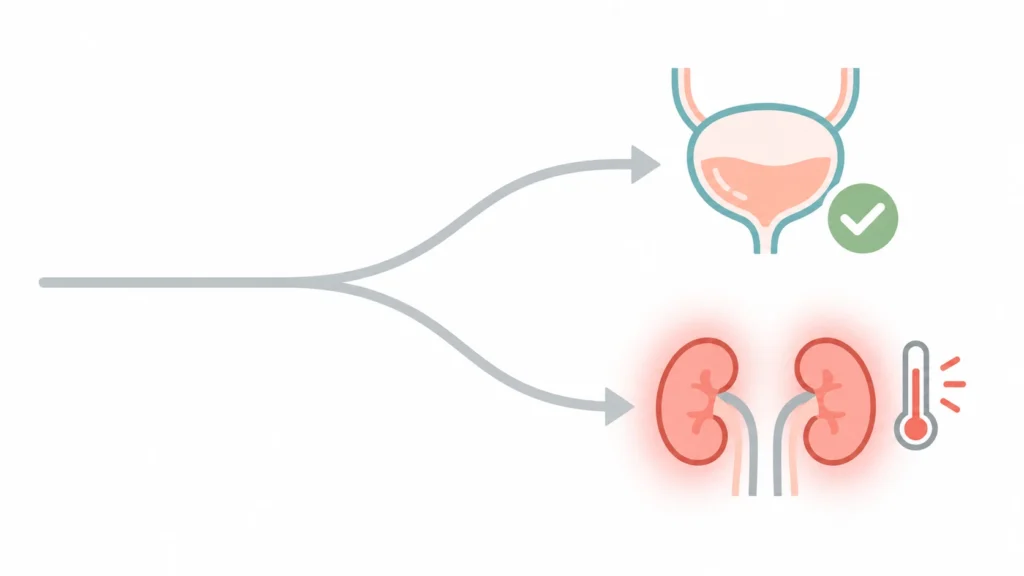
The NHS says a doctor may sometimes suggest waiting 48 hours before starting antibiotics, in case symptoms settle. That’s a decision to make with a clinician, and it only suits healthy women with mild symptoms. Get treatment without delay if any of these apply:
- Fever, chills, back or side pain, nausea or vomiting
- You’re pregnant
- You’re a man
- The patient is a child, or an older adult who is frail or confused
- You have diabetes, a weak immune system, a catheter or kidney problems
- You see blood in your urine
- Symptoms are getting worse, or aren’t better after 48 hours
How long does a UTI last without antibiotics?
Anywhere from a few days to many weeks. GoodRx says a simple UTI can last up to a week or longer without antibiotics, depending on how well your body fights it off. The trial data back that up: some women clear the infection within a week, while others still have symptoms a month and a half later. An internal medicine doctor at Norton Healthcare adds that an infection will likely last longer than usual if you don’t start antibiotics, and advises seeing a doctor for symptoms that go on longer than two to three days.
What happens if a UTI goes untreated
Many mild bladder infections settle down. The danger is the ones that don’t. Bacteria can climb from the bladder up the ureters to the kidneys and cause pyelonephritis, a kidney infection that brings fever, back or side pain and vomiting. In a small number of people, the infection then spreads into the blood and causes sepsis, a medical emergency.
GoodRx lists kidney damage among the possible results of an untreated or undertreated UTI. Serious complications were uncommon in the placebo trials, but they did happen, and they’re more likely in pregnancy, in men, in older adults and in people with diabetes or a weak immune system.
Untreated for 2 weeks or longer
If a UTI hasn’t cleared after two weeks, it’s unlikely to go away by itself soon. The 2020 review found that most of the improvement without antibiotics happened in the first 9 days, so symptoms still there at two weeks point to an infection that needs treatment. Book a visit, ask for a urine culture and mention how long the symptoms have lasted. Go the same day if you have a fever or back pain.
Signs your UTI is going away (and signs it isn’t)
Whether you’re on antibiotics or waiting 48 hours with a doctor’s okay, watch how your symptoms change from day to day:
| Signs it’s going away | Signs it’s getting worse |
|---|---|
| Peeing burns less or not at all | New fever, chills or shaking |
| The urge to pee settles and trips get less frequent | Pain in your back or side, below the ribs |
| Pressure low in the belly fades | Nausea or vomiting |
| Urine looks clearer and smells normal | New or more blood in urine |
| You feel more like yourself each day | No improvement 48 hours after starting treatment |
| Symptoms come back soon after you finish the antibiotic |
The NHS advises getting urgent help if symptoms don’t improve within 48 hours of starting treatment or get worse quickly. Confusion, drowsiness or trouble speaking need emergency care.
How long does a kidney infection last?
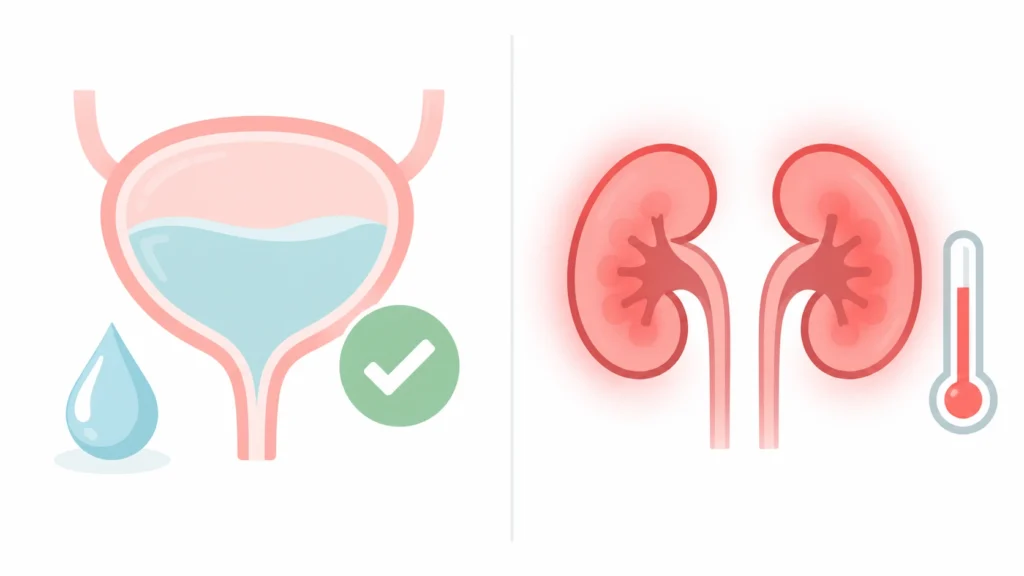
A kidney infection takes longer than a bladder infection to settle. In a study of 70 adults in the hospital with pyelonephritis, published in the American Journal of Medicine, the fever lasted a median of 34 hours after treatment began. About a quarter of patients still had a fever at 48 hours, and 13% at 72 hours. Norton Healthcare puts the time to feel better at closer to 3 to 7 days.
Under the Infectious Diseases Society of America’s 2025 guidance, most people need a 5 to 7 day course. People who are vomiting, can’t keep pills down or are seriously ill may need IV antibiotics in the hospital. If the fever hasn’t come down after about 3 days of treatment, call your doctor, as you may need a different drug or more tests.
How long a UTI lasts in men, pregnancy, older adults and children
Men. A UTI in a man is treated with a longer course, usually 7 days for a bladder infection without fever, and most men start to improve within 1 to 2 days of the right antibiotic, according to Harvard Health. There’s little evidence that a man’s UTI clears without treatment, and waiting raises the chance it reaches the prostate or kidneys. Our guide to UTIs in men covers prostate infections, which can take weeks of antibiotics.
Pregnancy. A UTI in pregnancy is always treated, with a 3 to 7 day course, because untreated infections can reach the kidneys and affect the pregnancy. Pregnant women are also checked for bacteria in the urine even without symptoms. Call your prenatal provider about any urinary symptoms.
Older adults. In older adults, a UTI may show up as new confusion, falls or weakness instead of burning. Bacteria in the urine with no symptoms are also common at older ages and usually don’t need antibiotics, which can make it hard to tell when a UTI has truly cleared. Our guide to bacteria in urine explains why a positive test alone isn’t proof of infection, and our guide to UTIs without pain covers the quieter signs.
Children. A child with a fever, pain when peeing, or new accidents should see a doctor the same day. Children shouldn’t be left to see if a UTI clears on its own.
Why won’t my UTI go away?
If your symptoms last longer than the timelines above, one of these is often the reason:
- The bacteria resist the antibiotic. Dr. Newton of UnityPoint Health notes your bacteria may have built resistance to the drug, and you’ll need more tests. A urine culture names the bacteria and the antibiotics that still work. Our guide to urinalysis results explains what those tests show.
- It isn’t a UTI. Vaginal infections, sexually transmitted infections and other conditions can feel the same. See our guides to UTI vs yeast infection and UTI vs STD.
- It’s a relapse or a new infection. Trials like the 2015 BMJ study count symptoms that return within 14 days as a relapse of the same infection, and later ones as a new UTI. A relapse may need a different antibiotic or a longer course.
- It’s a long-term UTI. The NHS describes long-term (chronic) UTIs in which short antibiotic courses may not work and urine tests may not show an infection, possibly because bacteria get into the bladder lining. If symptoms continue after treatment, ask for a referral to a specialist.
- Something keeps the infection going. Kidney stones, a bladder that doesn’t empty fully, an enlarged prostate or a catheter can let bacteria hang on.
If UTIs keep coming back, that’s a separate problem. The NHS and the AUA define recurrent UTIs as 2 in 6 months or 3 in a year, and the Urology Care Foundation says 20% to 40% of women who have one UTI will have another. Recurrent UTIs call for a doctor’s visit, a urine culture with each episode and a prevention plan.
Can you make a UTI go away faster?
The biggest time-saver is starting treatment sooner: get seen the same day through telehealth, urgent care or your own doctor, and take the first dose as soon as you have it. Pain relief, a heating pad and steady fluids can make the first day easier, but they don’t shorten the infection itself. Our guide on how to get rid of a UTI fast covers what helps while the antibiotic starts working and which home remedies don’t.
The bottom line
With antibiotics, a simple bladder infection usually eases within 1 to 2 days and is gone within a week. Without them, about a third of women improve within 7 to 10 days, but many don’t, and a few get a kidney infection. Kidney infections take longer, with the fever often breaking within 1 to 3 days. Men, pregnant women, children and anyone with fever or back pain shouldn’t wait. If a UTI isn’t better after 48 hours of treatment, or keeps coming back, see your doctor.
Frequently asked questions
What is the last stage of a UTI?
The most serious stage is sepsis. The CDC lists its warning signs as confusion, clammy or sweaty skin, extreme pain, fever or shivering, a racing heart and shortness of breath. Call 911 if these appear.
Can you flush out a UTI in 24 hours?
Not reliably. Drinking water dilutes urine and can ease the sting, and peeing often clears some bacteria, but it doesn’t kill an infection that has taken hold. Antibiotics are still the cure.
Should you avoid sex until a UTI clears?
It’s a good idea. GoodRx advises skipping sex while you have a UTI to avoid more irritation, and UnityPoint Health notes that sex moves bacteria closer to the urethra. Wait until your symptoms are gone.
What can be mistaken for a UTI?
Sexually transmitted infections, vaginal yeast infections, kidney stones and bladder irritation from certain foods or drinks can all feel similar. A urine culture helps tell a true UTI from these lookalikes.
Sources
- Hoffmann T, Peiris R, Del Mar C, Cleo G, Glasziou P. Natural history of uncomplicated urinary tract infection without antibiotics: a systematic review. British Journal of General Practice, 2020
- Gágyor I, et al. Ibuprofen versus fosfomycin for uncomplicated urinary tract infection in women: randomised controlled trial. BMJ, 2015
- InformedHealth.org (IQWiG). How effective are antibiotics in treating acute cystitis?
- Behr MA, et al. Fever duration in hospitalized acute pyelonephritis patients. American Journal of Medicine, 1996, via Relias Media
- NHS. Urinary tract infections (UTIs)
- Urology Care Foundation. Urinary Tract Infections in Adults, 2025
- American Urological Association. Recurrent Uncomplicated Urinary Tract Infections in Women: AUA/CUA/SUFU Guideline
- UF Health (A.D.A.M. Medical Encyclopedia). Urinary tract infection in women: self-care
- Gupta K, et al. International clinical practice guidelines for the treatment of acute uncomplicated cystitis and pyelonephritis in women: a 2010 update by the IDSA and ESCMID. Clinical Infectious Diseases, 2011
- Long B. Guideline Update: 2025 IDSA Management of Complicated UTI. emDocs, 2025
- Mayo Clinic. Urinary tract infection (UTI): Diagnosis and treatment
- Harvard Health Publishing. Men and urinary tract infections, 2025
- Centers for Disease Control and Prevention. About Sepsis
- GoodRx. How long does a urinary tract infection (UTI) last?, 2025
- Norton Healthcare. How long does a UTI last?, 2025
- UnityPoint Health. Can UTIs Go Away on Their Own?
Disclaimer
This blog is for informational and educational purposes only, and does not intend to substitute any professional medical advice or consultation. For any health related concerns, please consult with your physician, or call 911.