Types of Rashes and Skin Bumps: How to Identify What You Have
Most rashes come from skin irritation, allergies, eczema, hives or a passing infection, and they clear with simple care or a visit to a doctor. You can narrow down a rash by its look (flat, raised, blistered, scaly or ring-shaped), whether it itches or hurts, where it is, how fast it appeared and whether you feel sick. Most skin bumps, such as skin tags, cysts and lipomas, are harmless. Get emergency care for a rash with trouble breathing or swelling of the face or throat, or a rash that doesn’t fade when you press a glass against it.
Almost everyone gets a rash at some point, Cleveland Clinic notes. Some appear within minutes, others build over days, and a few hang around for months. The good news is that most are easy to manage once you know what you’re dealing with.
This guide walks through how to identify a rash, the most common types, rashes caused by infections and autoimmune disease, the bumps and lumps people find on their skin, home care, and the signs that mean you should see a doctor.
| Get emergency care right away for | See a doctor soon for |
|---|---|
| A rash with trouble breathing, or swelling of the face, lips, tongue or throat | A rash over most of your body |
| A rash that doesn’t fade under a pressed glass, mainly with fever or feeling unwell | A rash with fever or flu-like illness |
| A rash with confusion, a stiff neck or a severe headache | A rash that spreads fast, blisters or turns into open sores |
| Painful, hot, swelling skin that spreads quickly | A rash on the eyes, lips, mouth or genitals, or one that’s painful or looks infected |
Based on the American Academy of Dermatology (AAD), the NHS and Healthline.
What is a rash?
A rash is an area of irritated or swollen skin, according to MedlinePlus, the National Library of Medicine’s health site. Many rashes are itchy, red, painful and irritated, and some lead to blisters or patches of raw skin.
A rash isn’t a disease on its own. It’s a sign of something else, such as an irritating substance, an allergy, an infection or a long-term skin condition. MedlinePlus advises figuring out what kind of rash you have before you treat it, since the right care depends on the cause.
How to identify a rash: 6 questions to ask
Doctors don’t identify a rash from color alone. They look at a handful of clues together. You can do the same at home by asking these questions.
1. What does it look like?
Cleveland Clinic lists the many forms a rash can take: dry, blistering, blotchy, flaky or scaly, hive-like welts, inflamed or swollen. A few patterns point in a clear direction:
- Raised welts that come and go: hives
- Dry, scaly, thick patches: eczema or psoriasis
- A ring with a clearer center and a raised edge: often ringworm, a fungal infection
- Clusters of fluid-filled blisters: shingles, chickenpox, poison ivy or contact dermatitis
- Honey-colored or golden crusts: impetigo, a bacterial infection
- Tiny red or purple dots that don’t fade when pressed: bleeding under the skin, which needs urgent care
2. Does it itch, burn or hurt?
Itching points toward allergies, eczema, hives, scabies or a fungal rash. Pain is more typical of shingles, cellulitis and other infections. The AAD lists a painful rash as one of its signs to see a doctor.
A rash that doesn’t itch isn’t automatically harmless, so weigh the other clues too.
3. Where is it, and is it on one side?
Location gives strong clues:
- Where something touched your skin, such as a watch strap, a new detergent or a plant: contact dermatitis
- Inside the elbows, behind the knees, on the neck or face: eczema
- Elbows, knees, scalp and lower back: psoriasis
- A band or stripe on one side of the body or face: shingles
- Between the fingers, worse at night: scabies
- Across both cheeks and the bridge of the nose: possible lupus
- Sun-exposed skin only: a sun-sensitive rash, lupus or some medicines
4. How fast did it appear, and do you feel sick?
A rash that shows up soon after a new food or medicine may be an allergic reaction, Medical News Today notes. Contact dermatitis appears hours to days after contact, Healthline says. Shingles often starts with pain, itching or tingling several days before the rash shows up, according to the CDC.
How you feel matters most. The AAD says a rash with fever or illness, or one that spreads rapidly, needs medical attention.
5. Have you started anything new?
Think back over the past few days and weeks. New medicines, soaps, laundry detergent, lotions, cosmetics, jewelry, clothing dyes, foods and plants can all trigger a rash. Healthline advises stopping any new cosmetics or lotions that may have caused it.
6. How does it look on your skin tone?
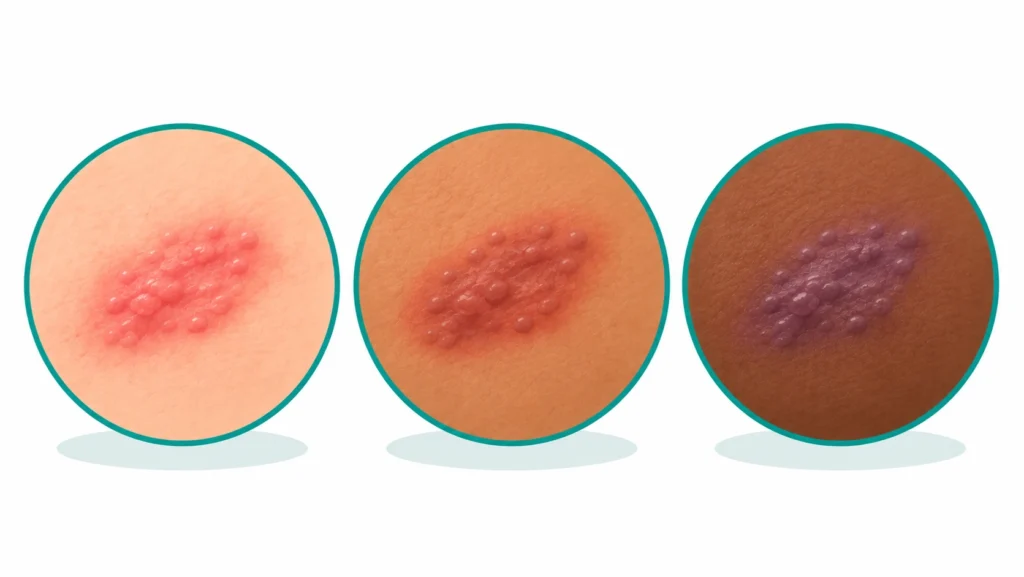
Many rash photos online show light skin, where rashes look red or pink. On brown and Black skin, the same rash can look different:
- Healthline notes that rashes such as contact dermatitis and eczema can look brown, purple or gray on darker skin tones, or may barely show
- The AAD says hives on brown or Black skin are often close to the natural skin tone, and heavy swelling can make them look white
- Mayo Clinic notes that the lupus butterfly rash is harder to see on Black or brown skin
- The NHS advises checking paler areas, such as the palms, soles of the feet and the inside of the eyelids, when looking for a meningitis rash on darker skin
On darker skin, texture, swelling, warmth and itch can tell you more than color.
Common types of rashes
This table covers the rashes doctors see most often. Each one has more detail below.
| Rash | What it looks like | Usually itchy? | Common places |
|---|---|---|---|
| Contact dermatitis | Red or dark patches with clear borders where skin touched something; may blister and ooze | Yes | Anywhere skin touched the trigger |
| Eczema | Dry, scaly, cracked patches; can ooze or thicken | Yes, often intensely | Inner elbows, behind knees, neck, face, hands |
| Hives | Raised welts from pinhead to dinner-plate size that move around | Yes | Anywhere |
| Psoriasis | Thick, well-defined scaly plaques, silvery on light skin | Sometimes | Elbows, knees, scalp, lower back |
| Heat rash | Small, raised, itchy or prickly spots | Prickly | Covered, sweaty skin |
| Drug rash | Spots or hives after a new medicine | Often | Anywhere |
| Ringworm | Scaly ring with a clearer center | Yes | Body, groin, feet, scalp |
| Shingles | Painful blisters in a stripe on one side | Burns or tingles | Torso, face |
| Scabies | Small, intensely itchy bumps and thin lines | Yes, worse at night | Between the fingers and elsewhere |
Based on Healthline, Cleveland Clinic, the AAD, the CDC, the NHS and American Family Physician.
Contact dermatitis
Contact dermatitis is a common type of rash, MedlinePlus says. You get it where you touched an irritant, such as a chemical, or something you’re allergic to, like poison ivy. Cleveland Clinic lists fragrances, preservatives, nickel in costume jewelry and poison ivy as common allergens, and soaps, detergents and household cleaners as common irritants.
Healthline describes the rash as having visible borders where your skin met the substance. It’s usually itchy, scaly or raw and may have blisters that weep, ooze or crust.
Eczema (atopic dermatitis)
Eczema often starts in infancy and tends to run in families, Cleveland Clinic says. People with asthma or allergies are more likely to have it. The NHS describes itchy, dry, cracked skin, often behind the knees, at the elbows or on the neck. Forefront Dermatology adds that long-term scratching can leave skin thick and leathery.
Hives
Hives (urticaria) are raised spots or patches that can be as small as a pinhead or larger than a dinner plate, according to the AAD. When you press on a hive, it turns pale. Each hive usually disappears within 24 hours, but new ones can appear, so the rash seems to move around. Triggers include allergies, infections, medicines, sun, exercise and stress, WebMD notes. Insect stings can cause hives and swelling too, and Cleveland Clinic notes the swelling from a wasp sting can last for days.
Deep swelling, called angioedema, can come with hives. The AAD advises going to urgent care or an emergency room for swelling of the face, tongue or throat, since breathing or swallowing problems can come on quickly.
Psoriasis
Psoriasis is a lifelong condition that causes a thick, scaly rash, Cleveland Clinic explains. Healthline describes sharply defined patches that look silvery on light skin or darker on dark skin. They often form on the scalp, elbows, knees and lower back.
Heat rash
Heat rash, or prickly heat, causes small, raised spots that feel itchy or prickly, according to the NHS. It happens when sweat gets trapped under the skin. Keeping the skin cool usually lets it settle. If your rash is on your belly, our guide to a rash on your stomach sorts the common causes by where they show up.
Drug rashes
Medicines can cause rashes as a side effect or as an allergic reaction, Medical News Today notes, often with hives, itchy skin or swelling. Antibiotics are a common example; our guide to antibiotics for UTI lists rash among their side effects. Tell your doctor about any rash on a new medicine. A drug rash that blisters, peels or involves the mouth or eyes needs emergency care.
Rashes caused by infections
Bacteria, viruses, fungi and tiny mites can all cause rashes. Infection rashes are more likely to come with fever, pain or feeling unwell.
Fungal rashes: ringworm and yeast
Ringworm isn’t a worm. It’s a fungal infection called tinea. A review in American Family Physician describes it as a red, ring-shaped, scaly, itchy patch with a clearer center and an active border. It’s often confused with eczema, psoriasis and seborrheic dermatitis.
That mix-up matters. The same review notes that a ring-shaped rash that gets worse after using a steroid cream, such as hydrocortisone, should raise suspicion of a fungal infection. If you’re not sure, ask a doctor or pharmacist before reaching for a steroid.
Yeast (candida) can also cause skin rashes, Medical News Today notes. A vaginal yeast infection is one common form; our guide to UTI vs yeast infection explains how to tell them apart.
Bacterial rashes: impetigo and cellulitis
Impetigo causes sores that burst and leave crusty, golden-brown patches, often around the nose, mouth or hands, the NHS says. Healthline notes it’s most common in children ages 2 to 5.
Cellulitis is a deeper skin infection that often develops on the lower legs. Healthline describes painful, swollen skin that feels hot and tender and spreads quickly. On darker skin it can look brown, gray or purple rather than red. It needs prompt medical care.
The AAD lists these signs that any rash may be infected: pus, yellow or golden crusts, pain, swelling, warmth or an unpleasant smell.
Many viral illnesses cause a rash. A few to know:
- Shingles: a painful, often itchy, blistering rash that usually appears in a single stripe on the left or right side of the body, or on one side of the face, according to the CDC. Blisters crust over in 7 to 10 days, and the rash clears in 2 to 4 weeks. The CDC warns that shingles on the face can affect the eye and cause vision loss.
- Chickenpox: itchy spots that turn into blisters, then scabs (NHS)
- Measles: cold-like symptoms and small white spots inside the mouth, then a blotchy rash that starts on the face (NHS)
- Slapped cheek syndrome (fifth disease): a red rash on one or both cheeks after a few days of cold symptoms, mostly in children (NHS)
- Hand, foot and mouth disease: blisters on the hands and feet with mouth ulcers, mostly in young children (NHS)
Bites and mites: scabies
Scabies is caused by tiny mites that burrow into the skin. The NHS describes intensely itchy raised spots, often between the fingers, that are usually worse at night. Healthline adds that symptoms can take 2 to 5 weeks to appear and may include thin raised lines on the skin. Flea bites look different: Cleveland Clinic says they often appear in a line or cluster on the feet, calves and ankles. See how to tell flea bites and mosquito bites apart.
How to tell a fungal rash from a bacterial one
Appearance gives clues:
| Fungal rash | Bacterial rash | |
|---|---|---|
| Shape | Rings or patches with a raised, scaly edge | Crusts, pus bumps, or spreading redness |
| Feel | Itchy | Tender, warm or painful |
| Color clues | Clearer center | Yellow or golden crusts |
| Response to steroid cream | Often worse | Not the right treatment |
Looks can fool even experts, and smelly pits on the soles that seem fungal can turn out to be pitted keratolysis, a bacterial infection. When the cause isn’t clear, a doctor can scrape a little skin and check it under a microscope with a KOH test, the AFP review explains.
Autoimmune rashes, including lupus
Some rashes are a sign that the immune system is attacking the body’s own tissues. The best known is the lupus rash.
Lupus is an autoimmune disease. One common sign is a red, butterfly-shaped rash across the nose and cheeks, according to the Office on Women’s Health. Mayo Clinic notes that many, but not all, people with lupus get this rash, that it often appears after sun exposure, and that it’s harder to see on Black or brown skin.
Other skin signs of lupus include rashes on sun-exposed skin such as the face, arms and hands, patchy hair loss, and fingers and toes that turn white or blue in the cold or during stress, Mayo Clinic and the Office on Women’s Health report.
Psoriasis and eczema are also linked to the immune system. A rash on the face with joint pain, tiredness, fever or sun sensitivity is worth checking with a doctor, who may order blood tests.
Skin bumps and lumps: what they usually are
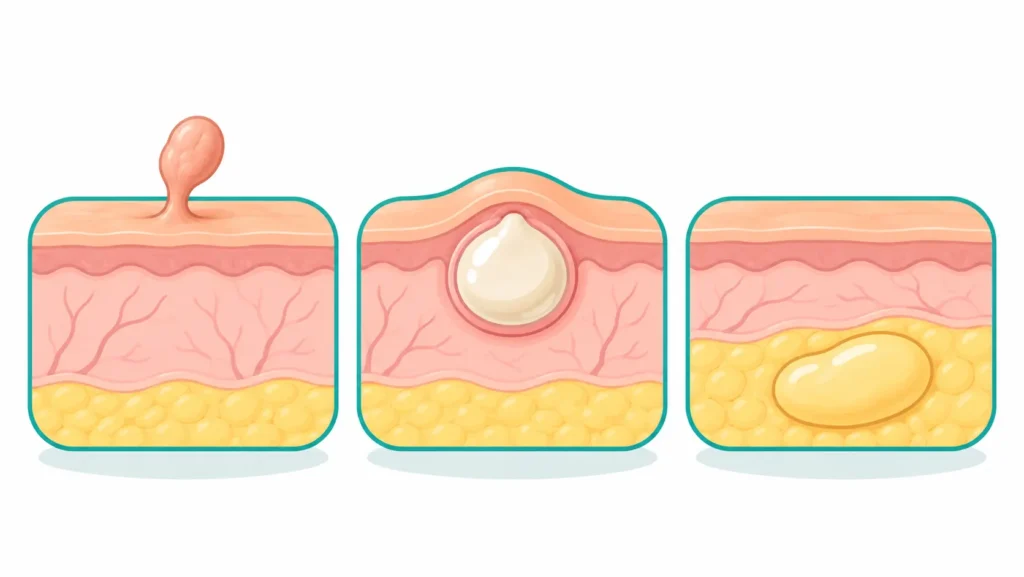
Not every spot is a rash. Single bumps and lumps under the skin are common, and most are harmless. This table is based on WebMD’s guide to skin lumps and bumps and Cleveland Clinic.
| Bump | What it’s like | Where | When to see a doctor |
|---|---|---|---|
| Skin tag | Small flap of skin with a bulge at the end | Neck, armpits, groin | If it bleeds, hurts or is irritated |
| Skin cyst | Small, flesh-colored sac under the skin, filled with soft keratin | Anywhere | If it gets red, painful, swollen or leaks |
| Lipoma | Soft, rubbery, round lump of fat that moves under the skin | Neck, shoulders, back, arms | If it grows fast, gets hard or fixed, or hurts |
| Wart | Rough bump caused by HPV; spreads by touch | Hands, feet, face, limbs | If it hurts, spreads, bleeds or is on the face or genitals |
| Keratosis pilaris | Tiny rough, sandpaper-like bumps, white or red | Upper arms, thighs, buttocks | Rarely needed |
| Folliculitis | Small red bumps or pimples around hair follicles | Neck, thighs, armpits, buttocks | If it’s painful or blisters; a doctor can prescribe antibiotics |
| Blood-filled pimple | Red, swollen pimple filled with blood, often after it’s squeezed or picked | Anywhere | If it shows signs of infection, keeps bleeding or won’t heal |
| Seborrheic keratosis | Thick, waxy, “pasted-on” bumps | Anywhere | If it looks like it could be skin cancer |
| Cherry angioma | Tiny bright red spots or bumps | Anywhere | If one turns dark brown or black |
| Dermatofibroma | Small, firm, reddish-brown bump | Legs | Any new spot is worth showing |
| Keloid | Raised scar that grows past the wound | Earlobes, shoulders, chest | If it’s large or itchy |
| Swollen lymph node | Pea-size or larger lump that shrinks as an infection clears | Neck, armpits, groin | Swollen 2 weeks or more, hard, growing, near the collarbone |
| Mole | Flat or slightly raised round spot, often brown or black | Anywhere | If it changes size, shape or color, bleeds or itches |
Cleveland Clinic says lipomas affect about 1 in 1,000 people and are most often found in adults ages 40 to 60. Most are under 2 inches across.
When a lump needs a doctor
Most lumps turn out to be harmless, says Dr. Nathan Mesko, an orthopedic oncologist at Cleveland Clinic, but it’s always smart to get them checked. He lists these warning signs:
- Pain, bleeding, redness, warmth, hardness or an open sore
- Fast growth or a change in how it looks
- A lump that lasts more than a few weeks
- A lump larger than 2 inches, about the size of a golf ball, or one that keeps growing
- Any lump on a breast or testicle
Cancerous lumps often start small and painless and grow steadily over weeks or months, Dr. Mesko notes. WebMD adds that swollen lymph nodes with weight loss, night sweats, fever or tiredness need a doctor’s visit.
How doctors find the cause
Your doctor will look at the rash, ask about your symptoms and take a medical history, Cleveland Clinic explains. Healthline adds that they may ask about your diet, new products, medicines and hygiene habits. Tests may include:
- Skin biopsy: a small sample of skin checked in a lab
- Allergy tests: prick testing, helpful for hives, and patch testing, helpful for allergic contact dermatitis
- Blood tests: for antibodies or signs that a rash is part of a wider illness
- Skin scraping (KOH test): to look for fungus
If the cause isn’t clear or the rash keeps coming back, a board-certified dermatologist can help.
How to treat a rash at home
Treatment depends on the cause, but these steps from Healthline and Cleveland Clinic ease most mild rashes:
- Wash with a mild, fragrance-free cleanser instead of scented bar soap
- Use warm water, not hot
- Pat the skin dry instead of rubbing it
- Don’t scratch; scratching can break the skin and let germs in, Cleveland Clinic warns
- Stop using any new cosmetic, lotion or product that may have triggered the rash
- Apply an unscented moisturizer to dry, eczema-prone skin
- Try an over-the-counter hydrocortisone cream for itchy, non-infected rashes, or calamine lotion for chickenpox and poison ivy
- Soak in a lukewarm colloidal oatmeal bath for itchy eczema or psoriasis
- Take an oral antihistamine to calm itching from hives and allergies
- Use cold compresses on mild contact rashes
Skip steroid creams on a rash you think might be ringworm. If a rash isn’t improving with home care, see a doctor. Prescription options include stronger steroid creams or pills, medicines such as tacrolimus and pimecrolimus, and treatments that calm the immune system, Cleveland Clinic says.
When to see a doctor about a rash
The AAD lists six signs that a rash needs medical attention:
- A rash over most of your body
- A rash that blisters or turns into open sores or raw skin
- A fever or illness with a rash
- A rash that spreads rapidly
- A painful rash
- A rash involving the eyes, lips, mouth or genital skin
Also see a doctor for a rash that looks infected, one that doesn’t clear within a few days, or one that comes with joint pain, a sore throat, red streaks near the rash or a recent tick or animal bite, Healthline advises.
Call 911 or go to the ER for:
- Trouble breathing, a tight throat, or swelling of the face, lips, tongue or throat
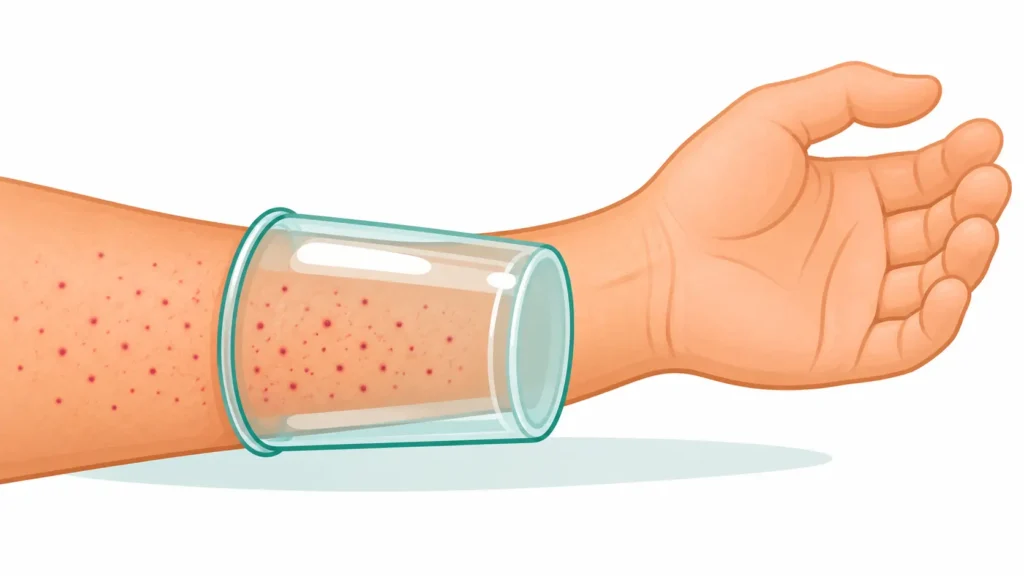
- A rash that doesn’t fade when you press the side of a clear glass firmly against it. The NHS explains that a meningitis rash starts as small red pinpricks and spreads into red or purple blotches. Check paler areas such as the palms and soles on darker skin
- A rash with confusion, a stiff neck, a severe headache, dizziness or a fever of 100.4°F (38°C) or higher
- Painful, swollen, hot skin that spreads quickly
- A blistering or peeling rash after starting a new medicine
- Shingles near the eye
The bottom line
Rashes have many causes, but most fall into a few groups: irritation and allergies, long-term conditions like eczema and psoriasis, hives, infections and, less often, autoimmune disease. Looking at the shape, itch, location, timing and how you feel will narrow it down, and on brown or Black skin, texture and swelling often say more than color. Most skin bumps are harmless, but a lump that grows, hardens, lasts for weeks or is bigger than 2 inches needs a check. Gentle skin care handles most mild rashes. A rash with fever, fast spread, blisters, pain or one that doesn’t fade under a glass needs a doctor, sometimes right away.
Frequently asked questions
Should I cover a rash or let it breathe?
Healthline suggests letting a rash breathe and keeping clothing off it when you can. Ask your doctor how to care for open or weeping sores, which sometimes need a dressing.
What vitamin deficiency causes skin rashes?
One example is pellagra, caused by too little niacin (vitamin B3). MedlinePlus lists scaly sores, mainly on sun-exposed skin, among its symptoms. It can come from diet or from trouble absorbing the vitamin.
Are rashes contagious?
It depends on the cause. Rashes from viruses, bacteria, fungi or scabies can spread through contact or shared items. Rashes from allergies or irritation are your own skin’s reaction, so they don’t pass to others.
How long does a rash last?
According to the AAD, a rash can take days or even weeks to heal. MedlinePlus adds that most rashes clear up fairly quickly, but some last a long time and need ongoing treatment.
Sources
- American Academy of Dermatology. Rash 101 in adults: When to seek medical treatment
- American Academy of Dermatology. Hives: Signs and symptoms
- Cleveland Clinic. Skin Rash: Types, Symptoms, Causes, Diagnosis and Treatments, 2020
- Cleveland Clinic. Lipomas
- Cleveland Clinic Health Essentials. Should You Worry About the Lump Under Your Skin? 2025
- MedlinePlus. Rashes
- MedlinePlus. Pellagra
- Centers for Disease Control and Prevention. Shingles Symptoms and Complications
- NHS. Meningitis symptoms
- NHS. Rashes in babies and children
- Mayo Clinic. Lupus: Symptoms and causes
- Office on Women’s Health. Lupus symptoms
- Ely JW, Rosenfeld S, Seabury Stone M. Diagnosis and Management of Tinea Infections. American Family Physician, 2014
- Healthline. Everything to Know About Rashes (with Pictures)
- WebMD. Lumps and Bumps: What’s on My Skin? 2025
- Medical News Today. What is causing my rash?
- Forefront Dermatology. Chronic Rashes, 2026
- Cleveland Clinic. Flea Bites: What They Look Like, Symptoms & Treatment, 2021
Disclaimer
This blog is for informational and educational purposes only, and does not intend to substitute any professional medical advice or consultation. For any health related concerns, please consult with your physician, or call 911.