Red Circle on Skin Not Itchy? 11 Rashes That Look Like Ringworm but Aren’t
A red circle on the skin that doesn’t itch is often granuloma annulare, a harmless ring of smooth bumps, or the early rash of Lyme disease, which feels warm but rarely itches. Pityriasis rosea, a medicine reaction, secondary syphilis and a few other conditions can also form rings. Ringworm, the fungal infection most people suspect first, is often itchy and has a scaly edge. See a doctor soon for any ring that appears after a tick bite, comes with fever or aches, or keeps growing.
A ring on the skin catches the eye, and most people assume ringworm. But many round rashes look alike, and they need different care. An antifungal cream won’t help granuloma annulare, and a steroid cream can make ringworm worse.
This guide covers how to tell ringworm from its look-alikes, 11 rashes that form rings or round patches, small round dry patches, red dots that aren’t circles, the rare times a rash points to cancer, and when to see a doctor. For a wider look at every kind of rash, see our guide to types of rashes and skin bumps.
| Rash | Itch | Best clue |
|---|---|---|
| Ringworm | Often itchy | Scaly, raised edge with a clearer center |
| Granuloma annulare | Rarely | Smooth ring of firm bumps, often on hands, feet, arms or legs |
| Lyme disease rash | Rarely | Grows over days, feels warm, 3 to 30 days after a tick bite |
| Pityriasis rosea | Not in everyone | One large patch first, then many smaller ovals on the trunk |
| Secondary syphilis | Usually not | Rough, red or reddish-brown spots, often on palms and soles |
| Erythema annulare centrifugum | Sometimes | Slowly widening ring with a fine scale inside the edge |
| Discoid lupus | Sometimes | Raised, scaly patches on the face, scalp or ears that can scar |
| Tinea versicolor | Can itch | Patches lighter or darker than your skin, upper body |
| Nummular eczema | Often intensely itchy | Coin-shaped spots on legs, forearms or hands |
| Hives | Itchy | Smooth welts that change shape and come and go |
Based on the American Academy of Dermatology (AAD), the CDC, the National Library of Medicine and Verywell Health.
Is it ringworm? How to tell
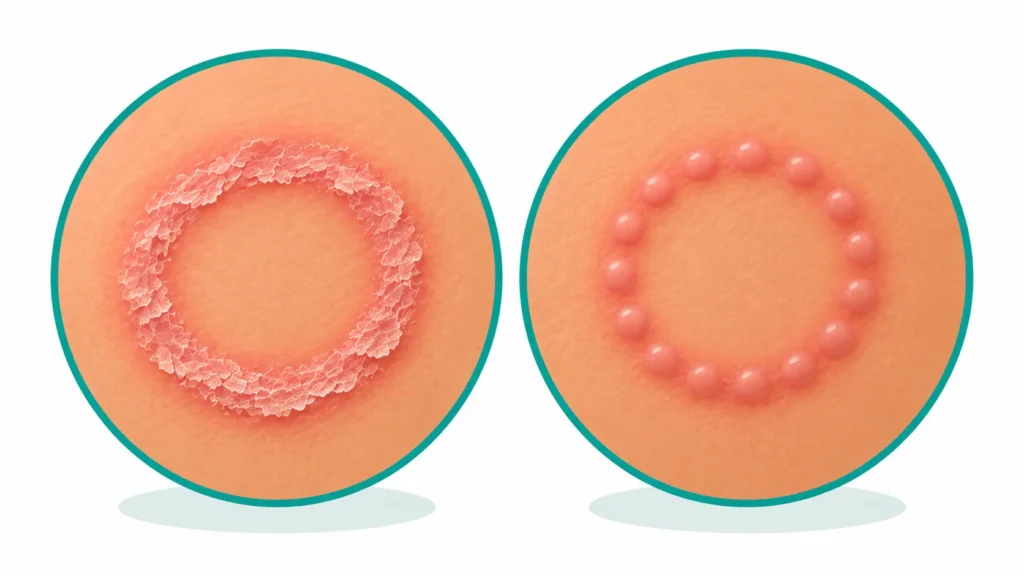
Ringworm isn’t a worm. It’s a skin infection caused by a fungus. On the body, the AAD describes roundish, flat patches with a raised, scaly border. The center often clears first, and the patches can slowly grow and spread to other areas.
Color depends on skin tone. The AAD says the patches tend to look red or pink on light skin and brown or gray on skin of color.
Ringworm is often itchy, and the itch can be intense. It spreads through skin-to-skin contact with infected people or animals, according to the CDC.
Why you shouldn’t guess with a steroid cream
The CDC warns against using steroid creams on rashes that could be ringworm, since steroids can make the infection worse. It advises doctors to test a suspected ringworm rash before treating it. If you aren’t sure what your ring is, skip the hydrocortisone and get it checked.
Rashes that look like ringworm but aren’t
Here are 11 conditions that form red circles, rings or round patches. The first six don’t usually itch, or don’t itch in everyone.
1. Granuloma annulare
Granuloma annulare (GA) is one of the most common reasons for a ring that doesn’t itch. The AAD describes a raised, ring-shaped patch that is often reddish but can be pink, violet or skin-colored. Small bumps often appear first and then join into a ring. It rarely causes pain or itch.
Nationwide Children’s Hospital describes the ring as clear in the center with a smooth, raised border. It often appears on the arms and legs, alone or in groups. GA is not infectious or contagious, and its cause is unknown.
Granuloma annulare vs. ringworm: Nationwide Children’s notes that GA is often mistaken for ringworm, but ringworm is usually scaly and itchy and GA is not. GA can also be confused with bug bites or a Lyme rash.
MedlinePlus says GA most often affects children and young adults and is slightly more common in females. Most cases clear without treatment within about two years, though rings can last for years and new ones can show up later.
2. Lyme disease rash (erythema migrans)
The Lyme disease rash is the round rash you shouldn’t wait on. Lyme disease is a bacterial infection spread by tick bites, and the CDC describes its rash this way:
- It starts at the site of the tick bite 3 to 30 days later, about 7 days on average
- It shows up in roughly 70% to 80% of infected people
- It grows over several days and can reach 12 inches (30 cm) or more across
- It may feel warm but is rarely itchy or painful
- It sometimes clears in the middle as it grows, making a bull’s-eye, but it doesn’t always look like a classic bull’s-eye
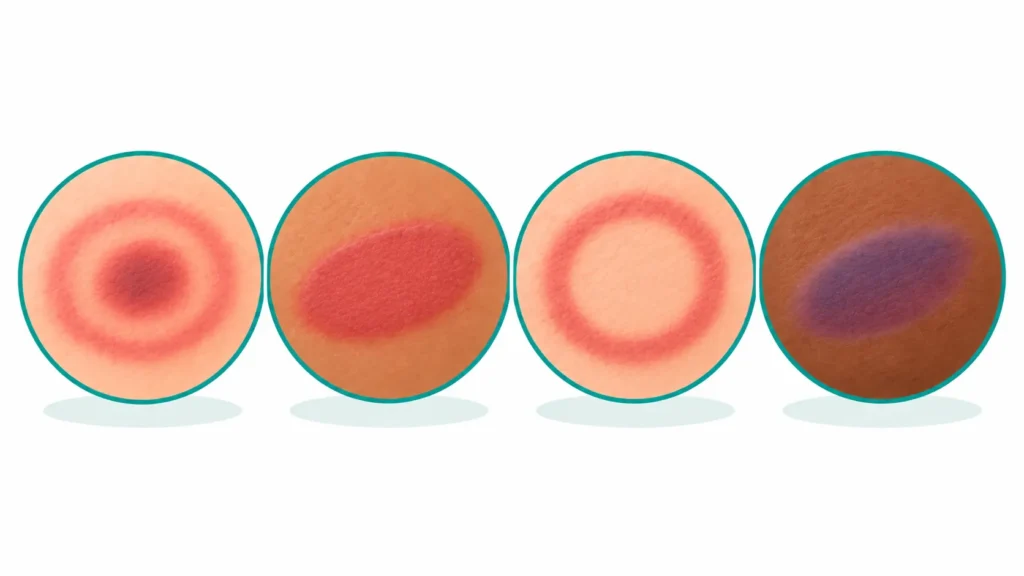
The CDC’s photo guide shows how varied the rash can be. Some are red ovals with no clear center, some have a crust in the middle, some look bluish, and some show up as several oval patches at once.
Other early Lyme symptoms include fever, chills, headache, tiredness, muscle and joint aches and swollen lymph nodes. Without treatment, the CDC says later signs can include more rashes, a drooping face, severe joint pain and swelling, and heart palpitations.
Bull’s-eye rash that isn’t Lyme: The CDC lists several rashes that can look like Lyme but aren’t. These include a large itchy reaction to an insect bite, a fixed drug reaction, ringworm, pityriasis rosea, granuloma annulare and hives.
3. Pityriasis rosea
Pityriasis rosea starts with one larger spot called the herald patch. The AAD says it is usually oval or round, slightly raised and about an inch across, though some reach 4 inches. It usually begins on the chest, belly or back. Within days to weeks, more patches spread out, and Mayo Clinic says they can line up in a shape like drooping pine-tree branches.
Not everyone gets itchy skin or flu-like symptoms, according to the AAD. When flu-like symptoms appear, they can include a sore throat, swollen lymph nodes or tiredness.
The AAD says it is most likely between ages 10 and 35, isn’t contagious, and is thought to be caused by a virus. The rash lasts 6 to 8 weeks, sometimes longer. If you’re pregnant and get it, tell your obstetrician.
4. Fixed drug eruption
A fixed drug eruption is a skin reaction to a medicine. The CDC says it can appear up to two weeks after a person takes the drug, and it comes back in the same place every time that medicine is taken again.
DermNet describes oval, well-defined red patches. The palms, soles and lips are common sites, and the spot often turns darker as it fades. If a round patch keeps returning in the same place, think about what you took before it showed up and tell your doctor.
5. Secondary syphilis
Syphilis is a sexually transmitted infection (STI). In its second stage, the CDC says the rash usually won’t itch and can be so faint you might not notice it. It can show up on the palms of the hands or the bottoms of the feet as rough, red or reddish-brown spots.
These symptoms go away whether or not you get treatment, but the infection doesn’t. The CDC warns that without the right treatment, syphilis moves into its later stages. Our guide to UTI vs STD explains how STI testing works.
6. Erythema annulare centrifugum
Erythema annulare centrifugum (EAC) is a less common ring-shaped rash. According to a StatPearls review from the National Library of Medicine, it starts as red bumps that spread outward while the center clears. A fine “trailing scale” sometimes sits just inside the moving edge.
The ring grows slowly, about 2 to 3 millimeters a day, and rarely gets wider than 4 inches. It may or may not itch and is most common on the thighs and legs. The cause is often unknown, though infections, medicines and other illnesses have been linked to it. It lasts about 11 months on average, and most cases clear on their own.
7. Lupus
Lupus is an autoimmune disease, and two of its skin forms can look like ringworm.
- Discoid lupus: the AAD describes raised, scaly patches, mostly on the face, scalp or ears. They can leave scars, and on the scalp the hair loss can be permanent. On skin of color, patches may leave dark or light spots as they fade. Verywell Health notes the rash is sometimes itchy.
- Subacute cutaneous lupus: some people get a ring-like rash after sun exposure, according to the AAD.
This is why “lupus rash looks like ringworm” is a common search. A scaly ring on the face or ears that doesn’t clear with antifungal cream, or one that flares after sun, is worth showing to a dermatologist.
8. Guttate psoriasis
Guttate psoriasis causes many small, round, red or pink spots, often on the arms, legs and torso. The National Psoriasis Foundation says each spot usually has a fine scale. It’s often triggered by a strep infection such as strep throat, often begins in childhood or young adulthood, and makes up about 8% of psoriasis cases.
9. Tinea versicolor
Tinea versicolor is a yeast infection of the skin. The AAD describes spots that are lighter or darker than the skin around them and may be rough and flaky. They can be white, pink, salmon, red, tan or brown, and small spots can join into larger patches.
The spots stand out more after you tan, since the yeast stops the skin from tanning. They can fade in cold weather and return when the air turns warm and humid. Verywell Health notes it isn’t related to poor hygiene and isn’t contagious.
10. Nummular eczema
Nummular eczema forms round to oval spots that look like coins. The AAD says they’re pink or red on lighter skin and brown, or lighter than the surrounding skin, on darker skin. They usually show up on the legs, forearms or backs of the hands, often on both sides.
Unlike most rashes on this list, nummular eczema itches, often intensely, and the itch can get worse when you try to sleep. The spots can last weeks or months.
11. Hives
Hives are raised welts that can be round or take other shapes, Verywell Health explains. They’re smooth rather than scaly, often come with sneezing or watery eyes when an allergy is the cause, and can clear quickly. Hives itch, so a ring that never itches is less likely to be hives.
Small round dry patches on skin that don’t itch
Searches for “small round dry patches on skin not itchy” are common. A few conditions above fit that description:
- Guttate psoriasis: many small round spots with a fine scale
- Tinea versicolor: rough, flaky spots lighter or darker than the skin, sometimes mildly itchy
- Pityriasis rosea: oval, slightly raised, scaly patches on the trunk
- Discoid lupus: scaly patches on the face, scalp or ears
One rare cause is worth knowing about. Mycosis fungoides, a slow-growing lymphoma of the skin, can start as a scaly rash that causes no other symptoms, according to Cleveland Clinic. It tends to appear on skin that doesn’t get much sun, like the lower belly, thighs, buttocks and chest, and it’s easy to mistake for eczema or psoriasis.
A dry, round patch that doesn’t respond to moisturizer or over-the-counter creams after a few weeks deserves a dermatology visit.
Red dots or spots, not a circle
Many people searching for a red circle on skin actually have small red spots or dots. Two common causes look nothing like a ring:
- Petechiae: Cleveland Clinic describes flat, pinpoint dots that are purple, red or brown. They aren’t itchy or painful. They often appear on the arms, legs, buttocks, belly, inside the mouth or inside the eyelids.
- Cherry angiomas: small, bright red spots about 1 to 5 millimeters wide, sometimes with a pale halo. Cleveland Clinic says they’re harmless, shouldn’t itch and show up in about half of adults after age 30.
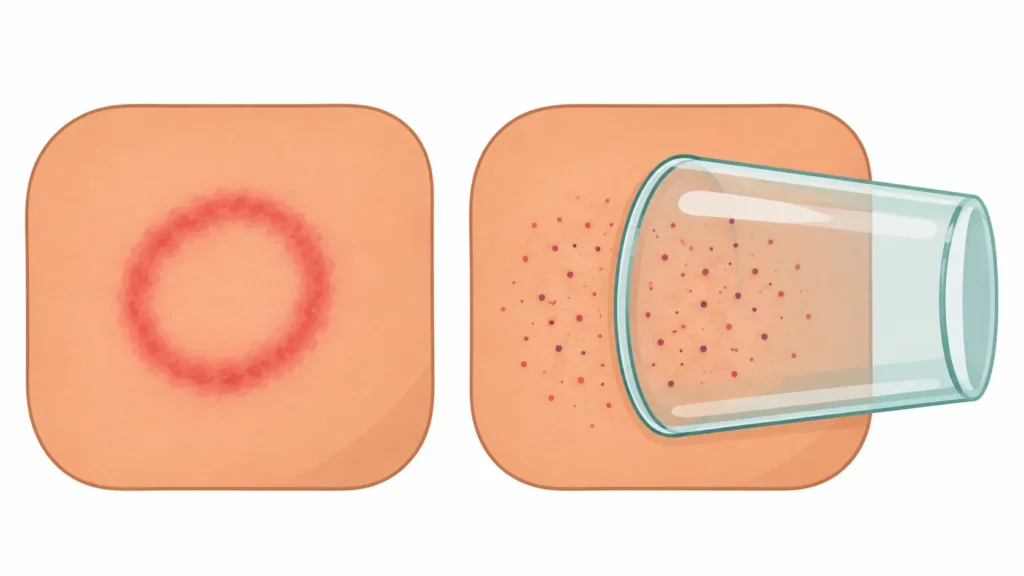
The press test
Petechiae don’t fade when you press on them. Cleveland Clinic explains that petechiae stay purple, red or brown under pressure, while a regular rash turns pale. You can press the side of a clear glass on the spots to check.
Petechiae can come from straining hard (coughing, vomiting, lifting), some medicines, infections such as strep throat with scarlet fever, low platelets or leukemia. Cleveland Clinic advises getting medical help right away if pinpoint red dots come with fever, confusion, dizziness, fainting or trouble breathing, or if they spread quickly.
Can a red circle or red spots be cancer?
Rarely. Most round rashes come from the conditions above. A few skin signs can point to blood or skin cancer:
- Leukemia: the American Cancer Society lists easy bruising, petechiae and bleeding among the signs of leukemia in children, caused by low platelets. When one type of leukemia (AML) spreads to the skin, it can cause a red or purple rash.
- Skin lymphoma: mycosis fungoides, covered above, is rare. Cleveland Clinic says providers diagnose about 3,000 people a year with cutaneous T-cell lymphomas, and about 70% have this type. Treated early, the 10-year survival rate is 95%.
The American Cancer Society notes that most of these symptoms are more likely caused by something other than cancer. Still, bruising you can’t explain, spots that keep appearing, tiredness, fevers or frequent infections need a doctor’s visit and blood work.
How doctors find the cause
Your doctor or dermatologist will look at the rash and ask when it started, whether it’s growing, what medicines you take, and whether you’ve been around ticks, pets or new sexual partners. From there, they may use:
- Skin scraping: the AAD explains that a dermatologist can scrape off a little skin and look at it under a microscope for fungus. MedlinePlus says this KOH test can tell granuloma annulare from a fungal infection.
- Skin biopsy: a small sample of skin checked in a lab, which MedlinePlus says may be needed to confirm granuloma annulare.
- Blood tests: for Lyme disease, syphilis, lupus or blood counts. For Lyme, the CDC says early blood tests can be falsely negative in the first few weeks, so a typical rash after a tick bite is treated right away.
Treatment depends on the cause
| Cause | Usual care |
|---|---|
| Ringworm | Over-the-counter antifungal cream twice a day for about 2 to 4 weeks; large areas may need a prescription (AAD) |
| Granuloma annulare | Often none needed; strong steroid creams or shots, or freezing, for those who want it gone (MedlinePlus) |
| Lyme disease | Antibiotics such as doxycycline for 10 to 14 days, or amoxicillin or cefuroxime for 14 days (CDC) |
| Pityriasis rosea | Usually clears on its own in 6 to 8 weeks (AAD) |
| Fixed drug eruption | Avoid the medicine that triggers it; it returns each time the drug is taken (CDC, DermNet) |
| Secondary syphilis | Treatment from a provider to stop it reaching later stages (CDC) |
| Erythema annulare centrifugum | Most cases clear on their own; steroid cream on the edge can help (StatPearls) |
| Discoid lupus | Creams, shots or pills that calm swelling; early scalp treatment can prevent scarring (Verywell Health, AAD) |
| Tinea versicolor | Antifungal medicine (Verywell Health) |
| Nummular eczema, guttate psoriasis | Prescription care from a dermatologist |
For mild rashes while you wait to see a doctor, Verywell Health suggests bathing in lukewarm water with a mild cleanser, using a fragrance-free lotion, wearing loose clothing and trying a cool compress or an oatmeal bath for itch. Avoid scratching or picking at the patch.
When to see a doctor
Make an appointment if:
- A ring appears after a tick bite or time outdoors in tick areas
- The ring keeps growing, changes shape or new ones appear
- You have fever, tiredness, joint aches or flu-like symptoms with it
- The area gets warm, painful, blistered or starts oozing
- A ring-shaped patch of bumps hasn’t gone away within a few weeks (MedlinePlus)
- Pityriasis rosea gets worse or hasn’t cleared in three months (Mayo Clinic)
- A scaly patch on your face, scalp or ears is leaving scars or hair loss
- A ring treated with antifungal cream isn’t improving
Get emergency care for:
- Trouble breathing, chest pain or swelling of the face, lips or throat with a rash, which Verywell Health says can mean a life-threatening allergic reaction
- Pinpoint red or purple dots that don’t fade when pressed, with fever, confusion, dizziness or fainting
- Spots that spread quickly
The bottom line
A red circle on your skin that doesn’t itch is often not ringworm. Granuloma annulare forms smooth, painless rings that clear on their own, while the Lyme rash grows over days after a tick bite and needs antibiotics. Pityriasis rosea, a medicine reaction, secondary syphilis, EAC, lupus, guttate psoriasis and tinea versicolor can also form rings or round patches. Ringworm itself is often itchy and scaly. Skip steroid cream until you know the cause, and see a doctor for a ring that grows, follows a tick bite, or comes with fever or aches. Tiny red dots that don’t fade when pressed are a different problem and need prompt care.
Frequently asked questions
Can it still be ringworm if it’s not itchy?
Yes. The AAD notes that ringworm in the groin can be itchy and painful, but not always. A skin scraping checked under a microscope is the surest way to know whether a ring is fungal.
Does ringworm live on bed sheets?
It can spread through them. The CDC lists shared towels and bedsheets as one route, and the AAD says the fungus can survive on objects for a long time, so wash bedding and towels in hot, soapy water.
Is ringworm caused by poor hygiene?
Not on its own. The CDC says anyone can get ringworm. Heavy sweating, shared showers or locker rooms, contact sports, tight shoes and close contact with infected animals raise the risk, as does a weak immune system.
Can stress cause red circles or spots on skin?
Stress is one trigger for hives, according to the AAD. Hives can form round welts, but they itch, and each one usually fades within 24 hours while new ones appear elsewhere.
Sources
- American Academy of Dermatology. Ringworm: Signs and symptoms
- American Academy of Dermatology. Ringworm: Diagnosis and treatment
- Centers for Disease Control and Prevention. Ringworm Basics
- American Academy of Dermatology. Granuloma annulare: Signs and symptoms
- MedlinePlus. Granuloma annulare
- Nationwide Children’s Hospital. Granuloma Annulare
- Centers for Disease Control and Prevention. Signs and Symptoms of Untreated Lyme Disease
- Centers for Disease Control and Prevention. Lyme Disease Rashes, 2024
- Centers for Disease Control and Prevention. Clinical Treatment of Erythema Migrans Rash
- American Academy of Dermatology. Pityriasis rosea: Signs and symptoms
- American Academy of Dermatology. Pityriasis rosea: Overview
- Mayo Clinic. Pityriasis rosea: Symptoms and causes
- DermNet. Fixed drug eruption
- Centers for Disease Control and Prevention. About Syphilis
- StatPearls. Erythema Annulare Centrifugum. National Library of Medicine
- American Academy of Dermatology. Lupus and your skin: Signs and symptoms
- National Psoriasis Foundation. Guttate Psoriasis
- American Academy of Dermatology. Tinea versicolor: Signs and symptoms
- American Academy of Dermatology. Nummular dermatitis: Signs and symptoms
- American Academy of Dermatology. Hives: Causes
- American Academy of Dermatology. Hives: Signs and symptoms
- Cleveland Clinic. Petechiae
- Cleveland Clinic. Cherry Angioma
- American Cancer Society. Signs and Symptoms of Childhood Leukemia
- Cleveland Clinic. Mycosis Fungoides
- Verywell Health. 9 Rashes That Look Like Ringworm But Aren’t, 2026
Disclaimer
This blog is for informational and educational purposes only, and does not intend to substitute any professional medical advice or consultation. For any health related concerns, please consult with your physician, or call 911.