Complete Blood Count (CBC): What the Test Shows and What Your Results Mean
A complete blood count (CBC) is a routine blood test that counts your red blood cells, white blood cells and platelets and measures hemoglobin and hematocrit. It helps find anemia, infection, bleeding problems and some blood cancers. You don’t need to fast for it. A result a little outside the normal range is common and often harmless, but a severely low white cell or platelet count, or a big drop in hemoglobin, need a doctor’s attention soon.
The CBC is one of the most common blood tests there is. It’s part of many yearly checkups, and doctors order it when you feel tired, run a fever or bruise easily. The report, with its rows of abbreviations and numbers, can be confusing.
This guide explains what a CBC blood test measures, each line on the report, the CBC with differential, normal ranges, what high and low results can mean, when a result is serious, whether a CBC can find cancer, and how to prepare.
What is a CBC blood test?
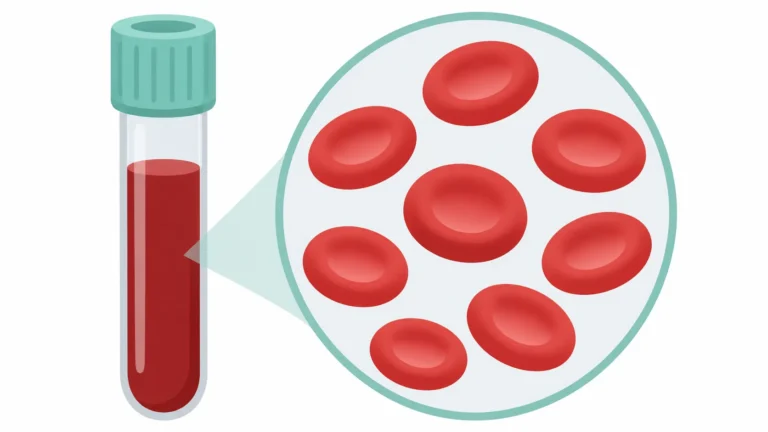
CBC stands for complete blood count. MedlinePlus describes it as a group of tests that measure the number and size of the different cells in your blood. You may also see it called a full blood count (FBC), a blood cell count or a hemogram.
Your blood carries three main types of cells, all made in the bone marrow:
- Red blood cells carry oxygen from your lungs to the rest of your body
- White blood cells fight infections and other diseases
- Platelets help your blood clot and stop bleeding
A machine counts these cells and measures their size. Cleveland Clinic notes that if anything looks unclear, a pathologist checks the sample under a microscope.
Why doctors order a CBC
According to Cleveland Clinic, a provider might order a CBC test:
- As part of a routine health exam, often alongside a urinalysis, a cholesterol test and other basic labs
- To look into symptoms such as fever, weight loss you can’t explain, night sweats, bruising, bleeding or fatigue
- To keep track of a long-term condition, like cancer or chronic kidney disease
- To see how a treatment or medicine is affecting your body
- To check your health during pregnancy
Mayo Clinic adds that it can help find the cause of weakness, swelling and pain.
What a CBC measures: your report, line by line
Most CBC reports list the same rows. Here’s what each one means, based on Cleveland Clinic’s guide.

Red blood cells, hemoglobin and hematocrit
| Report line | What it measures |
|---|---|
| RBC (red blood cell count) | The number of red blood cells in a set amount of blood, usually a microliter (mcL); one drop of blood is about 40 to 50 mcL |
| Hb or Hgb (hemoglobin) | The amount of hemoglobin, the iron-rich protein in red cells that carries oxygen |
| Hct (hematocrit) | The percentage of your blood made up of red blood cells |
Red cell indices: MCV, MCH, MCHC and RDW
These numbers describe the size of your red blood cells and how much hemoglobin they hold. They help doctors sort out what kind of anemia someone has.
| Report line | What it measures |
|---|---|
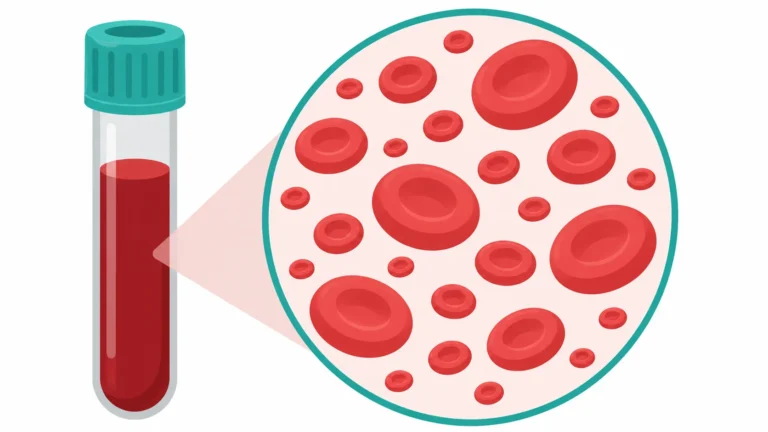
| MCV (mean corpuscular volume) | The average size of your red blood cells |
| MCH (mean corpuscular hemoglobin) | The average amount of hemoglobin in each red blood cell |
| MCHC (mean corpuscular hemoglobin concentration) | The average concentration of hemoglobin in a set amount of blood |
| RDW (red cell distribution width) | How much your red blood cells differ in size |
WebMD notes that a high MCV, meaning larger red cells, can happen with low vitamin B12 or folate, while smaller cells can point to a type of anemia. A low RDW means your red cells are close to the same size; a high one means a big gap between the largest and smallest. Our guide to what a high RDW means covers that number in detail.
White blood cells
The WBC (white blood cell count) is the total of all your white blood cells. A basic CBC reports only this total. A CBC with differential, covered below, breaks it into five types.
White blood cells in your blood are different from the white cells a urine test picks up. If your urine report flagged them, see our guide to white blood cells in urine.
Platelets and MPV
| Report line | What it measures |
|---|---|
| PLT (platelet count) | The total number of platelets in your blood sample |
| MPV (mean platelet volume) | The average size of your platelets |
When platelets run low, you may bruise or bleed easily. One sign is a rash of tiny red dots called petechiae that don’t fade when you press on them.
CBC with differential
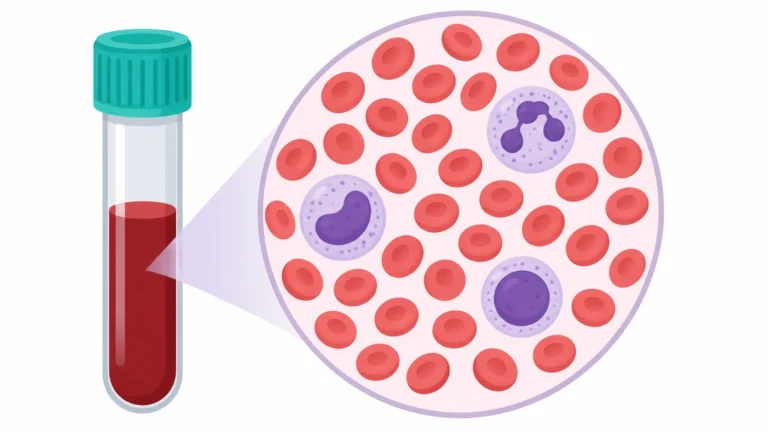
A CBC with differential, sometimes written “CBC w/ diff” or “CBC with auto differential,” also counts each type of white blood cell. Cleveland Clinic explains that this gives your provider more information about what’s happening with different immune cells. The “auto” means a machine did the count.

The five types, as Cleveland Clinic describes them:
| White cell type | What it does |
|---|---|
| Neutrophils | First responders that fight bacterial and fungal infections |
| Lymphocytes | Fight viral infections and help the immune system remember past infections |
| Monocytes | Clean up cell debris during an infection and alert other white cells to intruders |
| Eosinophils | Fight parasitic infections and play a part in allergic reactions |
| Basophils | Release histamine during allergic reactions |
A differential may also list immature granulocytes (white cells that aren’t fully developed) and nucleated red blood cells (immature red cells). Each type can appear as an absolute number, marked “abs,” or as a percentage of all your white cells.
CBC with or without differential? A CBC without differential gives only the total white cell count. Your doctor adds the differential when they need to know which types of white cells are high or low.
CBC normal ranges
Normal ranges vary by lab, so always compare your numbers to the reference range printed on your own report. These are the adult ranges Cleveland Clinic lists:
| Test | Normal range for adults |
|---|---|
| WBC | 4,000 to 10,000 cells per mcL (4.0 to 10 k/mcL) |
| RBC | Women: 4.0 to 5.4 million cells per mcL; men: 4.5 to 6.1 million cells per mcL |
| Hemoglobin | Women: 11.5 to 15.5 g/dL; men: 13 to 17 g/dL |
| Hematocrit | Women: 36% to 48%; men: 40% to 55% |
| MCV | 80 to 100 fL |
| MCH | 27 to 31 pg per cell |
| MCHC | 32 to 36 g/dL |
| RDW | 12% to 15% |
| Platelets | 150,000 to 400,000 per mcL (150 to 400 k/mcL) |
| MPV | 7.0 to 9.0 fL |
| Neutrophils | 2,500 to 7,000 per mcL |
| Lymphocytes | 1,000 to 4,800 per mcL |
| Monocytes | 200 to 800 per mcL |
| Eosinophils | Less than 500 per mcL |
| Basophils | Less than 300 per mcL |
| Immature granulocytes | Less than 100 per mcL |
| Nucleated red blood cells | Less than 10 per mcL |
“Women” and “men” here follow Cleveland Clinic’s ranges for people with estrogen or testosterone as their main hormone. Source: Cleveland Clinic.
Other trusted sources use slightly different cutoffs. Mayo Clinic, for one, lists a white cell range of 3.4 to 9.6 billion cells per liter, which equals 3,400 to 9,600 per mcL. Cleveland Clinic says ranges also shift with:
- The lab doing the test
- Your hormone status, which is why many reports give separate male and female ranges
- Your age, since children have different ranges than adults
- Pregnancy and other health conditions
- The units the lab uses
How to read your CBC report
A few tips make the report easier to follow:
- Check the units. Cleveland Clinic points out that results in cells per microliter look much larger than the same results in thousands per microliter (k/mcL or k/µL). A WBC of 6,500 cells/mcL and 6.5 k/mcL mean the same thing.
- Look for flags. Most reports mark results outside the range with an H (high) or L (low).
- Compare to your lab’s range, not one from the internet, since each lab sets its own.
- Don’t panic over a small miss. Mayo Clinic says that in someone with no symptoms, results slightly outside the standard range may not need follow-up.
- Look at the whole picture. Mayo Clinic notes that a CBC may not give all the answers, so your provider weighs it with other tests and your health as a whole.
Results are usually ready within a few days, and sometimes in 24 hours, according to Cleveland Clinic.
What high and low results can mean
Many conditions raise or lower blood counts. Some are serious, and many are common and easy to treat. This table draws on Cleveland Clinic and Mayo Clinic.
| Result | Name | Common causes |
|---|---|---|
| Low red cells, hemoglobin or hematocrit | Anemia | Low iron or vitamin B12, blood loss, low kidney function, blood and bone marrow disorders |
| High red cells | Erythrocytosis | Heart and lung conditions, sleep apnea, polycythemia vera, dehydration |
| High white cells | Leukocytosis | Infection or inflammation most often; allergies, autoimmune conditions, some medicines, hard exercise, leukemia or lymphoma |
| Low white cells | Leukopenia | Autoimmune conditions, medicines, infections, bone marrow problems, cancer |
| High platelets | Thrombocytosis | Infections, immune system conditions, medicine side effects |
| Low platelets | Thrombocytopenia | Immune thrombocytopenia, some cancers, hemolytic uremic syndrome, medicine side effects |
Low kidney function can cause anemia because damaged kidneys make less of the hormone that tells your body to make red blood cells.
MedlinePlus stresses that an abnormal level doesn’t always mean you have a condition that needs treatment.
When a CBC result is serious
Mayo Clinic says that when results are far above or below the standard ranges, your provider may refer you to a hematologist, a doctor who treats blood conditions. These cutoffs help show when a low count matters:
- Neutrophils (ANC): Neutropenia means fewer than about 1,500 neutrophils per microliter. Cleveland Clinic calls 1,000 to 1,500 mild, 500 to 1,000 moderate, and below 500 severe. The American Cancer Society says the risk of infection is much higher when the ANC drops below 500.
- Platelets: The American Cancer Society says the risk of bleeding goes up when platelets fall below 20,000.
- Hemoglobin: The American Cancer Society cites World Health Organization cutoffs for anemia of below 12 g/dL in women and below 13 g/dL in men. Anemia can cause tiredness, shortness of breath, dizziness and a racing heartbeat.
A low white count that’s normal for you
Some people have a lower neutrophil count all their lives. Cleveland Clinic describes benign ethnic neutropenia, a lifelong form that is most common in people of African, Middle Eastern and West Indian descent. People with it are not considered at higher risk of infection, even though their counts fall below 1,500. If your count has always been a little low and you’re healthy, mention it to your doctor.
Can a CBC detect cancer?
A CBC can raise a red flag for some blood cancers, but it can’t diagnose cancer on its own. City of Hope explains that abnormal CBC results may point to leukemia or lymphoma, and that more tests are needed to confirm a diagnosis.
Most other cancers don’t show up on a CBC. City of Hope notes that most cancers are not yet detectable through blood testing, and that normal results don’t guarantee you don’t have cancer. Its pathologist, Dr. Paulie Papavassiliou-Bajic, says a single number on a blood test is rarely diagnostic for cancer on its own.
For people already being treated for cancer, the CBC plays a different role. Mayo Clinic notes that results outside the standard range during cancer treatment might mean the treatment needs to change.
What can throw off your CBC results
Not every abnormal number comes from a disease. Things that can affect a CBC include:
- Diet, activity, medicines, your menstrual period and not drinking enough water, according to MedlinePlus
- Dehydration, which WebMD says can push your hematocrit up
- Hard exercise, which Mayo Clinic says can raise the white cell count
- Living at high altitude, where a higher red cell count is common as the body adjusts to thinner air, IAPAC notes
- Smoking, which StatPearls lists as a cause of high red cells
- Pregnancy, during which StatPearls says the lower limit for hemoglobin is usually lowered to 10 g/dL
If a result is slightly off and one of these factors applies, tell your doctor, since it may explain the number.
How to prepare and what to expect
Do you need to fast for a CBC blood test? No. Cleveland Clinic and Mayo Clinic both say you can eat, drink and take your medicines as usual. If your provider ordered other tests on the same blood sample, such as a cholesterol or glucose test, you may need to fast for those.
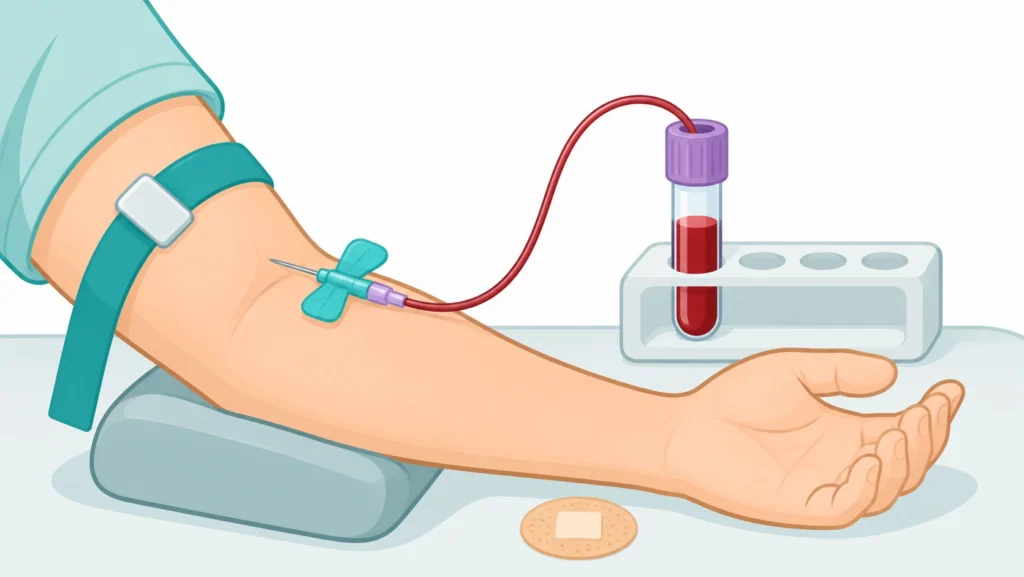
During the test: A health care professional cleans your arm and puts a small needle into a vein, usually at the bend of your elbow. MedlinePlus says it usually takes less than five minutes. In babies, Cleveland Clinic notes, providers usually draw blood from the heel instead.
After the test: Your arm may be a little sore for a few hours, and a small bruise can form. Cleveland Clinic says a few people feel faint or lightheaded after a blood draw, and there’s a small risk of infection at the needle site. You can go back to your usual activities right away.
The bottom line
A complete blood count measures your red blood cells, hemoglobin, hematocrit, white blood cells and platelets, plus the size of those cells. It’s a quick test that needs no fasting and helps find anemia, infection, bleeding problems and some blood cancers. Compare your results to the range on your own report, since labs differ, and don’t worry over a value that’s just outside it. A neutrophil count below 500, platelets below 20,000 or a large drop in hemoglobin need prompt care. A CBC can hint at leukemia or lymphoma, but it can’t diagnose cancer, and most other cancers don’t show up on it.
Frequently asked questions
What are the most important numbers on a CBC?
No single number tells the whole story. A 2022 research review calls the white blood cell count one of the most important, while hemoglobin shows anemia and the platelet count shows clotting ability.
What do doctors do if your white blood cell count is low?
They look for the cause, which may be a medicine, a viral infection, an autoimmune condition or a bone marrow problem. Severe neutropenia needs treatment, since Cleveland Clinic warns it can be life-threatening without it.
What do doctors do for a low red blood cell count?
Your provider will want to know why it’s low before choosing a plan. Cleveland Clinic says the next step may be more tests, starting treatment, or only keeping an eye on your levels.
Does a CBC show how well your kidneys work?
Not directly, according to Cleveland Clinic. Kidney function is checked with other blood tests, but some CBC numbers, such as lymphocytes and MCV, can add to the picture alongside them.
Sources
- Cleveland Clinic. Complete Blood Count (CBC), 2024
- Mayo Clinic. Complete blood count (CBC), 2026
- MedlinePlus. Complete Blood Count (CBC)
- WebMD. Complete Blood Count (CBC) Test, 2026
- Cleveland Clinic. Neutropenia
- American Cancer Society. Understanding Your Lab Test Results
- City of Hope. Does cancer show up in blood work? 2024
- StatPearls. Normal and Abnormal Complete Blood Count With Differential
- IAPAC. Complete Blood Count (CBC)
- Seo IH, Lee YJ. Usefulness of Complete Blood Count (CBC) to Assess Cardiovascular and Metabolic Diseases in Clinical Settings, 2022
- National Cancer Institute. Definition of complete blood count
Disclaimer
This blog is for informational and educational purposes only, and does not intend to substitute any professional medical advice or consultation. For any health related concerns, please consult with your physician, or call 911.